






 Portuguese
  Spanish
  3 min of reading
  0 comments


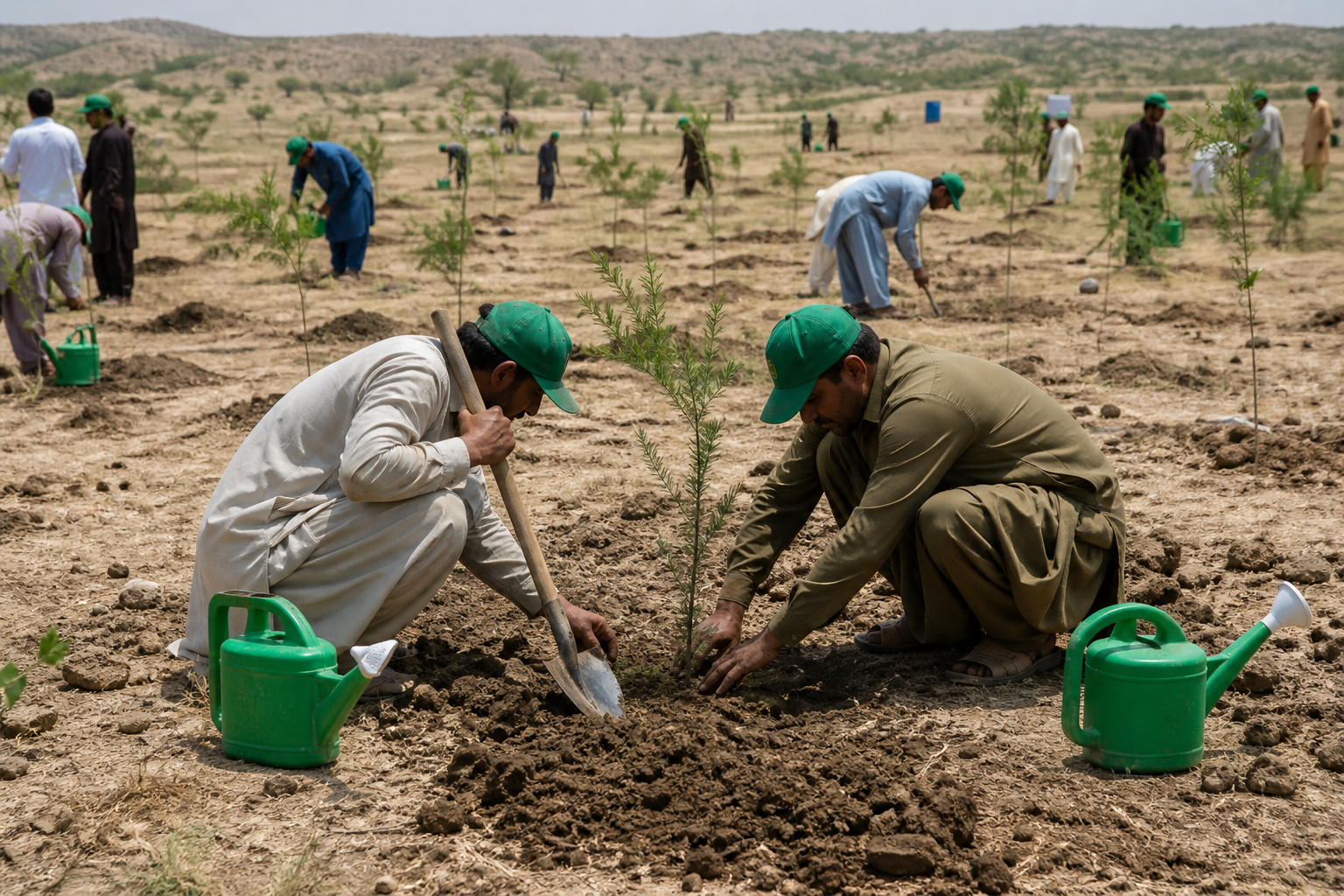
With only about 5% forest cover, Pakistan bets on environmental restoration, green jobs, and territorial protection to recover critical areas and contain the effects of the climate crisis.
One of the world’s largest environmental initiatives has gained momentum in Pakistan, where the planting of 10 billion trees has become a direct response to the climatic impacts pressing the country. With intense heatwaves, water scarcity, and advancing desertification, reforestation has ceased to be merely an ecological action and has taken on a strategic role in national public policies.
In this scenario, the low forest cover, estimated at around 5% of the territory, has placed environmental preservation at the center of priorities. Therefore, the program began to combine forest recovery, income generation, ecosystem protection, and strengthening of rural communities into a single long-term strategy.
Reforestation became a national priority
The project initially gained strength in Khyber Pakhtunkhwa, a region that served as a base to test and expand the model. Then, in 2018, the Pakistani government officially launched the national program known as the Ten Billion Tree Tsunami Programme, with the aim of expanding environmental restoration on a much larger scale.
-
He started with a jigsaw, his father’s screwdriver, and many drawings made during classes; years later, the young man who built a roller coaster in his own backyard went viral on the internet, was hired by Cacau Park, and now coordinates Brazilian and foreign professionals in the installation of an attraction weighing 737 tons, 55 meters high, one kilometer long, featuring moments of zero gravity and a speed of 120 km/h, in a journey that turned curiosity, calculations, and persistence into a professional career.

-
Between Egypt and Sudan, Bir Tawil is no man’s land that neither country wants on paper, but in practice has gold mining, nomadic tribes, and even fake “kings.”

-
Swimming champion Shavarsh Karapetyan dove about 40 times into a frozen lake in Armenia to rescue a sunken bus, saved 20 lives, and lost his career because of it.
-
Júlia Pimentel, an 11-year-old from Minas Gerais, independently invented a new formula to calculate the square root using simple addition and multiplication, and her method was published in one of the most important mathematical scientific journals in Brazil.


From then on, reforestation began to combine preservation, social development, and territorial protection. With this, the initiative connected sustainability and productive inclusion, especially in rural areas with few economic opportunities.
Strategies helped the country reach billions of trees
The program’s progress was not only due to large-scale planting. In practice, Pakistan adopted different environmental recovery techniques to expand results and protect vulnerable areas.
Among the main actions are the planting of trees in degraded areas, the protection of vulnerable ecosystems, the monitoring of regions at risk of deforestation, the natural recovery of protected areas, and the direct participation of local communities.


Thus, the project managed to move from a regional experiment to a national environmental movement, with environmental, social, and economic impact.

Green jobs strengthened rural communities
One of the most significant effects of reforestation was the creation of job opportunities. According to estimates released in reports on the program, more than two million jobs were associated with the initiative, mainly in rural regions.
These vacancies helped generate income in areas with fewer economic opportunities. In this process, young people and local workers began to directly participate in environmental preservation, creating a stronger relationship between community, territory, and nature.
Environmental results begin to appear
Although the deepest effects still depend on time, the first environmental results are already being observed in some regions. Satellite images and studies of reforested areas indicated a net growth of vegetation in monitored zones.
Advances such as a gradual increase in vegetation cover, reduction of deforestation in monitored areas, a slight increase in local precipitation indices, and the natural recovery of protected ecosystems were also observed. However, the most lasting impacts still require constant maintenance and technical monitoring.
Tree survival is still a central challenge
Despite advances, reforestation success depends on the survival of planted trees. Therefore, audits, monitoring, and strategic adjustments remain essential steps to keep the program running.
At the same time, the choice of species must consider soil, climate, available water, and agricultural use of the regions. Otherwise, inadequate management can strain water resources or reduce productive areas.
The future of forests in Pakistan
Currently, Pakistan is trying to consolidate reforestation as a long-term policy. Forest recovery can help the country face extreme heat, desertification, and water scarcity, while green jobs show that preservation can also generate economic and social impact.
Therefore, the great challenge will be to transform billions of planted seedlings into permanent, well-managed forests capable of protecting the territory. Will Pakistan be able to sustain this environmental effort long enough to restore its degraded areas?


-

1 person reacted to this.