






 Portuguese
  Spanish


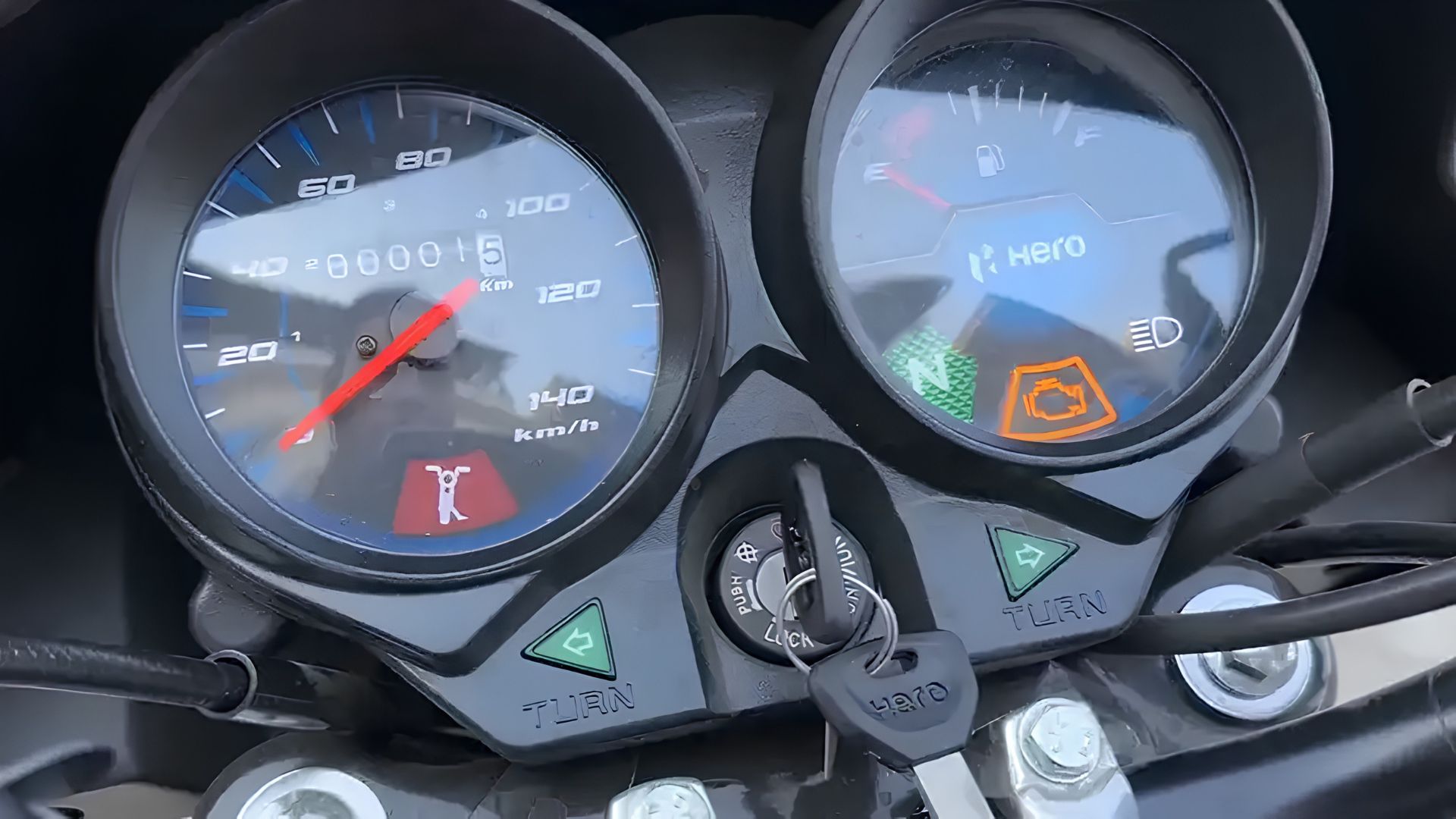


97 cc 0 km motorcycle in India gets up to 70 km/l, weighs 109 kg, and reveals how the country dominates cheap vehicles worldwide.
In 2025 and 2026, the Indian two-wheeler market once again drew global attention for a direct reason: extremely low price combined with high energy efficiency. One of the clearest examples is the Hero HF 100, a Hero MotoCorp model that ranks among India’s most affordable 0 km motorcycles. According to the manufacturer’s official page consulted on May 2, 2026, the motorcycle uses a 97.2 cc single-cylinder engine, delivers 5.9 kW at 8,000 rpm, torque of 8.05 Nm at 6,000 rpm, a 4-speed gearbox, a 9.1-liter tank, and a curb weight of 110 kg. HT Auto reports an initial price of ₹59,489 ex-showroom in Delhi and a declared consumption of 70 km/l for the model.
This set of numbers helps explain India’s strength as one of the largest global two-wheeler markets: the focus is not on extreme performance or sophisticated technology, but on low purchase cost, fuel economy, and simple maintenance. The scale of the sector also appears in data from the Society of Indian Automobile Manufacturers, which reported on October 15, 2025, domestic sales of 10,236,639 two-wheelers between April and September 2025. Within this scenario, the HF 100 represents the logic of mass daily mobility, designed to travel far, consume little, and cost less from purchase to continuous use.
Continue reading below to understand how this motorcycle works, why it costs so little, and what it reveals about the future of mobility in emerging countries.
-
Toyota Launches First 100% Electric Car in Brazil: bZ4X with 343 HP, All-Wheel Drive, 361 km Range, Priced at $419,990 BRL, Limited to 99 Units

-
Chinese SUV Achieves 24.4 km/l, Outperforms Toyota Yaris Cross in Real-World Tests with 224 hp Hybrid System, Offers 51-Liter Tank for Greater Range, and Costs Up to R$ 5,000 Less.

-
Uber Black Revamps Fleet, Drops Ten Car Models and Sets Deadline for Electric BYD Dolphin
-
Chinese Giant Uses Metal Structures and Cranes to Deliver Over 700 Electric Cars to Brazil


97 cc engine prioritizes extreme economy and daily use reliability
The HF 100 is based on a simple and efficient engine. The model uses a 97.2 cc single-cylinder engine, with a power output of approximately 8 horsepower and torque close to 8 Nm.
These figures are modest when compared to higher displacement motorcycles, but they perfectly fulfill the project’s objective.


The focus is not on speed, but on efficiency. This type of engine is designed to run for long periods with low consumption and minimal maintenance, something essential in markets where the motorcycle is the primary means of transport.
Consumption of up to 70 km/l places model among the most economical in the world
One of the most impactful figures is consumption. The HF 100 can achieve up to 70 km per liter, depending on usage conditions.
This figure positions the model among the most fuel-efficient vehicles in the world.
With a 9.1-liter tank, the theoretical range can exceed 630 km. This range drastically reduces the need for frequent refueling.
In practice, this means extremely low operating cost, one of the main factors for the model’s success.
109 kg weight facilitates driving and reduces mechanical wear
Another important point is the weight. At just 109 kg, the HF 100 is one of the lightest motorcycles in its category.
This brings direct advantages, such as ease of driving, less effort in maneuvers, and reduced component wear.

Furthermore, the reduced weight contributes to low fuel consumption. This combination makes the motorcycle accessible to different user profiles, including beginners.
Simple structure reduces cost and increases durability
The motorcycle’s construction follows a clear philosophy: simplicity. The model uses:
- 4-speed manual gearbox,
- drum brakes,
- basic analog dashboard,
- conventional suspension.
These components are not the most modern, but they are robust and inexpensive. Mechanical simplicity reduces production and maintenance costs, in addition to facilitating repairs in any region.
Update to environmental standards keeps model competitive
Even though it is a low-cost model, the HF 100 has been updated to meet the latest environmental standards. The most recent version already complies with standards such as OBD-2B in India, which require more rigorous emission control.

This shows that the model manages to maintain a low price without becoming completely outdated in relation to legislation.
Extremely low price reflects industrial structure and scale of the Indian market
The price of the HF 100 is not just a result of technical simplicity. It is directly linked to the context of India. The country has large-scale production, a consolidated local supplier chain, cheaper labor, and high demand for affordable vehicles.
These factors allow manufacturers to significantly reduce costs. The scale of production is one of the main elements that make this price level possible.
The HF 100 was not designed to compete with premium motorcycles. It meets a specific need: accessible transportation.
In India, millions of people use motorcycles as their primary means of transport. This includes daily commutes to work, transport of small loads, and urban mobility.
The model offers a practical and economical solution for this scenario.
Comparison with other markets shows structural price difference
When compared to markets like Brazil, the price difference is striking. However, this difference cannot be analyzed directly.
Factors such as taxes, logistical costs, regulations, and market structure strongly influence the final value. Still, the contrast highlights how India has managed to develop a highly cost-efficient segment.
The HF 100 is not alone. Other entry-level models, such as TVS Sport and Bajaj Platina, compete for the same audience.
This intense competition pressures manufacturers to keep prices low and improve efficiency. The result is a highly competitive market where consumers benefit from reduced costs.
Model shows that mobility can be accessible without relying on complex technology
The HF 100 represents a different approach from that adopted in developed markets. While some countries focus on electrification and advanced technology, India prioritizes accessibility.
The model shows that it is possible to offer efficient mobility without complex or expensive systems. The proposal is functional, direct, and adapted to the user’s reality.
The success of the HF 100 reinforces India’s position as a leader in affordable vehicles.
The country not only consumes but also exports this type of solution to other emerging markets.
This strategy expands the global presence of Indian manufacturers.
Cheap motorcycle redefines the concept of cost-benefit in individual transportation
The HF 100 is not just a cheap motorcycle. It redefines what cost-benefit means in mobility.
With extremely low consumption, simple maintenance, and a reduced price, the model delivers a complete solution for daily transportation. The focus is not luxury, but maximum efficiency with minimum cost.
Now the direct question remains: in a scenario of expensive fuels and rising cost of living, could simple and highly economical models like this gain ground in markets like Brazil, or does the structural difference still prevent this reality?


I need one