






 Portuguese
  Spanish


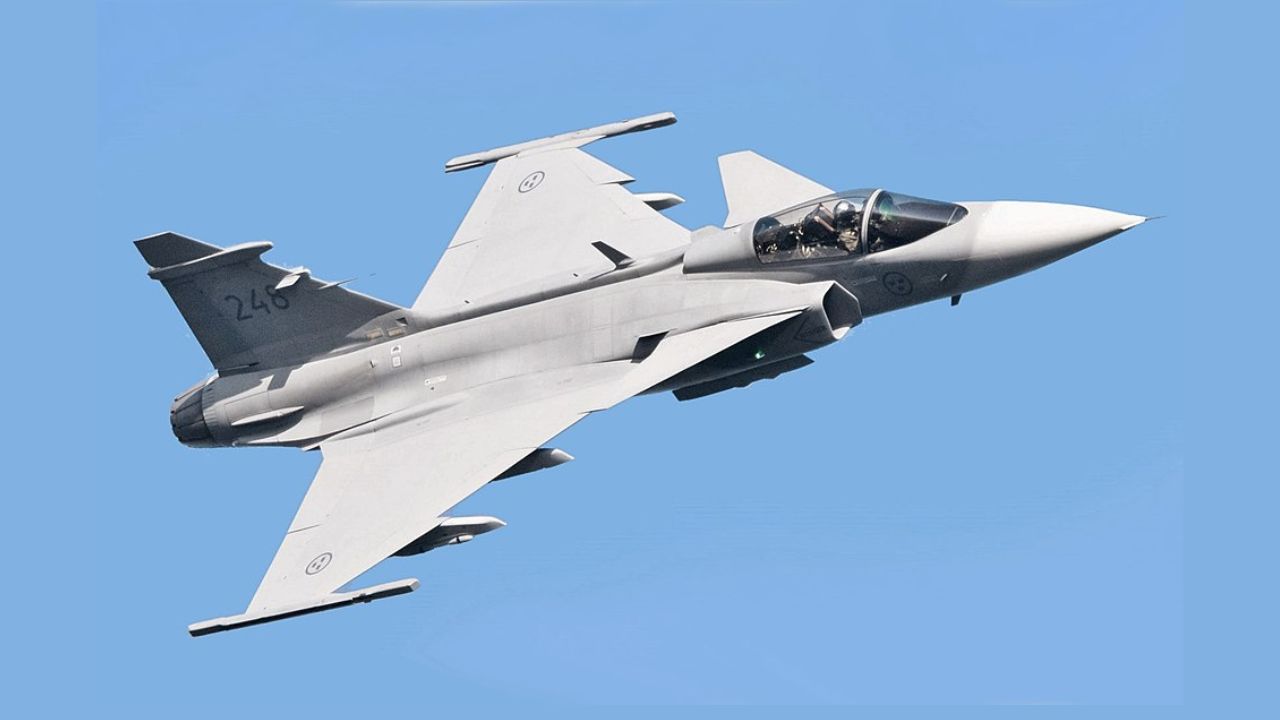


F-39 Gripen: learn about its history, technical capabilities, and everything about one of the most powerful fighters in the FAB.
The F-39 Gripen is the combat fighter chosen by the Brazilian Air Force (FAB) to protect the country’s airspace. Developed by the Swedish company Saab, the aircraft is one of the most modern multi-role fighters today — capable of attacking targets in the air, on the ground, and at sea, all in a single mission. Since 2022, F-39 aircraft have been arriving in Brazil regularly, and in May 2023, the only Gripen production line outside Sweden, operated by Embraer in partnership with Saab, was inaugurated in Gavião Peixoto, in the interior of São Paulo.
What is the F-39 Gripen?
The Gripen — whose name comes from an ancient mythological creature, half-lion, half-eagle — is classified as a fourth-and-a-half generation light fighter. This classification indicates that it is between conventional combat aircraft and fifth-generation ones, like the American F-35, incorporating advanced technologies without the extremely high cost of the most modern models.
The acronym JAS, present in the aircraft’s original Swedish name (JAS 39 Gripen), perfectly summarizes its capabilities: “Jakt” (air-to-air combat), “Attack” (ground attack), and “Spaning” (reconnaissance). In other words, it is an aircraft designed to do everything — and switch functions with just a touch on the panel, according to the manufacturer.
-
Rare fox feared “extinct” found alive on Caribbean island after over two decades without official sightings

-
21-Year-Old Brazilian Student Turns Homemade Popsicle Hobby into $100,000-a-Month Business

-
Australia Dumps Hundreds of Thousands of Tons of Gravel into Rivers to Restore Natural Barriers and Reverse 150 Years of Erosion

-
Bird-Inspired Robot Glides on Air Currents up to 10 m/s, Balances Itself, and Aims to Save Energy in Industrial Inspections and Meteorological Balloons




Furthermore, the Gripen was designed with a focus on low maintenance costs throughout its estimated lifespan of about 50 years. Its main systems, including the engine and radar, were modularized to facilitate repairs and reduce aircraft downtime.

How the project came about
The Gripen’s story begins in the late 1970s, when the Swedish government realized that its most modern fighters at the time — the Saab 35 Draken and the 37 Viggen — were becoming obsolete. In 1979, Swedish authorities began studies to develop a multi-mission capable replacement.
Among the requirements demanded by the Swedish Air Force were: a maximum speed of Mach 2 (twice the speed of sound), the ability to operate on short runways — only 800 meters long by 9 meters wide — and to be smaller than the Viggen, while maintaining or exceeding its payload capacity.
Other aircraft were analyzed during the process, including the American F-16, the F/A-18 Hornet, and the French Mirage 2000. Still, the Swedish government chose to develop the aircraft with its own national industry. In 1980, Industrigruppen JAS was created, a consortium formed by Saab, Ericsson, Volvo Aero, and other Swedish companies.

On June 30, 1982, the Swedish Parliament approved contracts worth SEK 25.7 billion for Saab, covering the construction of five prototypes and a first batch of 30 aircraft.
From first flight to entry into service
The first Gripen prototype was presented to the public on April 26, 1987, a date that coincided with Saab’s 50th anniversary. However, problems with the flight control system delayed the first flight by about 18 months.
On December 9, 1988, pilot Stig Holmström took prototype serial number 39-1 into the air for the first time, on a 51-minute flight. The test program, however, faced two accidents during development, which led to important adjustments in the aircraft’s flight control software.
After these corrections, the Gripen entered service with the Swedish Air Force in 1997. From 2003 onwards, more advanced versions — with improved avionics and in-flight refueling capability — began to be delivered.
F-39 Gripen Technical Characteristics
The Gripen combines agility, power, and technology in a relatively compact structure. See the main technical specifications of the aircraft:
| Feature | Data |
| Length | 14.1 meters |
| Wingspan | 8.4 meters |
| Height | 4.5 meters |
| Wing area | 30 m² |
| Max speed | Mach 2 |
| Engine | Volvo RM12 (derived from GE F404-400) |
| Weapon capacity | Up to 6,050 kg |
| Max angle of attack | 80 degrees |
| Estimated lifespan | Around 50 years |
The arsenal the F-39 Gripen can carry
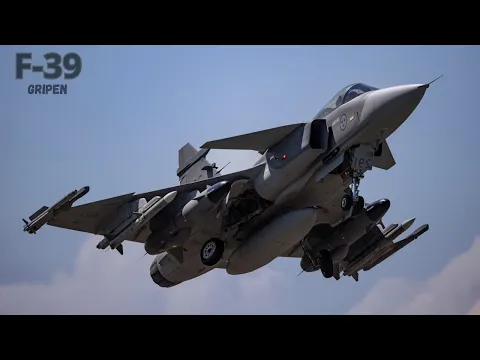
The Gripen was designed to be flexible in armament integration and can carry up to 6,050 kg of equipment and weapons in flight. Among the systems compatible with the aircraft are:
- Mauser BK-27 automatic cannon (27 mm caliber), for close-range air combat.
- AIM-9 Sidewinder missile — short-range air-to-air missile.
- IRIS-T missile — high-maneuverability short-range air-to-air missile.
- MBDA Meteor missile — long-range air-to-air missile, integrated into Swedish Gripens from 2010.
- AGM-65 Maverick missile — for ground target attack.
- RBS-15 anti-ship missile — for maritime combat operations.
- GBU-49 guided bomb — precision munition for ground attacks.
- Litening Pod (from Israeli Rafael Systems) — external sensor for reconnaissance and target designation.
How the F-39 Gripen arrived in Brazil?
The Brazilian version of the Gripen, designated F-39E, had its first flight on August 26, 2019, at Saab’s facilities in Linköping, Sweden. A few days later, on September 10, 2019, the first unit was formally delivered to the FAB to begin flight tests.

The aircraft arrived in Brazilian territory on September 20, 2020, disembarking at the Port of Navegantes, in Santa Catarina, and continuing by land to Gavião Peixoto, São Paulo, where Embraer conducts the system integration test program.
The arrival of operational aircraft and the timeline in Brazil
From 2022, F-39 Gripen fighters began arriving in Brazil in regular batches, all through the Port of Navegantes. Check out the chronology of the main deliveries and program milestones:
- April 2, 2022 — Arrival of the first two operational Gripens at the Port of Navegantes; transferred to Gavião Peixoto on April 6.
- September 25, 2022 — Disembarkation of two more aircraft at the Port of Navegantes.
- December 19, 2022 — Ceremony at Anápolis Air Base (GO) marks the start of operational activities for the 1st Air Defense Group (1st GDA).
- May 5, 2023 — Arrival of two more F-39Es at the Port of Navegantes; integrated into the 1st GDA on May 9.
- May 9, 2023 — Inauguration of the Gripen E production line in Brazil, at Embraer in Gavião Peixoto, with the presence of President Lula and Defense Minister José Múcio.
- December 11, 2023 — Arrival of aircraft FAB 4107 at the Port of Navegantes; integrated into the 1st GDA on December 15.
- September 23, 2024 — Arrival of aircraft FAB 4108; integrated into the 1st GDA on September 26.
- June 12, 2025 — Arrival of the tenth F-39E Gripen aircraft (FAB 4110) at the Port of Navegantes; integrated into the 1st GDA on June 17.
Tests carried out in Brazil: from Amazonian heat to short runway
Since its arrival, the F-39 Gripen has undergone a series of test campaigns in Brazilian territory to validate its performance under the country’s climatic and geographical conditions.

In January 2024, the FAB 4100 aircraft participated in exercises to test the IRST (Infrared Search and Track) — a passive sensor capable of detecting long-range targets through heat, without emitting signals that could be tracked by the enemy.
Between March and April 2024, the same aircraft went to Belém and Salinópolis, in Pará, where it underwent humidity and heat tests — during one of the flights, it was equipped with two IRIS-T missiles on its wingtips.
By February 2025, the tests in Anápolis (GO) were the most demanding yet. With a temperature of 32ºC and an altitude of 1,100 meters, the fighter flew with a full load — extra fuel tanks plus short and long-range missiles. 14 missions were carried out, which included simulations of short-runway landings and rapid field refueling. Unlike previous cycles, the focus this time was exclusively on flight performance and the maneuverability of the loaded aircraft.
Furthermore, between December 4 and 8, 2023, the Department of Aerospace Science and Technology (DCTA) conducted the first phase of the contractual Operational Evaluation of the F-39E at Anápolis Air Base — a formal stage that verifies whether the fighter meets the requirements agreed upon with the FAB.
The Brazilian factory and technology transfer
One of the pillars of the contract between Brazil and Sweden is technology transfer. Unlike other countries that simply buy ready-made aircraft, Brazil negotiated access to the Gripen systems’ source code and complete technical documentation, which allows the FAB and Embraer to make updates and integrate new equipment independently.

The production line inaugurated in Gavião Peixoto in May 2023 is the only one outside Swedish territory and integrates the so-called complete Gripen hub in Brazil, which also brings together a development center and a flight test center — all in the same location.
Therefore, the program goes beyond buying aircraft: it positions Brazil as an industrial partner of Saab, with the capacity to assemble and, in the future, export Gripen aircraft to other countries from national territory.







Canada doesn’t need a custom axe (F35) for all occasions. Sometimes a Swiss army knife (Grippen) is what is required for the job, economically and affectively. Save the axe for the special occasions.