






 Portuguese
  Spanish


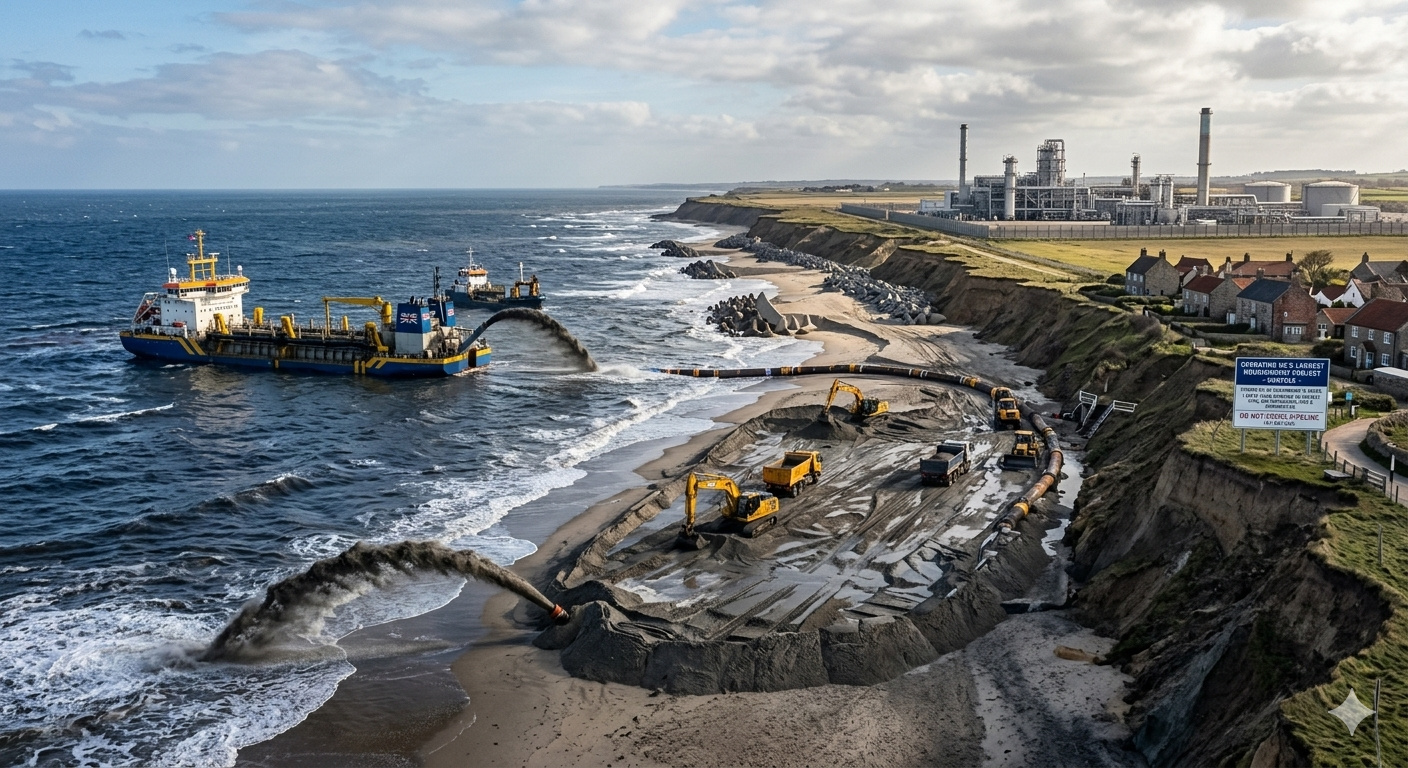


UK uses 1.8 million m³ of sand to reinforce beaches, contain erosion, and protect energy infrastructure in Norfolk.
In 2019, the UK carried out one of the largest coastal interventions ever undertaken in Norfolk: the Bacton to Walcott Sandscaping, a project led by the North Norfolk District Council that placed approximately 1.8 million cubic meters of sand on the beaches between the Bacton Gas Terminal, Bacton and Walcott, in eastern England. According to the local council itself, the work raised and widened the beach strip to create natural protection against the force of the sea, in an area hit by the 2013 North Sea storm, which caused damage, flooding, and the loss of up to 10 meters of cliff next to the terminal.
The critical point of the operation was not just coastal erosion, but British energy security. The Bacton Gas Terminal, described by Water Projects Online on November 11, 2019, as critical national infrastructure capable of meeting up to one-third of the UK’s gas demand, was increasingly pressured by coastal retreat.
The intervention redesigned approximately 6 kilometers of coastline with a solution inspired by the Dutch concept of sandscaping, combining coastal engineering, flood protection, local community defense, and climate adaptation into a single sand barrier designed to work with the ocean’s natural processes.
-
MIT Scientists Develop Method to Transform CO₂ into a Construction Ally, Boosting Cement Strength by 13% in 24 Hours for More Sustainable Infrastructure

-
Canadian City Builds 8 Tiny Homes in 72 Hours for Homeless Youth, Plans 40 Affordable Houses for Female-Led Families Amid Housing Crisis

-
45-year-old Brazilian mother of 9 and grandmother of 12 receives 27 m² house made from recycled plastic, built in 15 hours with interlocking blocks and a recycled roof.
-
Ireland Installs 654 Modular Homes to Shelter 2,640 Ukrainian War Refugees, Offering a 60-Year Guarantee and a Model for Future Housing Crises


Project moves 1.8 million m³ of sand to rebuild at-risk coastal strip
The Bacton to Walcott Sandscaping was conceived as a large-scale solution to a growing problem: accelerated coastal erosion.


Over decades, the Norfolk region had been losing a significant part of its coastline due to the continuous action of waves, currents, and storms. In some stretches, the sea advanced steadily, threatening homes, roads, and critical infrastructure.
To contain this advance, a massive volume of material was needed. **Approximately 1.8 million m³ of sand were dredged from the seabed and transported to the coast**, creating a new beach strip capable of absorbing wave energy.
Artificial beach nourishment acts as a “flexible wall” against the sea
Unlike rigid structures such as concrete walls or dikes, the project adopted a nature-based approach.
The deposited sand acts as a **dynamic barrier**, absorbing the impact of waves and redistributing itself over time.

**This type of solution is known as “beach nourishment” or _sandscaping_, and it has an important advantage:** instead of rigidly resisting the sea, it works with natural processes. **The sand moves, adjusts, and continues to protect the coast even after environmental changes.**
Bacton gas terminal was one of the main targets for protection
**One of the most critical elements of the project lies in what it protects.** The Bacton coast hosts an important natural gas terminal for the UK, responsible for a significant portion of the country’s energy supply.
Without intervention, erosion could compromise the integrity of the structure over time.
**This transformed the project into an issue of energy security**, not just environmental. The beach protection, therefore, was not only conceived for residents or tourism, but to keep essential infrastructure functioning.
Project protects coastal villages threatened by continuous erosion
In addition to the gas terminal, several local communities were at risk. Villages like Bacton and Walcott faced the possibility of losing land, homes, and access to services due to the advancing sea.

Beach nourishment created a buffer zone between the ocean and these inhabited areas. This extra layer of sand reduces the force of waves before they hit solid ground, decreasing the risk of structural damage.
Operation required offshore dredging and continuous material transport
The project’s execution involved a complex logistical operation. Specialized vessels were used to dredge sand from the seabed in specific areas and transport it to the coast.
The material was then deposited along the beach and redistributed with the aid of machinery to form the new coastal strip.
This process occurs on a large scale and requires precise planning, both to ensure adequate volume and to avoid significant environmental impacts.
Sand-based solution may require maintenance over the years
An important point about this type of intervention is that it is not permanent in the traditional sense. As sand is a mobile material, part of it can be naturally redistributed over time, requiring periodic replenishment.
However, this characteristic is also seen as an advantage. The beach functions as an adaptive system, responding to sea conditions instead of trying to block it completely.

The Bacton to Walcott Sandscaping has become cited as an example of modern coastal adaptation. It shows how nature-based solutions can be used to address complex problems such as erosion and sea-level rise.
This approach is gaining ground in different countries, especially in regions vulnerable to climate change.
Coastal erosion is a growing problem in various parts of the world
The case of Norfolk is not isolated. Coastal erosion affects various regions of the planet, driven by factors such as:
- sea-level rise,
- increased storm intensity,
- changes in ocean currents.
These factors increase pressure on coastal areas, demanding increasingly complex solutions.
Projects like the one in Bacton show a shift in how the sea is managed. Instead of relying solely on rigid structures, modern engineering seeks to integrate natural processes into technical solutions.
This allows for the creation of more flexible and potentially more sustainable systems, capable of adapting over time.
Mega-operation reveals that sand has become a strategic resource in coastal defense
One of the most interesting points of this topic is sand itself. The material, which seems simple and abundant, becomes a strategic resource when used on a large scale for coastal protection.
Moving millions of cubic meters of sand ceases to be a punctual activity and becomes a planned operation, with a direct impact on the economy, infrastructure, and security.
Now the direct question is: if countries are already moving millions of tons of sand to redesign their coasts and protect critical infrastructure, to what extent can coastal engineering based on “invisible walls” become the main line of defense against the advance of the oceans in the coming decades?






Norfolk in not on the Atlantic coast
A bit of a mistake in the header. Norfolk is on the East Coast and faces erosion due to the North Sea. The Atlantic Ocean is on the West Side of Great Britain, bordering Cornwall etc.
Just what BLACKPOOL needs please contact our council.