






 Portuguese
  Spanish


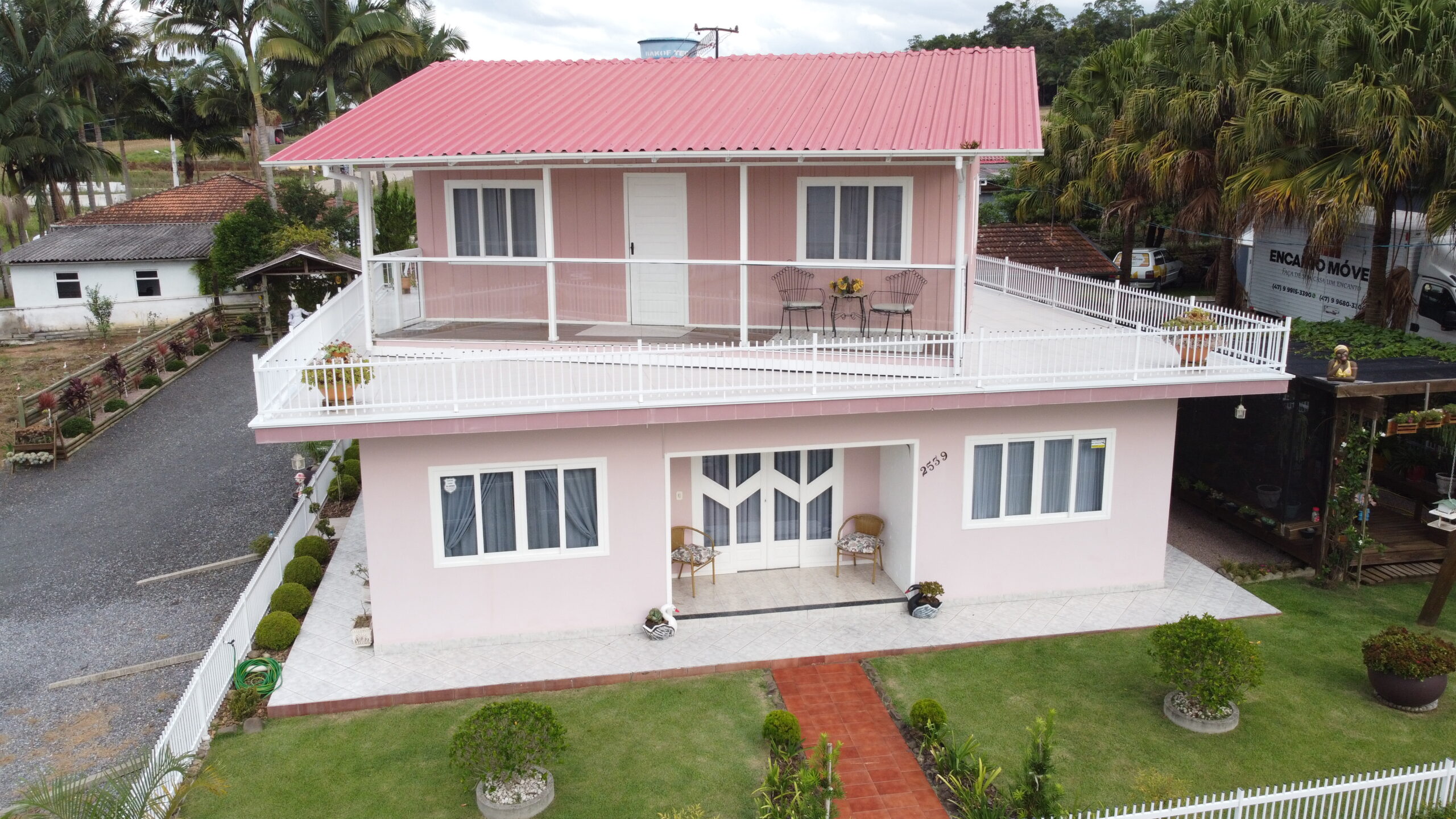
Revolving house in Santa Catarina rotates on tracks and became an attraction after farmer created structure to follow the shade.
In 1988, in rural Ituporanga, Santa Catarina, retired farmer Jens Cellarius transformed a simple idea from rural daily life into one of the most curious constructions in the Alto Vale do Itajaí: a revolving house created so he could always drink chimarrão in the shade. According to Jornal O Sul, in a report published on April 6, 2016, the residence became a local tourist attraction precisely by combining a homemade solution, mechanical ingenuity, and unconventional architecture.
The detail that made the property famous is on the second floor, made of wood, which can change position on the masonry base through a pulley system that runs on a track, manually operated by a crank. The structure allows the orientation of the upper part of the house to be altered according to the sun’s position, transforming a simple need, seeking shade, into a rare residential mechanism in Brazil.
Over the years, the house ceased to be just a family curiosity and began to receive visitors interested in understanding how a residence can rotate without dismantling its own structure. Still according to Jornal O Sul, since the creation of a guestbook, more than 3,000 people had already visited the site, consolidating the construction as an unusual attraction in Ituporanga.
-
How Underwater Bridge Foundations Support Thousands of Tons Without Sinking: The Engineering Techniques Behind River and Sea Constructions

-
BYD’s Giant Ship Docks in Southern Brazil with 7,216 Electric and Hybrid Cars, Marking the Largest Automotive Operation at the Port in 2026 and Bringing First-Half Total to Nearly 15,500 Vehicles
-
Cuba Implements Sweeping Economic Reforms, Legalizes Holdings and Corporations, Allows Foreign Investment in Private Companies, and Lifts Employee Limits After Over 60 Years
-
8-Year-Old Entrepreneur from Brazil Builds Poultry Business with 80 Birds, Aspires to Study Agronomy at Leading University



Revolving house in Santa Catarina was created to follow the shade during the day
The idea was born from a common need in rural areas of Southern Brazil: to escape the strong sun during certain periods of the day.
According to reports released by regional media and videos that went viral on social media, the farmer wanted to maintain a comfortable space to sit, talk, and drink chimarrão without constantly having to change places.


It was then that the improbable solution emerged: making the upper floor of the house rotate to follow the shade throughout the day.
Structure rotates on metal tracks installed at the base of the construction
What draws the most attention to the residence is the system used for movement. The second floor was built on a circular structure supported by metal tracks. This allows the upper part of the house to change position without compromising the fixed base.
The mechanism resembles industrial systems used in rotating platforms, but adapted in an artisanal way for a rural residence.
Unlike modern automated projects, the house does not use sophisticated electric motors. The system works manually, using a crank that helps slowly move the rotating structure.
This reinforces the artisanal character of the construction and increases the interest of visitors, who are often surprised to see an entire residence change position with a relatively simple mechanism.
Second floor rotates entirely and changes house orientation throughout the day
The most impressive point is that the rotation involves practically the entire second floor of the residence. By changing position, windows, balcony, and living areas become oriented towards another side of the landscape.
In practice, the house can better follow the shade, alter the incidence of sunlight, and even partially modify the surrounding view. With dissemination on social media and regional reports, the residence began to attract visitors.
Many people go to the site just to see up close how the rotating system works. Videos showing the movement of the structure helped transform the house into a known curiosity outside Santa Catarina.
Idea mixes rural creativity with practical solution for thermal comfort
Although it seems eccentric, the idea also relates to thermal comfort. By changing the house’s position relative to the sun, it’s possible to better control the direct incidence of heat in certain environments.

This creates a kind of passive climate adaptation, something modern architects frequently seek in sustainable projects.
Rotating house projects have already appeared in countries like the United States, Australia, and Canada. However, many use expensive automated systems and advanced technologies.
The differential of the Santa Catarina construction lies precisely in its simplicity. The structure was created in a rural environment, with artisanal adaptation and a focus on an everyday need.
House movement resembles rotating platforms used in industrial engineering
Although adapted in an artisanal way, the principle used has similarities with mechanisms employed in industrial engineering.
Rotating platforms are used in heavy equipment, storage systems, and mobile structures. In the case of the Santa Catarina house, the concept was reinterpreted for residential use, creating an unusual solution for everyday life.
Construction shows how simple inventions can gain national repercussion
The case of the rotating house reinforces how creative solutions developed outside major centers can gain enormous repercussion.
Without the participation of large companies or millionaire technologies, the construction became a topic on social media and in reports precisely because of the originality of the idea. This transformed a domestic solution into a nationally known attraction.
House created for drinking chimarrão in the shade ended up becoming a symbol of rural creativity

The most curious thing is that it all started with an extremely simple goal: to follow the shade to make the chimarrão moment more comfortable. Over time, the idea surpassed its original function and became an example of creativity applied to construction.
Today, the rotating house is remembered not only as an architectural curiosity but also as a demonstration of how improbable solutions can emerge from rural daily life.
Would you live in a house capable of rotating and completely changing its position throughout the day just to follow the sun, the shade, and the landscape?







Be the first to react!