






 Portuguese
  Spanish
  4 min of reading
  0 comments


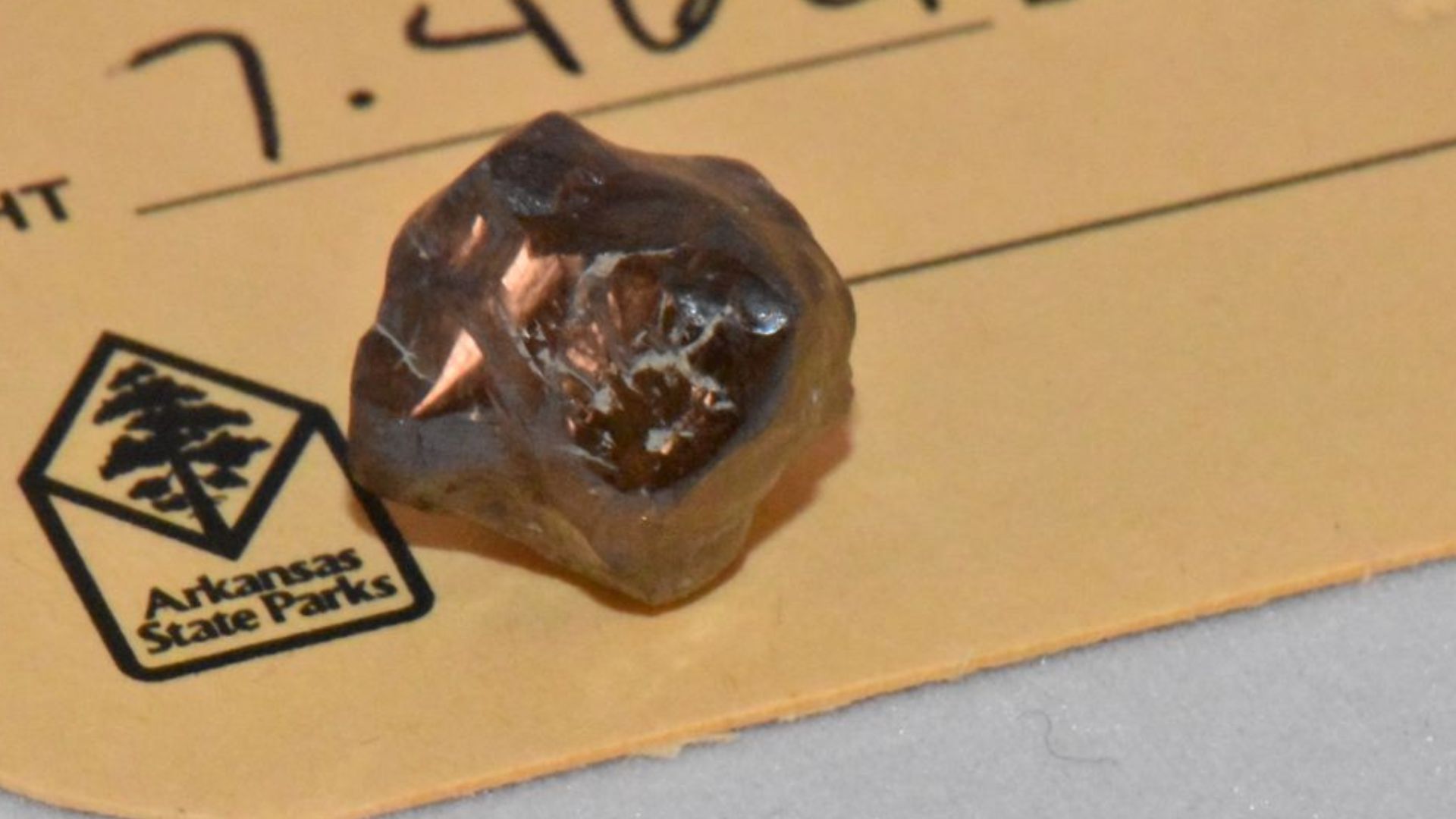
French tourist found a 7.46-carat diamond in a volcanic park in the USA and recorded one of the largest finds in the site’s history.
What started as an impromptu stop during a trip through the United States ended with a discovery that few people manage to make in their entire lives. Frenchman Julien Navas entered a volcanic park in the state of Arkansas to try his luck searching for gemstones and ended up finding a 7.46-carat diamond, one of the largest ever recorded at the site.
The discovery occurred at the Crater of Diamonds State Park, an area formed over an ancient volcanic structure where visitors can search for diamonds and legally keep any stone found. The brown diamond found by Navas entered the list of the largest ever recorded in the park since it was turned into a public area in 1972.
Trip to watch rocket launch ended in a rare discovery inside a volcanic crater
Julien Navas, a resident of Paris, was in the United States to watch the launch of the Vulcan Centaur rocket by United Launch Alliance in Florida. After the space mission, he decided to continue traveling around the country before returning to France.
-
Survivor of 1966 SS Daniel J. Morrell Shipwreck in Lake Huron Recounts 38-Hour Ordeal in Extreme Cold

-
The Greatest Hoax in World Cup History? The Film That Denied Brazil’s 1958 Victory and Exposed How Fake Evidence Can Seem Convincing on TV
-
Fake South Korean Online Stores Offer Shopping Thrill Without Spending Money or Receiving Products
-
The War of Jenkins’ Ear: How a Severed Ear Sparked One of the 18th Century’s Most Unusual Conflicts


During the journey, he heard about the Crater of Diamonds State Park in Murfreesboro, Arkansas. The site is known for allowing any visitor to search for diamonds in an area open to the public upon payment of an entrance fee.

Curious about the possibility of finding a real gemstone, Navas decided to make a detour on the trip and spend a day trying his luck in the park. The decision would end up completely changing his passage through the American state.
After hours digging in the mud, tourist found a diamond the size of a gumdrop
Navas arrived at the park on January 11, 2024, and rented a basic diamond search kit. Days earlier, the region had received more than 25 millimeters of rain, leaving the ground extremely wet and muddy.
After spending hours digging without finding anything significant, he decided to abandon deep excavation and start observing only the surface of the soil. It was at that moment he noticed a small brown stone different from the others.
When he took the material to the park’s identification center, staff confirmed it was a brown diamond of 7.46 carats, described as rounded and with a color similar to deep chocolate.
The stone made it to the list of the largest diamonds found by visitors in over 50 years
According to the park’s records, the diamond found by Julien Navas became the eighth largest ever discovered by visitors since 1972, the year the area was officially turned into a state park.


The location has a long history of discoveries. The largest diamond ever found in the United States remains the legendary Uncle Sam Diamond, over 40 carats, discovered in the same region in 1924.
Among the park’s most famous finds are also the Amarillo Starlight, 16.37 carats, and the Esperanza Diamond, 8.52 carats.
The park exists over an ancient volcanic chimney that has been producing diamonds for over a century
The Crater of Diamonds State Park is considered one of the few places on the planet where the public can search for diamonds directly in the original area where they were brought to the surface by ancient volcanic activity.
The region is positioned over a geological structure known as a lamproite pipe, formed by eruptions that occurred about 100 million years ago. These events transported diamonds formed at great depths to layers close to the Earth’s surface.
Since the beginning of discoveries in the area, in 1906, tens of thousands of diamonds have been found at the site. According to records cited by the park, more than 75,000 stones have been recovered throughout history.
More than 600 diamonds are found every year by tourists and amateur hunters
The park maintains a search area of approximately 37.5 acres, equivalent to more than 15 hectares, where visitors use shovels, sieves, and simple mining techniques.
Official data shows that more than 600 diamonds are registered annually at the site, although the vast majority are much smaller than the one found by Julien Navas.

Employees explain that heavy rains often aid discoveries because erosion removes part of the topsoil and exposes stones that were hidden just below the surface. This was exactly the scenario encountered by the French tourist during his visit.
The diamond got its own name and is set to become a family jewel after crossing an ocean hidden in the mud
After the official confirmation, Navas decided to name the stone Carine Diamond, in honor of his fiancée, Carine Eizlini. According to reports released by the park and the American press, he intends to turn the diamond into jewelry for his future wife and the couple’s daughter.
The Frenchman described the discovery as something hard to believe and stated that he plans to return to Arkansas in the future to repeat the experience.
In a world where most diamonds come from giant mines, industrial excavations, and billion-dollar operations, Julien Navas’s story seems like something from another era: a regular visitor entered an ancient volcanic crater carrying only simple tools and left with a stone that had spent millions of years hidden in the mud waiting for someone to see it.





Be the first to react!