Portuguese
  Spanish


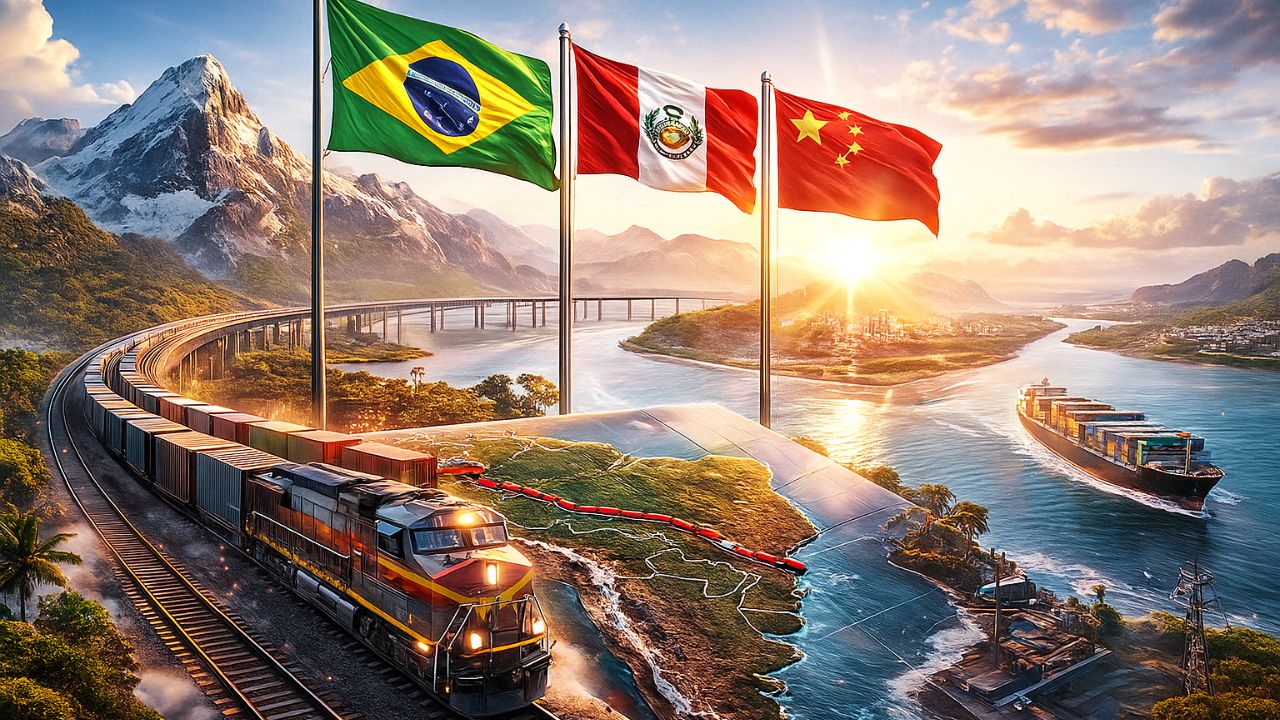


While Brazil, Peru, and China negotiate behind the scenes a giant railway linking the Atlantic to the Pacific, the project promises to shorten the route to Asia, moving up to US$ 100 billion and changing the balance of power in South America.
At this very moment, negotiators in Brasília, Beijing, and Lima are silently discussing a giant railway that could cross the heart of South America. It is not just a simple regional road. It is a continental-scale railway that starts from the Atlantic Ocean, in Brazilian territory, crosses remote areas of the Amazon, surpasses the border with Peru, climbs mountains over 4,000 meters high, where the air is thin and machines need to be adapted, until it reaches the Pacific Ocean.
This giant railway is seen as the missing piece to connect two oceans in an almost straight line. If it comes to fruition, it could reduce Brazil’s average export time to China from about 40 days to less than 25, shortening distances, reducing costs, and increasing Brazil’s strategic weight on global trade routes.
At the same time, it opens up space for the flow of hundreds of billions of dollars in commodities, minerals, technology, and geopolitical influence. Unlike many megaprojects that remain only talk, this initiative has already entered the official phase of studies and formal negotiations.
-
Brazilian Startup Turns Coffee Grounds into Plant-Based Leather, Cutting Water Use by Over 50 Times for High-Impact Sustainable Fashion

-
Eco Invest Auction Aims to Unlock $10 Billion in Investments, Focusing on Green Fertilizers, Critical Minerals, Batteries, and AI for Clean Industry in Brazil

-
Half of Brazilians Prefer Lower Taxes with Private Health and Education, While 44% Opt for Higher Taxes for State-Provided Services, Datafolha Survey Reveals

-
Brazil’s Most Expensive Toll Rises to R$ 40.60 on Route from São Paulo to the Coast, Nearly Matching Bus Fare to Santos




Where The Giant Railway Starts And Passes
The project is known as the Brazil-Peru Transoceanic Railway, also referred to as the Bioceanic Railway or the China Railway in South America. The route under study has an estimated length of between 4,000 and 5,400 kilometers, depending on the final route. In terms of scale, this means a giant railway longer than the distance from Lisbon to Moscow.
On the Brazilian side, several strategic points stand out. Ilhéus, in Bahia, emerges as a possible starting point on the Atlantic. The Mara Rosa region, in Goiás, appears as an important junction where different lines cross.
The Port of Santos, in São Paulo, is on the radar for being the largest in Latin America. Brasília hosts high-level political and technical meetings. In successive visits, Chinese delegations toured these locations to measure land, evaluate existing railways, talk to governors, and record every technical detail of the potential route for the giant railway.
These inspections were not ceremonial visits. They are part of a coordinated study process, where Brazil provides information on infrastructure, legislation, and logistical demands, while China offers experience, technology, and financial capacity.
Each back-and-forth of teams deepens the feasibility analysis of the giant railway and sharpens the view on which regions may benefit most or be more pressured by the project.
How Much It Costs And Who Controls The Giant Railway


Cost estimates show why this giant railway is treated as one of the largest infrastructure projects in the recent history of the region. Most frequent calculations indicate values in the range of US$ 50 to US$ 80 billion.
More conservative projections suggest around US$ 70 billion, while bolder studies see a possibility of reaching US$ 100 billion, depending on the final route, the type of work in the Andes, and the environmental solutions adopted.
For comparison, the maximum estimated value is close to three times the annual budget of Brazil’s Ministry of Health and represents an amount close to the entire GDP of some neighboring countries.
Brazil and Peru are the territories through which the giant railway will physically pass, but it is China that leads the financial and technological operation. In practice, the project has Chinese signature and strategic direction, with Brazil trying to balance development opportunities against the risks of external dependency.
On July 7, 2025, Brazil and China signed a memorandum of understanding marking the official start of joint feasibility studies, with a five-year term and the possibility of renewal.
During this period, technical teams are dedicated to topographic surveys, environmental impact analyses, demand simulations, cost calculations, and financing model definitions. On the Brazilian side, a public company linked to the Ministry of Transport coordinates national participation.
On the Chinese side, the control lies with the planning arm of the world’s largest state-owned railway company, responsible for thousands of kilometers of high-speed tracks and for construction in extreme environments.
Why China Invests So Much In The Giant Railway
The big question is why China would invest tens of billions of dollars in a giant railway in South America. The answer intertwines logistics, strategic security, and access to natural resources.
Currently, trade between the South American east coast and Asia largely depends on the Panama Canal or longer maritime routes. The canal, in addition to being congested, has size limitations for ships and is located in an area of political and military influence from the United States.
With the giant railway connecting the interior of Brazil to the Pacific, China gains an alternative route in which its financial and technological weight is dominant, reducing dependence on hubs controlled by American allies.
Soybeans, corn, iron ore, and other Brazilian products would reach Pacific ports in less time, ready to ship directly to the Asian market.
At the same time, the project fits into the Belt and Road Initiative, China’s global plan to build ports, railways, highways, and infrastructure in dozens of countries.
The giant railway in South America is an additional piece of this strategy, which combines investment and influence to consolidate economic and political presence across several continents.
For Beijing, it’s not just about logistics. It’s long-term power, whether through control of routes or easier access to essential raw materials for technology, energy, and defense.
What Brazil Can Gain From The Giant Railway

From a Brazilian perspective, the list of potential gains from the giant railway is consistent, especially in logistics, territorial integration, and attracting investments. Soybean and other grain producers in the Midwest currently face high costs to transport cargo over long distances by highways, with tolls, expensive fuel, and roads often in poor conditions. After that, they still face a long maritime journey to Asia.
With the giant railway, part of this production could travel by train to a port on the Pacific, significantly reducing the total travel time and lowering the logistical cost per ton, which increases the international competitiveness of Brazilian products.
Simultaneously, the country stops looking only to the Atlantic, the traditional route connecting with Europe and the United States, and starts to have a direct corridor to Asian markets, which are currently the fastest-growing.
Another important point is the integration of the internal network. The giant railway is likely to connect to projects like Fiol, Fico, and the North-South Railway, utilizing and strengthening tracks that are already planned or under construction.
Even if the entire bioceanic stretch takes time to complete, the process of interconnecting these lines already brings concrete gains for national logistics, shortening distances between producing regions and ports.
There is also the prospect of regional development. States historically isolated from export routes could gain branches, railway yards, industrial zones, and new jobs.
Along with the giant railway, proposals for logistics parks, processing factories, assembly plants, and distribution centers along the route emerge, fueled by Chinese capital and the interest of Brazilian companies to take advantage of the new corridor.
The Environmental And Social Risks Of The Giant Railway
Behind the modernization discourse, the giant railway also carries large-scale environmental and social risks, especially in the Amazon and in areas of high ecological sensitivity. The route under study cuts through forest regions, spring areas, and territories of indigenous and traditional communities.
Experts warn about the potential increase in deforestation, including indirect effects, as the railway facilitates access to remote areas and stimulates new frontiers of occupation.
Fragmentation of ecosystems, river contamination, and threats to habitats of fauna and flora are recurring points in criticisms from environmental organizations.
Segments associated with the integration railway in the Midwest, for instance, could affect dozens of indigenous lands and cross hundreds of springs in important basins like Xingu, Tocantins, Araguaia, and Tapajós. Without rigorous licensing and without real protection mechanisms, the giant railway could exacerbate already serious environmental problems in the Amazon region.
The rights of indigenous peoples and local communities are another sensitive point. Any route that crosses demarcated lands or areas of traditional use requires prior, free, and informed consultation, along with compensations and safeguards.
If this process is rushed, the giant railway is likely to face legal disputes, social resistance, and international pressure, which could delay the schedule, increase costs, and even stall the project indefinitely.
Technical, Political, And Geopolitical Challenges Of The Giant Railway
In addition to environmental and social issues, the giant railway faces complex technical and political challenges. Crossing the Andes requires long tunnels, bridges in earthquake-prone areas, and expensive engineering solutions that could raise costs per kilometer to very high levels.
In mountains over 4,000 meters, the physical limits for workers, machines, and materials become part of the problem, requiring meticulous planning and cutting-edge technology.
On the political front, projects of this magnitude span presidential terms in Brazil and Peru. Governments change, priorities shift, and attitudes toward China evolve.
An agreement signed today can be renegotiated, slowed, or even canceled in the future. Keeping the giant railway on track depends on a level of ongoing commitment that is uncommon in regional politics.
There is also a geopolitical backdrop. The Chinese expansion in infrastructure in Latin America is viewed with suspicion by the United States, which sees ports, railways, and strategic projects funded by Beijing as challenges to its historical influence in the region.
The giant railway enters this chessboard as yet another sensitive asset, capable of generating diplomatic reactions, contract disputes, and indirect conflicts in multilateral organizations and international forums.
Is The Giant Railway The Future Or A Risk For Brazil
If the giant railway materializes, Brazil could gain an unprecedented position in global trade routes, with a direct corridor to the Pacific and Asia, more internal integration, and new investments in infrastructure and industry.
At the same time, the country assumes environmental, social, financial, and geopolitical risks that could mark generations, if the project advances without transparency, safeguards, and long-term planning.
In summary, we are facing a historic choice. The same giant railway that could transform Brazil into a South American logistics power could also become a strategic blunder of significant proportions if not conducted carefully, with balance and respect for national sovereignty.
And you, faced with so many potential gains and risks, do you think this giant railway between Brazil, Peru, and China should really be built?