






 Portuguese
  Spanish


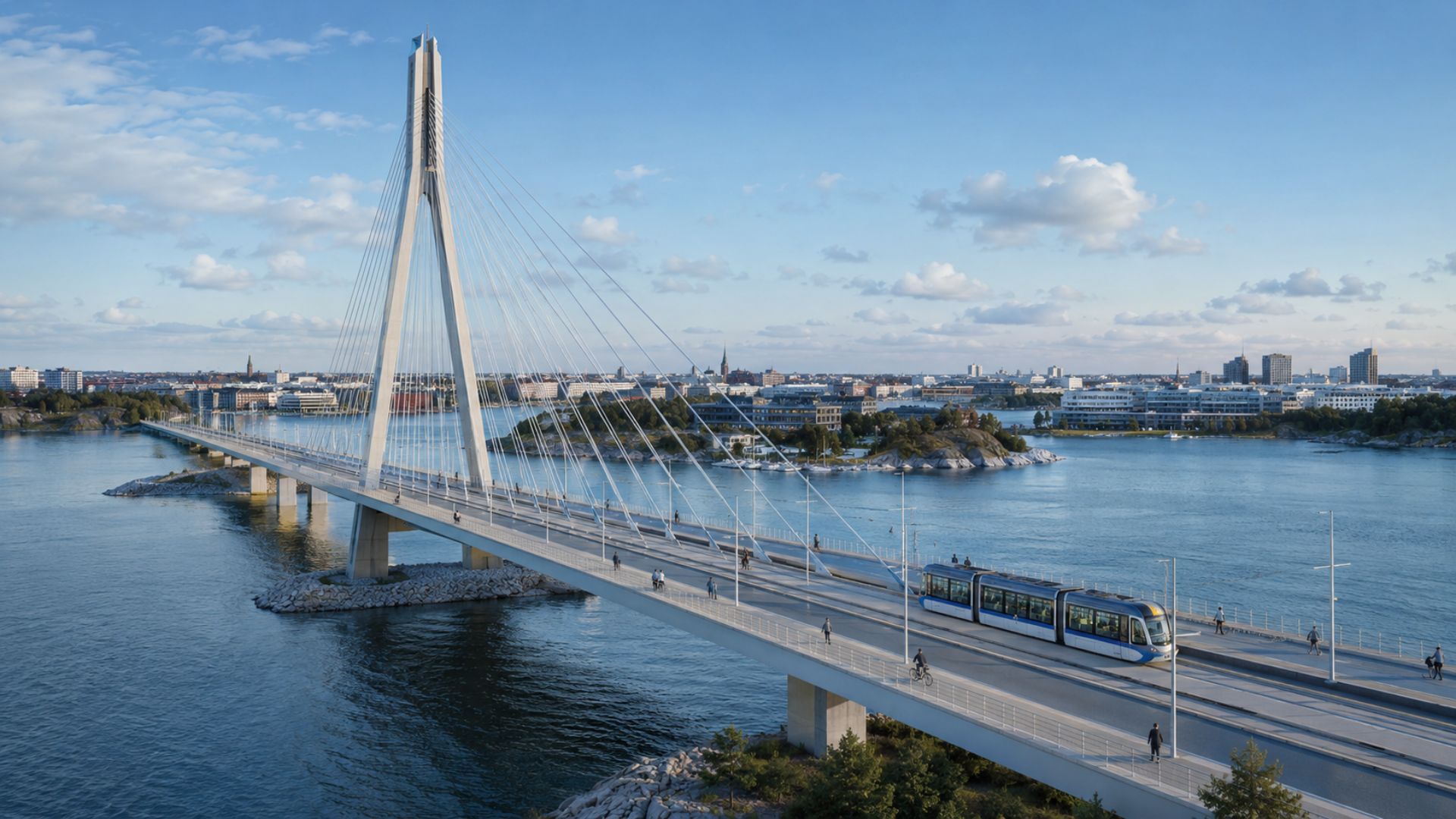


Helsinki inaugurated on April 18 the Kruunuvuorensilta bridge, the longest and tallest in Finland, with 1,191 meters in length and a diamond-shaped pillar of 135 meters. According to bicycledutch, the bridge cost 326 million euros and was designed exclusively for pedestrians, cyclists, and electric trams, permanently prohibiting car passage. More than 50,000 people visited the structure on the opening weekend, and the route between the island of Laajasalo and the city center was halved.
The largest bridge in Finland has a rule that defies almost everything expected of a structure of this size: cars are not allowed. The Kruunuvuorensilta, inaugurated on April 18, 2026, in Helsinki, was designed exclusively for pedestrians, cyclists, and a future line of electric trams that is expected to start operating in early 2027. The bridge is 1,191 meters long, with a deck 20 meters above the Baltic Sea and a diamond-shaped pillar rising to 135 meters, making it one of the tallest structures in the Finnish capital, surpassing the Olympic Stadium tower and the Kalasatama tower.
The impact on urban mobility is immediate. The bridge connects the island of Laajasalo to the center of Helsinki, halving the cycling distance between the two regions: from 11 kilometers to just 5.5. More than 50,000 people visited the bridge on the opening weekend, in an official event conducted by Mayor Daniel Sazonov and Deputy Mayor Johanna Laisaari. The project, which cost 326 million euros, is part of the Crown Bridges Light Rail strategy, an 8-kilometer tram corridor that will integrate rapidly growing neighborhoods into the heart of the city.
Why the bridge prohibits cars

The decision to exclude cars from the bridge was neither accidental nor an afterthought. Since the international design competition won in 2013 by WSP Finland in partnership with the London office Knight Architects, the premise was clear: the structure would be dedicated to sustainable transport. In Helsinki, 41% of trips are already made on foot, 25% by public transport, and 11% by bicycle, leaving only about 20% for automobiles.
-
In the Caucasus Mountains, a Community Preserves a Language So Rare Few Outsiders Can Understand It

-
Affordable Housing Project in Brazil’s Mato Grosso Aims for 700 Deliveries and $34 Million in 2026, Outpacing Major Developers in High-Demand Areas

-
Slovakia’s Ice Cave Holds Over 110,000 m³ of Frozen Wonders, Boasts Walls Up to 27 Meters Thick, and Was Among the First Electrified Caves Globally

-
Street Cleaner Accidentally Receives $200,000 Transfer, Returns Unexpected Fortune to Rightful Owner


The bridge reflects an urban policy that prioritizes modes of transport that do not generate emissions and occupy less space. For drivers who need to cross the same region, the alternative is to use an older bridge on a longer route. The bet is that, with the integration of trams in 2027, the line will become so efficient that the demand for cars will naturally decrease in the connected neighborhoods. The population of Laajasalo is expected to double by 2040, and the infrastructure has been designed to absorb this growth without relying on automobiles.
The diamond pillar and the engineering that withstands 200 years
The Kruunuvuorensilta bridge is a cable-stayed structure, supported by steel cables connected to the 135-meter central diamond-shaped pillar. The project was designed for a lifespan of up to 200 years, with low-carbon materials and the use of renewable energy during construction. The total estimated carbon footprint is 129 thousand tons of CO2 equivalent.
The cables have anti-icing rings designed to prevent the formation of dangerous blocks during the Finnish winter. The bridge also includes a lookout at the highest point, with benches and expanded space for pedestrians to stop and enjoy the view of the Baltic Sea and the Helsinki skyline without disrupting the flow of cyclists. The winding curves of the design offer different panoramas at each stretch: at one moment you see the Baltic, the next the city silhouette emerges.
The problems that appeared right at the inauguration


Despite public success, the bridge revealed flaws in the first few days. The expansion joints at both ends showed excessive unevenness, dangerous for cyclists descending at high speed down the ramp. One person has already been injured at the site, and warning signs and tactile strips were added after the inauguration.
Municipal authorities admitted that the error was made, despite staff having warned about the risk before the opening. The comparison with bridges of similar size in other countries shows that it is possible to build smoother joints. The drainage grates positioned in the middle of the bike path in some sections were also criticized, although in other places they were placed on the sidewalk. The correction is planned, but the episode showed that even projects of 326 million euros can err in details that directly affect user safety.
What the bridge changes for Helsinki and the world
The Kruunuvuorensilta positions Helsinki as a global reference in sustainable urban mobility. The bridge is not a bike path over a narrow river: it spans 1.2 kilometers over the Baltic Sea in one of the coldest capitals on the planet, designed to function even under snow, ice, and severe winds. When the trams start operating in 2027, the complete 8-kilometer corridor will connect growing residential neighborhoods to the center without any car needing to be used on the route. The electric trams will travel on grass-covered tracks along the corridor,
In the new Laajasalo neighborhood, built on former industrial land, many residents are already choosing not to buy a car. Hanna Harris, Helsinki’s director of urban design, stated that the development density is sufficient for services, schools, and commerce to be within reach for those who walk or cycle. The bridge is the piece that connects all this to the city center, without congestion, emissions, or parking.
Would you live in a neighborhood where the main bridge does not allow cars? Do you think this mobility model would work in Brazilian cities or is it exclusive to European capitals with less traffic? Tell us in the comments.


Make it motorable even electric train can be added, God bless you sir Amen.