Portuguese
  Spanish


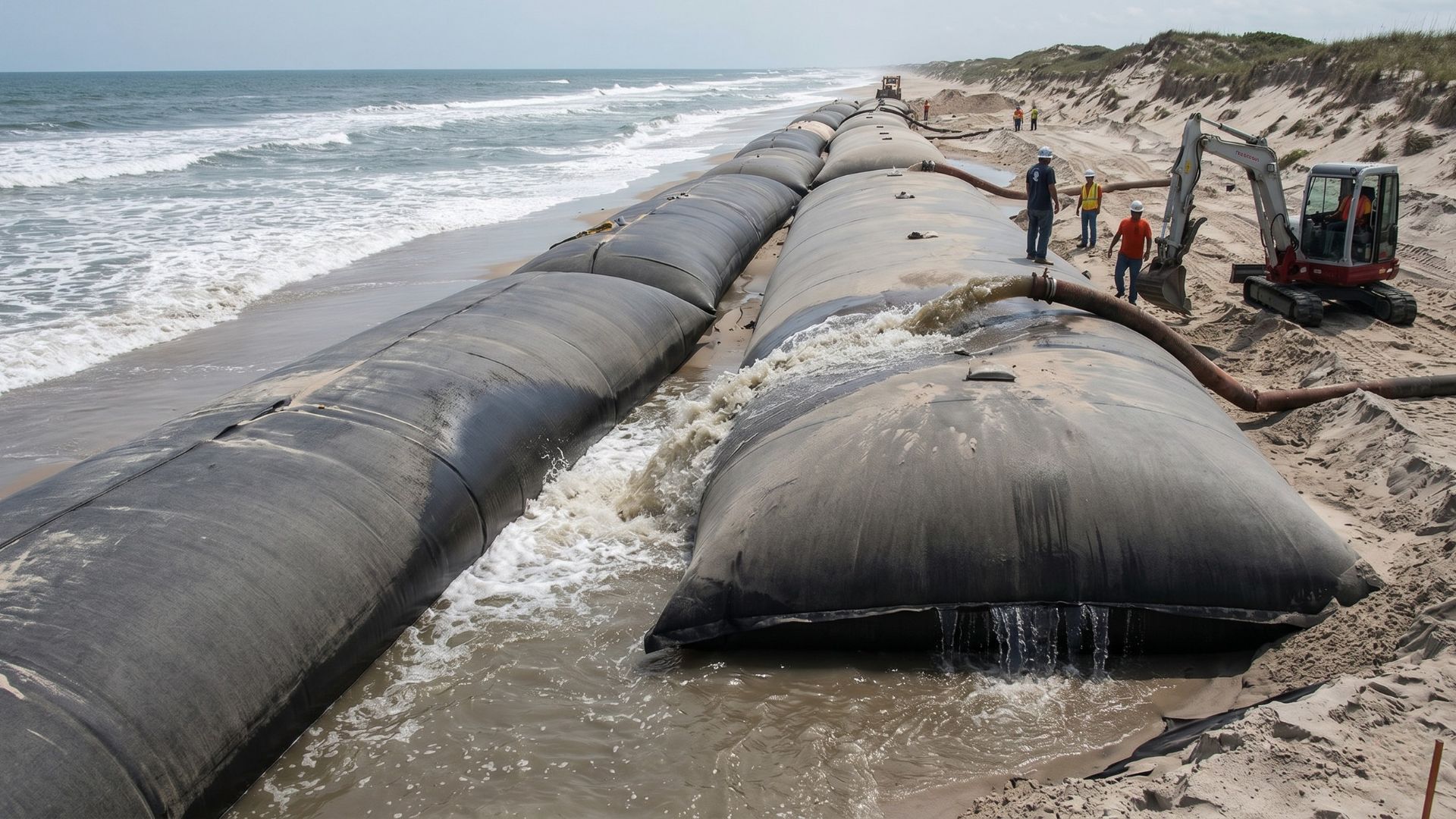


Giant geotextile tubes filled with sand are being used worldwide to contain erosion and reduce the ocean’s force.
While some countries rely on concrete walls and giant blocks against the sea’s advance, another technology has started gaining ground using something much simpler: huge synthetic fabric bags filled with sand. These structures are called geotextile tubes, “geotubes” or “giant geotextile bags”. In practice, they function as giant cylinders or bags made with permeable and durable synthetic fabrics, filled with sand or local sediments to form coastal barriers, breakwaters, and containment systems against erosion.
The technology began to be used on a large scale mainly from the late 1980s in the United States and then spread to coastal projects in Europe, Asia, Oceania, and Latin America.
Giant sand tubes work because they absorb and dissipate wave energy instead of creating rigid barriers
Unlike traditional concrete walls, geotubes act as flexible and partially permeable structures. Instead of reflecting all the sea’s force, they help dissipate part of the wave energy before it reaches the coast.
-
Sweden Removes 200-Ton Concrete Gallery to Restore Pjältån River’s Natural Flow in Europe’s Largest Aquatic Restoration Project

-
Key Infrastructure Projects for Brazil’s Next President: Expanding Railways to Cut Transport Costs, Reduce Truck Traffic, Create Jobs, and Boost Industries Nationwide

-
While China Builds Undersea Rail and Mexico Connects Two Oceans, Brazil Struggles with Grain Transport Due to Lack of Railways
-
Students Build Kansas’ First Hemp-Insulated Social House for a Needy Family: 85% Less Concrete, Solar Roof Returns Energy to Grid, Carbon Negative in Under 20 Years


The tubes are usually made with high-strength geosynthetic fabrics, generally derived from polymers like polypropylene and polyester. These materials are designed to withstand saltwater, UV radiation, abrasion, and constant sediment movement.

Once installed, the tubes are filled with sand pumped hydraulically or placed mechanically. The material itself removed from the beach, dredging, or the seabed can be used for filling, which reduces logistical costs and the need to transport giant rocks.
Structures can reach hundreds of meters in length and form entire breakwaters
The modern geotubes do not have a small standardized size. Technical studies describe tubes with 150 to 180 meters in length, width between 4 and 5 meters, and operational height close to 1.5 to 2 meters after filling.
In some projects, several tubes are stacked or aligned to form true artificial breakwaters. Depending on the purpose, they can act as coastal defense, dune stabilization, beach recovery, riverbank protection, and even temporary flood containment.


There are also versions in the form of individual giant bags, called geobags, which can be stacked like modular blocks against coastal erosion. Some manufacturers cite units with volumes above 5 m³ per bag.
Technology spread because it costs less than concrete and can use local sand
One of the factors that accelerated the spread of geotubes was the cost. In many coastal projects, transporting tons of concrete or rock to remote areas is extremely expensive.
Geotextile systems allow the use of locally available sand as filling, reducing the need for quarries, heavy transport, and gigantic maritime works.
Academic studies and technical publications also highlight another advantage: speed of installation. Since the tubes can be filled directly on-site with hydraulic pumping, some works can be executed much faster than traditional rock systems.
Moreover, geotubes are often described as “soft engineering” solutions because they try to work with the natural dynamics of the beach instead of simply blocking the ocean with rigid structures.
Countries started using geotubes against erosion, storms, and sea level rise
Today, geotextile systems appear in coastal projects around the world. Companies and technical publications cite applications in Germany, Spain, Australia, India, the United States, and other vulnerable coastal regions.
In some locations, the tubes are buried under sand to form invisible artificial dunes. In others, they remain visible functioning as coastal breakwaters.
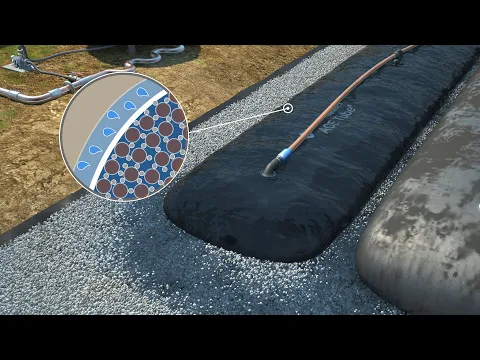
The NOAA, the United States oceanic agency, also considers geotubes as part of the approach called living shorelines, used to reduce erosion without completely transforming the coast into an artificial wall.
Giant structures also face criticism, wear, and risk of rupture
Despite the advantages, geotubes are not considered a perfect solution for every coastline. Experts point out that performance heavily depends on local conditions, wave type, abrasion, vandalism, sun exposure, and the quality of the material used.
If they remain fully exposed for long periods, the tubes can suffer mechanical wear, cuts, or ruptures. Some technical publications also warn about continuous maintenance in regions with extremely aggressive seas.
Even so, the technology continues to advance because it offers a faster, more flexible, and cheaper alternative for places where giant concrete structures would be unfeasible or environmentally problematic.
Geotubes show how the world tries to contain the ocean using fabric, sand, and coastal engineering
The idea seems unlikely at first glance: combating the advance of the sea using huge fabric bags filled with sand. But it was precisely this simplicity that turned geotubes into one of the most widespread coastal solutions of recent decades.
Today, these structures appear buried under beaches, lined up in artificial breakwaters, and hidden within coastal recovery projects on various continents.
At its core, geotubes represent an important shift in maritime engineering: instead of fighting the ocean only with concrete and stone, part of the world has started trying to contain the waves using flexible structures that work together with the natural dynamics of the sea.