






 Portuguese
  Spanish


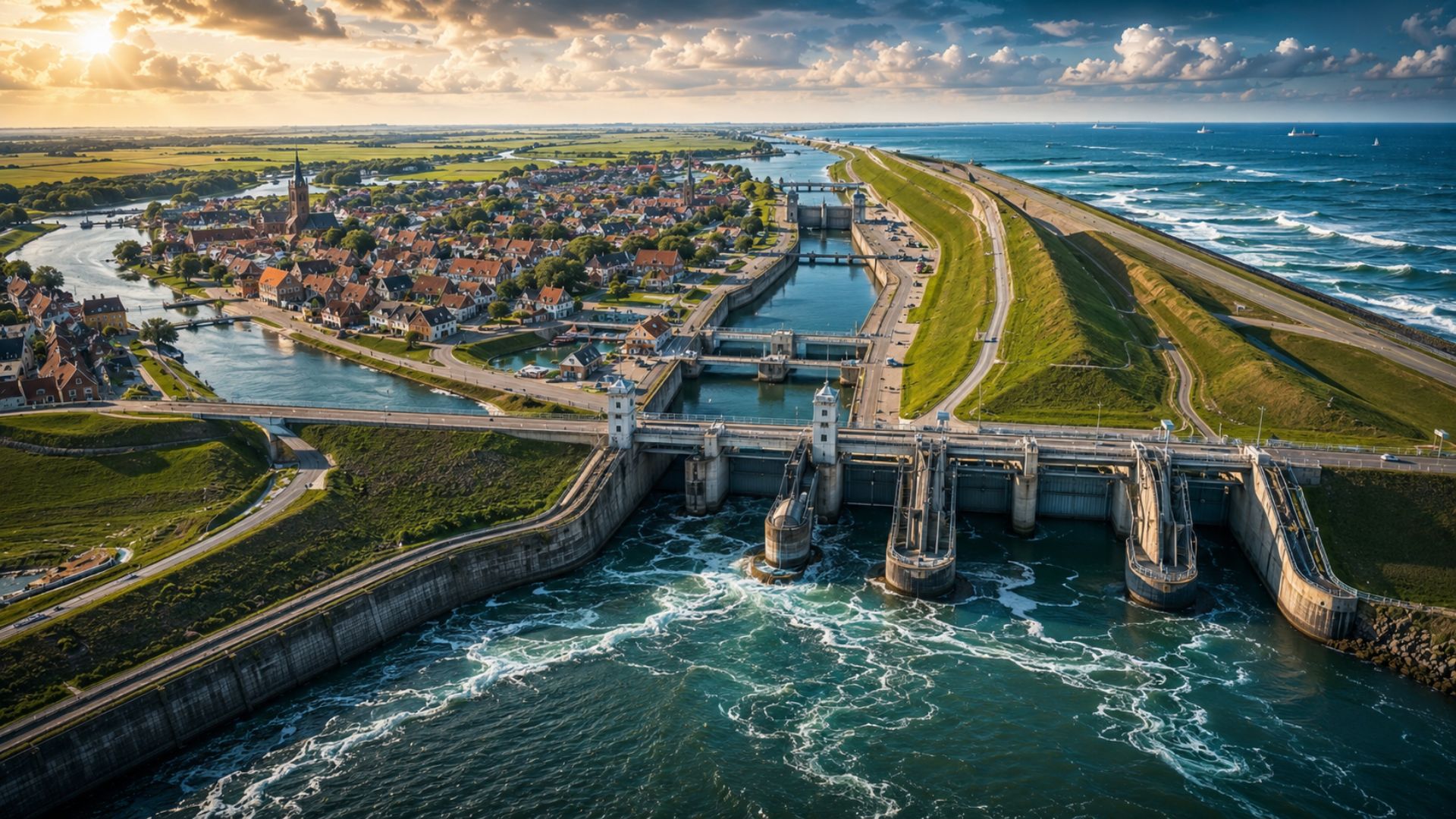


The defense is not just a wall: it is a web of dikes, polders, sensors, and movable barriers, one of them with arms the size of the Eiffel Tower. It all started on the night when the water surprised thousands of people sleeping. Today the goal is cold and ambitious: to reduce the risk of a new catastrophe to once every four thousand years.
A large part of the Netherlands lies below sea level and remains dry only because a true invisible machine, made up of dikes, pumps, and giant gates, works tirelessly to prevent the water from reclaiming the space that once belonged to it. This monumental defense system was born from a tragedy: on the night of January 31 to February 1, 1953, the North Sea invaded the country and killed 1,836 people, in the greatest natural disaster of modern Netherlands.
A precision note is needed: not the entire country is submerged. About 75% of the Dutch territory is below sea level or just a few meters above it, and the lowest point reaches seven meters below the sea line. The image of an entire country submerged is an exaggeration, but the reality is that a huge portion of the Netherlands is only habitable thanks to centuries of hydraulic engineering, maintained in operation every day.
The Netherlands as a bowl surrounded by water

Outside is the sea; inside, rivers, rain, groundwater, and canals accumulate, with millions of people living as if it were perfectly normal. The difference is that, in a real bowl, the water that enters does not leave on its own: someone needs to pump it out, and that is exactly what the Dutch learned to do on a national scale.
-
Alabama Family Converts Giant Grain Silos into a 1,750 sq ft Rustic Home, Spending $100,000 to Prove the Impossible

-
Modular ‘Microhouse’ Arrives Ready to Install in Hours Without Deep Foundations or Construction Waste

-
UK Student Develops Solar Water Purification System Using Fresnel Lens, Wins Global Young Scientists Popular Vote
-
Giant Dredger “No Woman, No Cry” Arrived in Brazil in 2010 to Clear 1.8 Million m³ of Sand and Improve Port Logistics


The secret of this land is the polders, areas surrounded by dikes from which water must be constantly removed so that the soil can exist. The Netherlands did not grow just by occupying empty spaces, but by creating land where there was once water, swamp, or lake. Each drained area turned into agricultural fields, roads, villages, or cities, in a process where the country literally manufactured part of its own territory over the centuries.
The windmills that were survival machines

But, for centuries, many of these windmills had a brutally practical function: pumping water. They removed water from the lower areas and pushed it to higher channels, creating a kind of artificial staircase through which the water was conducted out of the polders.
There was no magic in this, just pure mechanics: when the wind blew, the blades turned and activated wheels or screws that lifted the water from one level to another. These windmills were, in practice, pumping stations made of wood, fabric, and wind. Over time, they gave way to steam pumps, then to electric motors, and finally to automated systems, but the logic never changed: as water never rests, the Netherlands also cannot rest.
The trap of sinking soil


This victory over water, however, came at a hidden price. Much of the Dutch soil is made of peat, a dark and spongy material formed by the accumulation of plant remains over centuries. When this type of waterlogged soil is drained, it tends to sink over time, in a phenomenon known as subsidence.
The result is an engineering trap: the more efficient the Netherlands became at drying the land, the more some regions sank and the more dependent they became on continuing to be drained. Stopping the system, even for a short time, would mean letting the water return. Thus, the country found itself locked into a permanent commitment, forced to keep the pumps running indefinitely to not lose the ground it had conquered.
The night of 1953 that changed everything
The turning point came on the night of January 31 to February 1, 1953. A cruel combination of a strong storm, hurricane-force winds, and a high spring tide generated the largest storm surge ever recorded in the North Sea. While many people slept, the water surged over some dikes and breached others, opening dozens of large gaps in the country’s defenses, especially in the southwest.
The saltwater did not come in like a puddle, but as a dark and heavy force, carrying wood, mud, animals, and pieces of houses. The toll was devastating: 1,836 dead in the Netherlands, about 200,000 animals lost, approximately 100,000 people evacuated, and more than a thousand square kilometers of land flooded. The country that prided itself on controlling water saw its defenses fail in the face of an extreme storm and understood that it needed to redesign its protection on a national scale.
The Delta Works, the response to the tragedy
From that disaster was born one of the greatest coastal engineering works of the 20th century: the Delta Plan, or Delta Works. Instead of just patching up old dikes, the Netherlands decided to shorten its vulnerable coastline and close the most dangerous estuaries with an integrated system of dams, sluices, dikes, and storm barriers, designed with an ambitious goal: to reduce the risk of a new major flood to just once every four thousand years.
The jewel of this system is the Oosterscheldekering, the Eastern Scheldt barrier, the largest of the Delta Works, about nine kilometers long and inaugurated in 1986 by Queen Beatrix, who on the occasion declared that Zeeland was safe. Unlike a fixed wall, it has movable gates that remain open most of the time, allowing the tide and marine life to circulate, and only close when a storm threatens to push the sea into the country.
Arms the size of the Eiffel Tower
Another impressive work is the Maeslantkering, near Rotterdam, completed in 1997 to protect one of Europe’s most important port regions. It functions like a pair of giant, curved arms that can close over the water when a storm approaches. Each of these arms is as tall as the Eiffel Tower, giving a sense of the scale of this defense engineering.
But Dutch control doesn’t happen only on the coast. Further inland, structures with sluices, locks, and dams regulate river levels and keep navigation functioning. After all, in the Netherlands, it’s not enough to prevent the sea from advancing: it’s also necessary to manage the rivers from within, as part of the threat comes from water that falls as rain or arrives via large rivers from other European countries.
The invisible machine that never stops
The most powerful image of the Netherlands may not be a barrier against the sea, but a control room. Somewhere, sensors measure water levels, pumps go into operation, sluices adjust flows, and dikes are monitored, all while people go to work, children go to school, and tourists take photos, as if nothing were at stake. The system turns a permanent threat into operational routine.
One can think of the Netherlands as a body: the dikes are the skin that protects, the canals are the veins that distribute the water, the sluices are valves, the pumps are the mechanical heart, the sensors are the nerves, and the control centers are the brain that makes decisions. This balance is delicate because excessive rain, full rivers, high seas, and sinking soil are variables that need to be managed all the time, in an effort that allows no pause.
Give space to water instead of just blocking
In recent decades, the Netherlands has undergone an important shift in mentality. Instead of simply squeezing rivers between increasingly higher dikes, the country has adopted programs that create areas where water can spread in a controlled manner, such as parks, planned flood zones, and urban reservoirs. This strategy, known as giving space to water, recognizes that fighting against it all the time is expensive and risky.
The logic has shifted from just expelling the water to deciding where it can stay without destroying lives and infrastructure. This change is especially relevant in the face of climate change, which makes rain and tide extremes harder to predict. The Netherlands shows that living with water, under strict rules, can be safer than trying to defeat it at any cost, a valuable lesson for coastal cities around the world.
The Netherlands does not remain habitable because it has defeated the sea, but because it has built a system that never stops negotiating with it: sometimes it blocks, sometimes it pumps, sometimes it makes space, sometimes it closes giant gates, but it never ignores the threat. Behind every quiet street and every beautiful canal, there is a hydraulic decision and a constant vigilance. It is proof that when a country is born in vulnerable territory, survival is not an isolated event but a continuous process that spans generations.
Would you have the courage to live in a city below sea level, knowing that everything depends on pumps, dikes, and sluices working non-stop? What was the most surprising thing you learned about the Netherlands and its silent war against water? Leave your comment, tell us where you are reading from, and share the article with those interested in engineering, geography, and great works.


