Portuguese
  Spanish


The history of the Rutland Gate mansion exposes a rare contrast between extreme wealth and urban neglect: a luxurious house, tied to international fortunes, remains unused while a homeless man lives at the doorstep.
The scene seems scripted for a movie about inequality, but it happens in one of the most expensive areas of London. Behind a monumental door lies a mansion sold for £210 million, with 45 rooms, an indoor pool, and a privileged view of Hyde Park. Outside, the porch is occupied by a homeless man.
The property is located at Rutland Gate, in the Knightsbridge neighborhood, an address associated with international fortunes, luxury real estate, and billionaire storefronts. The contrast is almost impossible to ignore: a gigantic house, empty for years, while its most visible point is occupied by someone without a home.
A £210 million house with 45 rooms and no one inside
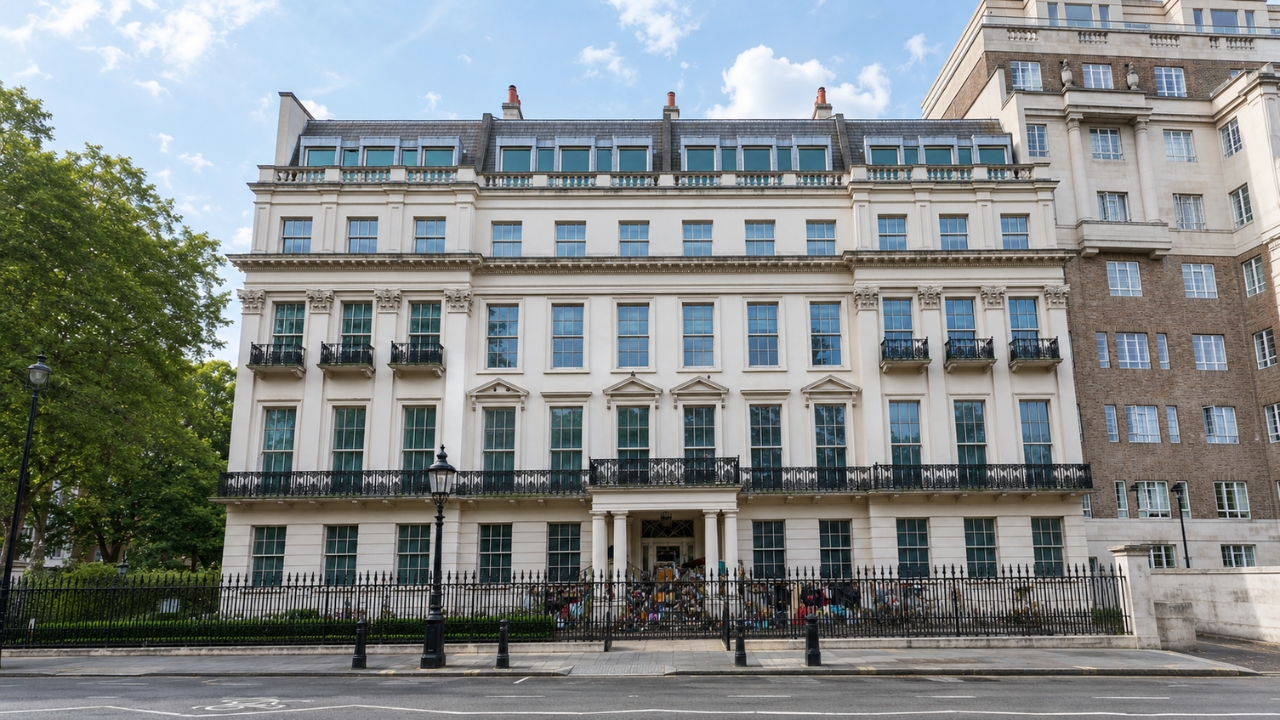
The mansion at 2 to 8A Rutland Gate was described by The Guardian as the most expensive house in the UK when it changed hands in 2020. The value of the transaction reached £210 million, a figure capable of buying entire buildings in many cities, but there it served to acquire a single residence.
-
China Constructs 5.1 km Undersea Highway in Dalian Bay, Reducing Travel Time from 1 Hour to 5 Minutes

-
Massive Transporters Otto and Lore Move ALMA Radio Telescope in Chile’s Atacama Desert
-
Singapore Turns Incinerated Waste Ash into Construction “Sand” in Ambitious Project to Revolutionize Megacity Waste Management
-
Brazilian Entrepreneur Turns Passion for Amazonian Cocoa into a Million-Real Chocolate Business After Studying in France



The property has numbers that seem straight out of a catalog of excess: 45 rooms, four elevators, indoor pool, 116 windows, and 68 of them facing Hyde Park. Yet, the most shocking point is not in the luxury, but in the silence.
The house, which could serve as the ultimate symbol of the global elite, has remained empty for years. There is no family enjoying the pool. There are no residents using the elevators. There are no parties in the halls. What exists is a monumental facade and an uncomfortable question: how can a property of this size remain abandoned in a city marked by a housing crisis?
The man who lives at the door of the empty palace
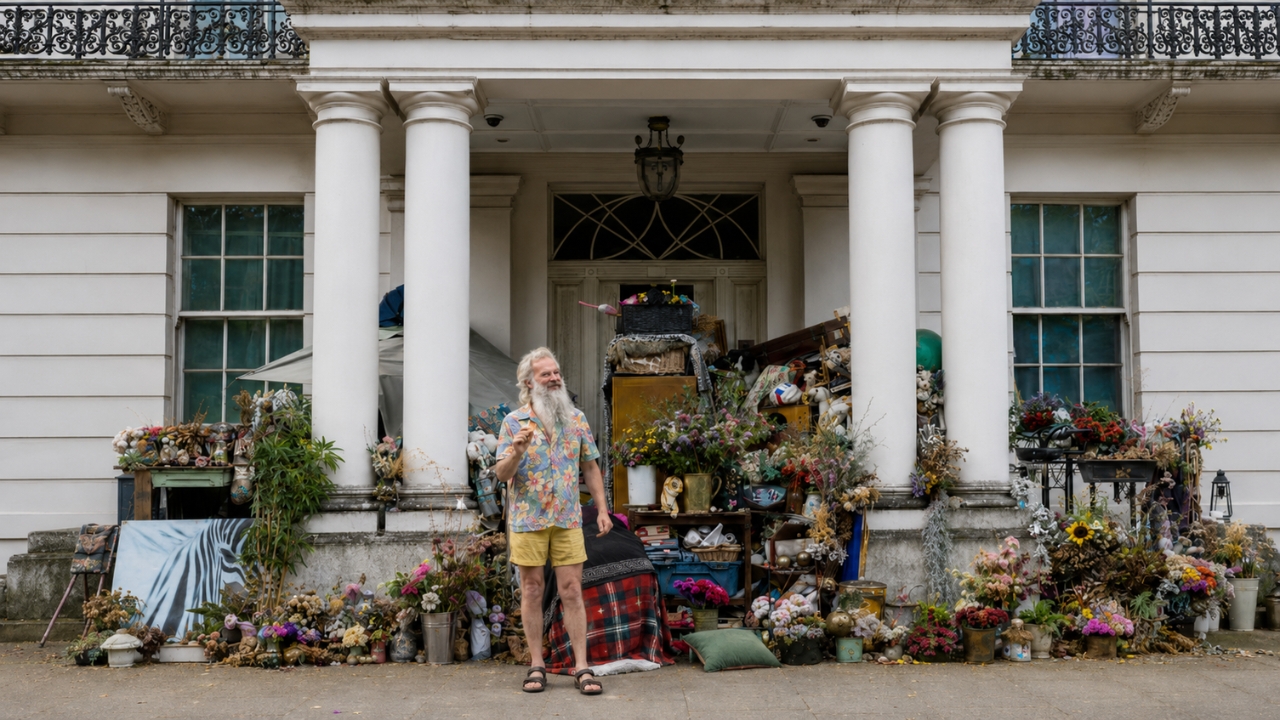
Outside the mansion lives Anders Fernstedt, described as a former journalist. He does not live inside the house but at the portico, in a sort of improvised shelter. That’s why the expression “only resident” needs to be understood as editorial contrast, not as actual occupation of the interior.
The image is powerful because it seems to summarize an entire city in a few meters. Behind the door, a residence that once had 24 marble bathrooms decorated with semi-precious stones. At the entrance, a man trying to organize his own survival with books, newspapers, flowers, bicycles, and objects accumulated around an improvised tent.
The case draws attention not only for its visual curiosity. It exposes an urban wound: luxury properties can go unused for years while people sleep in doorways, sidewalks, parks, and sheltered entrances from the cold.
Marble bathrooms, 24-carat gold, and a lifeless house
Before becoming a symbol of abandonment, the mansion was the scene of unimaginable ostentation. Its interiors once had trash bins covered with 24-carat gold leaf, Murano chandeliers, Lalique crystal bottles, and luxurious bathrooms that looked like pieces of jewelry.
In 2015, part of this universe was revealed to the public when the contents of the house were put up for auction. What was once invisible behind walls and doors began to circulate as a portrait of almost theatrical wealth.
The property’s history also carries powerful names. In the 1980s, the original houses were unified by Rafik Hariri, a billionaire businessman who later became the Prime Minister of Lebanon. After his death, the residence passed to Saudi Prince Sultan bin Abdulaziz.
The property, therefore, was never just a house. It always functioned as a showcase of power, foreign money, and international influence in London.
The connection with the collapse of a Chinese empire
The plot became even more complex after the 2020 sale. The purchase was associated with offshore structures and the world of great fortunes that use companies registered outside the country to hold high-value properties.
In British records, the property appears linked to Vision Perfect Global Limited, an entity incorporated in the British Virgin Islands. The registered active beneficiary is Yu Mei Ding, former wife of Hui Ka Yan, founder of Evergrande.
This detail turned the mansion into a piece of an even larger story. British public records from Companies House indicate the property’s connection to Vision Perfect Global Limited, while the case has become associated with the world of international fortunes, offshore companies, and disputes involving assets linked to Evergrande.
Meanwhile, the London house remained without a clear use and without a simple destination. The mansion, which once represented the power of global money, also came to symbolize the risk of billion-dollar assets trapped in opaque structures and international disputes.
The mansion, which once represented the power of global money, also came to symbolize the risk of fortunes built on debts, opaque companies, and international disputes.
The housing crisis that makes everything even more explosive
The impact of the story increases when the numbers of street homelessness come into play. British government data shows that, on a single night in the autumn of 2025, 4,793 people were estimated to be sleeping on the streets in England. In London, there were 1,277. In Westminster, the area where Rutland Gate is located, the total reached 360 people.
This contrast turns the mansion into something more than a real estate curiosity. It becomes a physical portrait of a question that many cities avoid facing: what does it mean to leave gigantic spaces empty while homelessness grows around?
In upscale areas of London, the debate about empty properties and luxury homes has gained even more strength because these houses have become symbols of a real estate market detached from the reality of those who cannot afford housing.
In this scenario, Rutland Gate is not just an address. It is a symbol of how the luxury market can completely disconnect from real life.
The abandoned luxury that became a portrait of a divided city
The final image is hard to forget. A house that once had gold in its interior details remains closed. A man lives on the porch. Tourists and residents pass by the facade without knowing they are in front of one of the most contradictory real estate stories in the United Kingdom.
The £210 million mansion impresses not only for its price, its 45 rooms, or its windows facing Hyde Park. It impresses because it reveals something deeper: in one of the richest capitals in the world, luxury can remain empty while human need sleeps at the door.
And perhaps it is precisely for this reason that this story draws so much attention now. Because it doesn’t just talk about an abandoned house. It talks about a city where excess and lack can occupy the same address.