






 Portuguese
  Spanish
  4 min of reading
  0 comments


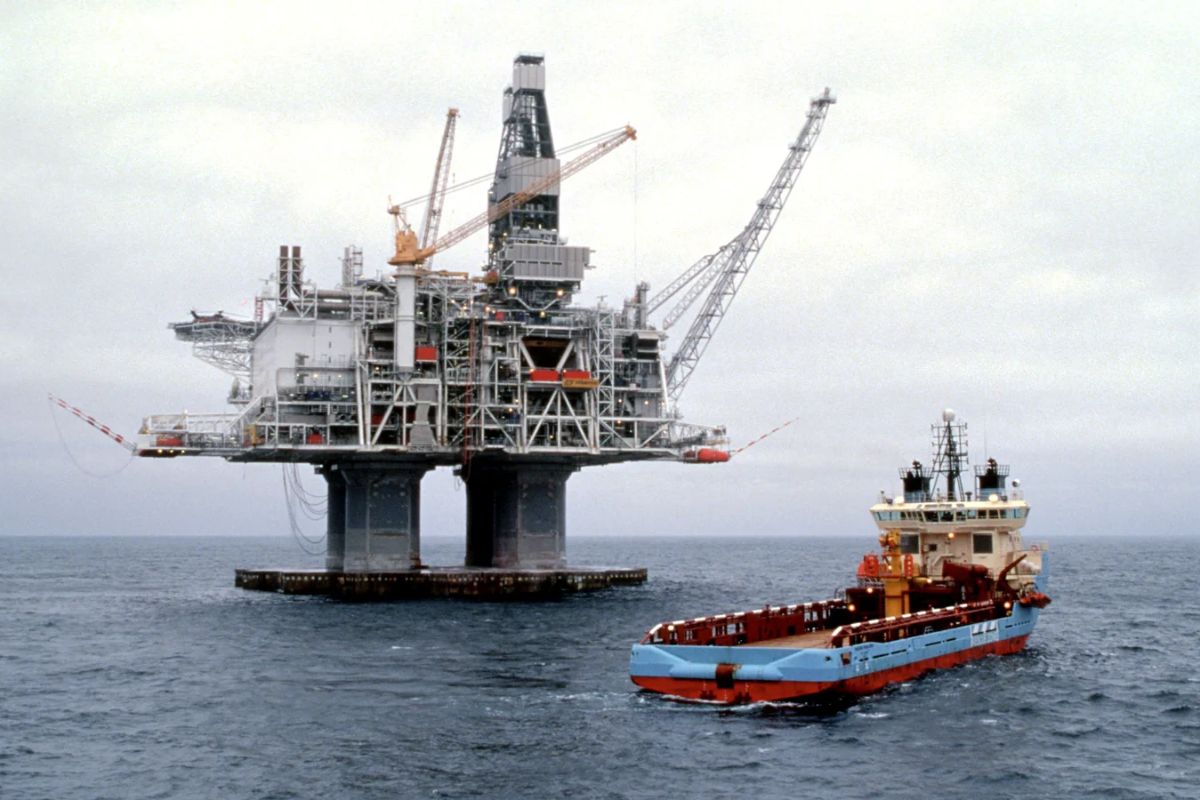
Anchored on the Coast of Canada, the Hibernia Platform Is a Concrete Fortress Designed to Withstand the Impact of Icebergs Weighing Millions of Tons.
In the heart of the North Atlantic, in a region known as the “Iceberg Route,” one of the most impressive engineering structures in the world has been operating for decades. Hibernia is the first platform that resists icebergs, a monumental project born out of the need to extract oil in one of the planet’s most hostile environments, marked by storms, fog, and the constant threat of collisions.
To operate in the path of inevitable collisions, engineering needed to create not just a platform, but an artificial island. Thus Hibernia was born, whose base of 1.2 million tons uses a ‘sawtooth’ wall not to stop the icebergs, but to destroy them upon impact. This is the story of engineering, challenges, and the legacy of this maritime fortress.
The Challenge of the Iceberg Route: An Environment of Giant Waves and Collisions
The Hibernia platform is located 315 km off the coast of Newfoundland, Canada, directly in the path where icebergs calved from Greenland drift southward. The engineering of the project had to account for a direct impact from a one-million-ton iceberg, an event expected to occur once every 500 years.
-
Survivor of 1966 SS Daniel J. Morrell Shipwreck in Lake Huron Recounts 38-Hour Ordeal in Extreme Cold

-
The Greatest Hoax in World Cup History? The Film That Denied Brazil’s 1958 Victory and Exposed How Fake Evidence Can Seem Convincing on TV
-
Fake South Korean Online Stores Offer Shopping Thrill Without Spending Money or Receiving Products
-
The War of Jenkins’ Ear: How a Severed Ear Sparked One of the 18th Century’s Most Unusual Conflicts


In addition to the ice, the climate is relentless. The region is famous for its giant waves, violent winter storms, and dense fog that can drastically reduce visibility in the summer. The challenge was exacerbated by the memory of the tragedy of the Ocean Ranger platform, which sank in the same area in 1982, killing 84 people and requiring a new safety standard for any future project. It was in this scenario that the idea of a fixed and ultra-resistant structure became imperative.
The Sawtooth Concrete Wall: The Shield Designed to Break the Ice

The solution to the iceberg challenge was the construction of a Gravity Base Structure (GBS), a concrete fortress that rests on the seabed by its own weight. The most innovative feature of this GBS is its external ice wall. Instead of a smooth wall, the structure is surrounded by 16 “teeth” of solid concrete, 1.4 meters thick.
The “sawtooth” design was not an aesthetic choice, but a brilliant application of engineering. The principle is the same as a knife: the force of the collision is focused on the sharp tip of the ‘teeth,’ creating such extreme pressure that pulverizes the ice at the point of contact. The energy of the iceberg is thus used against itself to force its fracture. In essence, the platform that resists icebergs uses the giant’s own energy against it, breaking it rather than simply trying to stop it.
The Radar and Towing System That Diverts Icebergs
But the brute force of the concrete wall is merely the last line of defense. The survival of Hibernia also depends on a sophisticated and proactive ice management program, its first line of defense. The platform operates with a sophisticated ice management program, its first line of defense. Three radar systems monitor the region in 360 degrees, detecting and tracking icebergs from a distance of up to 33 km.
When an iceberg is identified on a collision course, support ships are sent to intercept it. The most common technique is towing: the ship “lassos” the iceberg with a long floating line and slowly pulls it to divert its trajectory. Technology has evolved to include 3D profiling systems, which map the iceberg entirely (including the submerged part) to calculate the safest way to tow it, reducing the risk of it rolling during the operation.
The Legacy of Hibernia: The Economic Transformation of a Canadian Province
The impact of Hibernia goes beyond engineering. The project had a transformative effect on the province of Newfoundland and Labrador. Its construction and operation emerged at a critical moment, shortly after the collapse of the cod fishery in 1992, which left thousands unemployed.
The platform created a new industry in the region. During its peak construction, the project employed around 5,800 people. In 2023, 94% of Hibernia’s workforce was still made up of local residents. Since production began in 1997, the project has generated over 25 billion dollars in royalties for the government, revenue that for years came to represent more than a third of the province’s GDP and became the pillar that rebuilt its economy. By its 25th anniversary in 2022, the platform had already produced over 1.2 billion barrels of oil, double the amount projected in its original design.
How This Platform That Resists Icebergs Influences Exploration in the Arctic

Hibernia has become a technological model for energy exploration in other frozen frontiers of the planet. The concept of Gravity Base Structure (GBS) is now considered a proven and robust technology for ice-affected environments, influencing projects in regions such as the Chukchi and Beaufort Seas and the Russian Arctic.
The ice-resistant design, the science of advanced materials, such as high-strength lightweight concrete, and the operational philosophy that combines passive defense (the wall) with active defense (ice management) are vital lessons learned from Hibernia. This platform that resists icebergs is, therefore, more than a success story; it is proof that human ingenuity can transform a deadly environment into a productive frontier. It has not only conquered the Iceberg Route but has created the manual on how to operate safely in the most inhospitable places on Earth, a legacy that continues to shape the future of engineering.





-

-

-

-

-

-

36 people reacted to this.