Portuguese
  Spanish


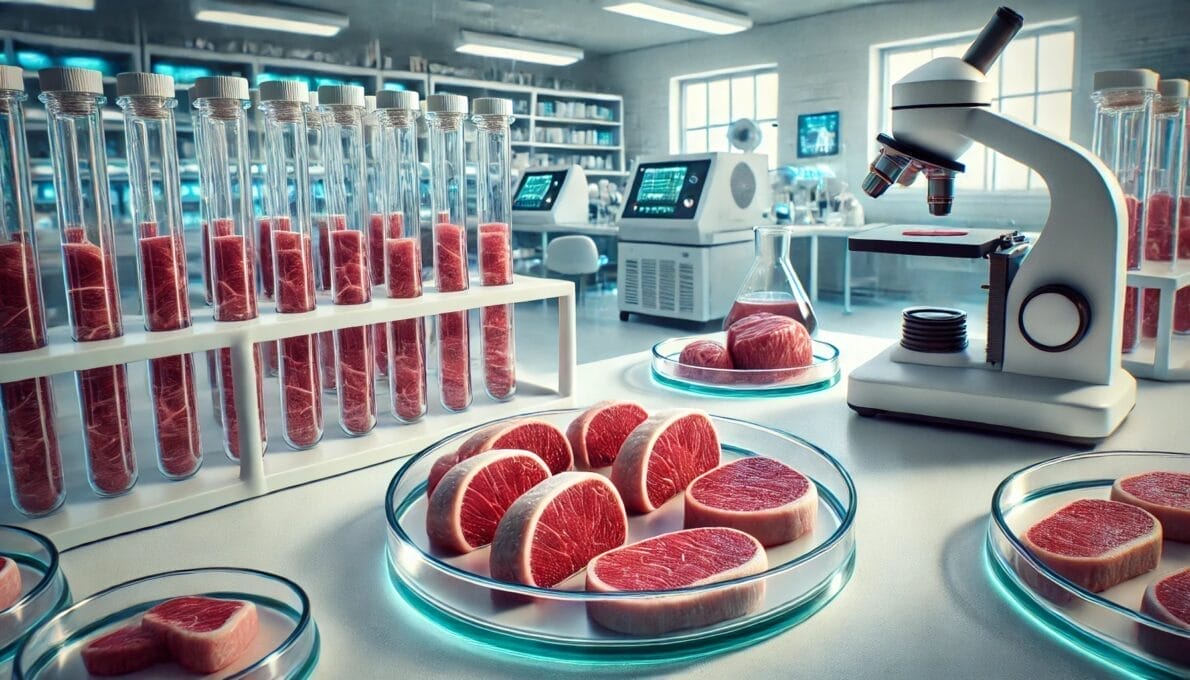

Get To Know The First Lab-Grown Beef That Is Ready For Commercialization. The Innovation Is Set To Reach Markets In Israel And Other Countries Soon, Revolutionizing The Food Sector.
Lucy, a Black Angus cow, was born in 2011 on a farm in California, and quickly stood out as a premium specimen, known for providing high-quality eggs. Her gametes were distributed globally to breeders interested in genetically improving their herds. Now, Lucy enters history in an innovative way: her contribution goes beyond the traditional. In this article, we will explore the revolutionary advancement of lab-grown beef, an innovation that promises to transform the food industry, focusing on sustainability and efficiency in animal protein production.
First Lab-Grown Meat Approved For Consumption
A handful of Lucy’s cells broke the mold. The material was sent to the city of Rehovot, in Israel. There, scientists from the cellular agriculture startup Aleph Farms “cultivated” eggs from the black angus and “harvested” steaks from them. Deceased in 2022 from natural causes, Lucy is now entering the history of the future of food as the “mother” of the first lab-grown meat to be approved for consumption.


The approval comes from the Ministry of Health of Israel, after a year and a half of consultations. Until now, only two countries had approved lab-grown meat: Singapore in 2020 and the United States in 2023. In both cases, the health authorities’ approval was for chicken meat. Thus, Lucy will be the first beef to be approved.
-
Engineers Develop Fridge-Sized Machine to Produce 95-Octane Synthetic Fuel from Air and Water, Aiming to Sustain Combustion Engines Without Oil

-
Two-Armed Robot Uses AI to Reassemble Destroyed Pompeii Frescoes, Solving an “Impossible” Puzzle
-
New Law in Brazil Requires Breaks for Type 1 Diabetes Management at Work, School, and Public Exams

-
Scientists Confirm “Greening” of Antarctica: Ice on the World’s Coldest Continent Turns Green as Mosses Multiply Over Tenfold in Four Decades


The first cut to be launched by the Rehovot foodtech, under the brand Alpeh Cuts, is a “petit steak”. For now, the lab-grown meat will be available in select restaurants in Israel.
According to Yoav Reisler, the company’s spokesperson, in an interview, a pilot production unit is currently operating and producing limited quantities of Aleph Cuts, about 10 tons per year. The facility has three specific purposes: regulatory approvals, launches, and expansion.
Hollywood Actors Invest In Lab-Grown Beef
Founded in 2017 by engineer and CEO Didier Toubia, PhD in genetics and CTO Neta Lavon, and molecular biologist Shulamit Levenberg, Aleph Farms has raised almost US$ 120 million to date, according to information from the Crunchbase platform. Among the 20 investors in lab-grown meat are actor Leonardo DiCaprio and U.S. based Alumni Ventures.
According to Reisler, at this moment, Aleph Farms’ main focus is reaching Asia via Singapore and the Middle East via Israel. The executive adds that lab-grown meat has also been submitted for approval in Switzerland, the United Kingdom, and the United States.
The company’s long-term strategy also includes collaboration with traditional companies in the sector. The executive highlights that these partnerships involve co-investment in production facilities and market positioning through purchase and distribution contracts. Among the companies is the Brazilian BRF.
The Lab-Grown Beef Market Is Expected To Reach US$ 1.1 Billion
Lab-grown meat emerges as an alternative to the shortage of agricultural land and the growing global demand for animal-derived protein. Valued at US$ 200 million, the global lab-grown meat market grew by 16.1% just in 2023.
By 2034, it is expected to hit US$ 1.1 billion. The technology for cultivating meat began to be developed in 2010. A process as complex as it is fascinating.
Scientists allowed Lucy’s fertilized eggs to proliferate for a short period. The new cells are then sent to gigantic bioreactors. There, they are fed with water, oxygen, nutrients, among other compounds. In a controlled environment, they multiply at a rapid pace. They grow, subdivide, and expand.