Portuguese
  Spanish



Berber pirate shipwreck found 900 meters in the Mediterranean reveals weapons, objects from three continents, and preserved remains after 260 years
The discovery of a pirate ship at a depth of 900 meters in the Mediterranean revealed a Berber corsair sunk around 1760, with heavy weapons, objects from three continents, and a preserved hull, expanding the understanding of attacks that spread fear throughout the region.


Unexpected discovery at the bottom of the Mediterranean
Odyssey Marine Exploration was searching in 2005 for the HMS Sussex, an 80-gun English warship lost in 1694 between Spain and Morocco.
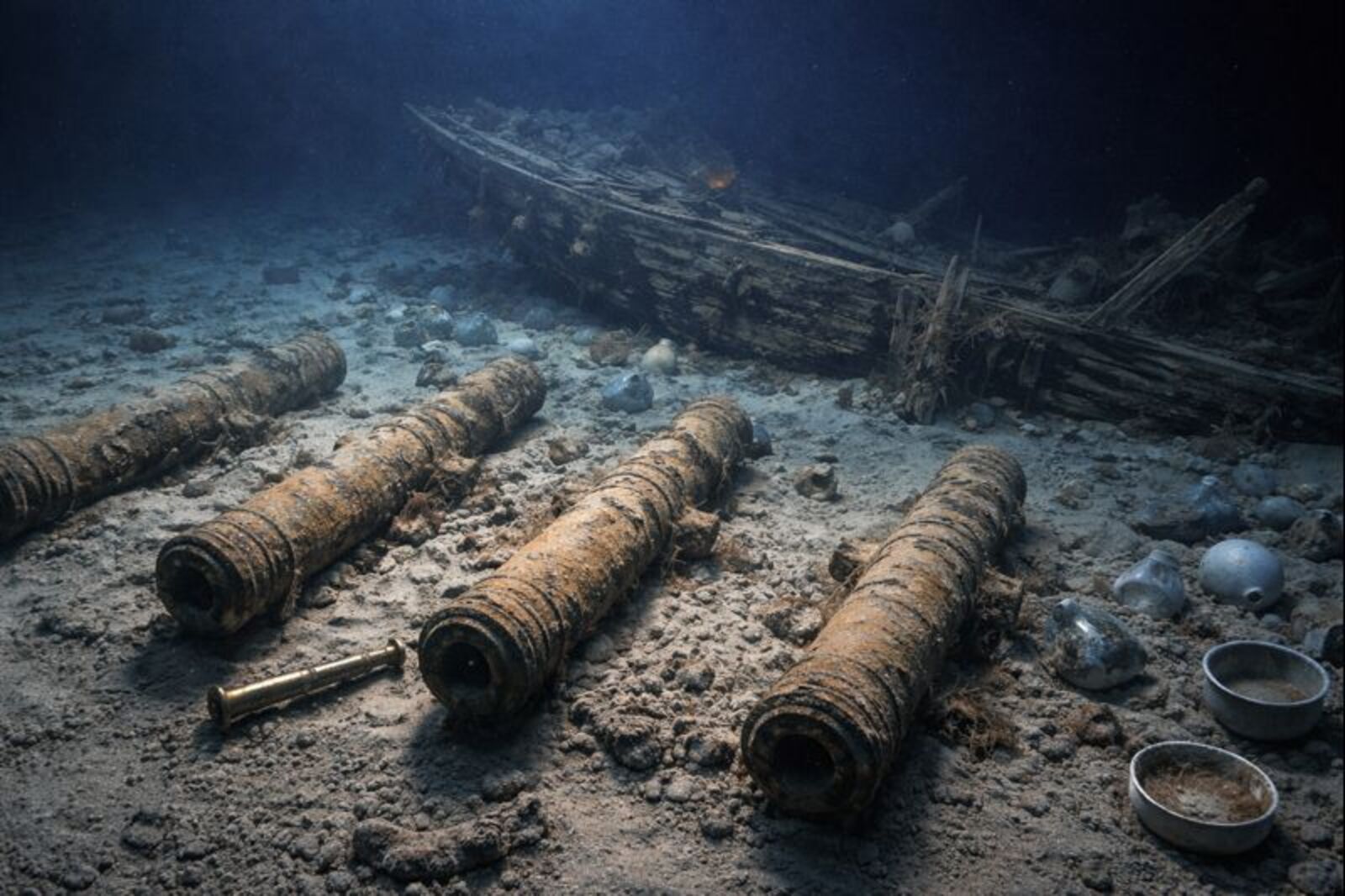
During the search, the remotely operated vehicle recorded four aligned cannons, a telescope, and objects scattered across the sediment on the seabed.
-
What is the dark substance found in the sand of Ipanema Beach? Civil Police conduct an examination, collect samples of the material, and initiate an investigation to identify the composition, clarify the origin, and verify if there was an environmental crime.

-
The beer that was hidden for 3,000 years has returned to the world: scientists find yeast preserved in Ancient Egyptian vessels and recreate a pharaoh’s drink to discover the lost taste of an ancient civilization.
-
NASA spotted a giant “surfboard” crossing the Moon’s orbit at 11,500 km/h, and the truth behind the mysterious object required a 0.338 millisecond photo to be revealed.

-
Brazilian project based on nanotechnology transforms the recovery of degraded areas in the Amazon, receives international recognition, and uses research in 9 states to accelerate the growth of native species and increase carbon capture.




Among the items were pots, bottles, and tea bowls from different origins, coming from three continents, something that did not match the expedition’s target.
The site did not hold the English ship. What appeared before the team was smaller, in deeper waters, and revealed a dangerous past.
The researchers identified the wreck as the first recognized pirate ship from Algiers in these waters. The discovery remained confidential for nearly two decades and was recently published in Wreckwatch.

A small ship with great striking power
The vessel was 45 feet long and was classified as a tartane, a type of ship with triangular sails and oars, useful for maneuvering in narrow coastal waters.
Its shape resembled fishing boats, allowing corsairs to approach merchant ships without raising suspicion.
The cargo hidden beneath the deck showed another reality. Remote inspections found four large cannons, ten swivel guns, and muskets for about twenty men.
The swivel guns were mounted on tracks and could be aimed at enemy masts or crowded decks, being used in close combat.
Sean Kingsley stated to Newsweek that the combination of heavy weaponry and varied cargo helps define a pirate ship, as ordinary merchants did not transport this type of arsenal.
Objects from various places aided in identification
The artifacts found in the wreck came from different regions. There were blown glass liquor bottles produced in Belgium or Germany.
Burnt tea bowls from the Ottoman Turkey and a European telescope, a rare item in the mid-18th century, likely taken from a captured ship, were also located.
Among the most revealing objects were pots and pans manufactured in Algiers. These utensils suggest that the crew reinforced the disguise of a peaceful merchant ship.
The ceramics were linked to kilns dug years earlier under Martyrs’ Square in Algiers. These kilns produced pieces identical to those found alongside the cannons.
Kingsley noted in Live Science that this eclectic collection made the wreck appear different from a typical Mediterranean merchant ship.
How the Berber privateers spread fear
The Berber privateers operated differently from Caribbean pirates. While names like Blackbeard threatened isolated ships, Algiers posed a risk to entire coastal populations.
Kingsley described Algiers as a city of 60,000 people who lived by the sword from the early 16th century until the French conquest in 1830.
Raiding groups reached as far as southern England and Ireland, as well as northern England. Each ship captured in the Atlantic or Mediterranean generated profit.
Residents taken in nighttime landings could yield ransom or slavery. Western merchants crossing the region faced the risk of capture on every journey.
Date of sinking and preservation
The identified wreck sank around 1760. Bottles found at the site were produced, at most, in that decade.
The Ottoman tea bowls found with the ship ceased production in Turkey around 1755.
A sudden storm likely sank the small vessel before it could reach shallow waters or a safe harbor.
The extreme depth helped protect part of the pirate ship. The lower third of the hull remains intact, buried under sediments where the teredos could not reach.
The upper parts, exposed above the seabed, were consumed by bivalve mollusks that devour exposed wood throughout the Mediterranean.
No fishing boat passed by the site and no diver disturbed the area. The wreck remains as if it had just settled on the bottom.
Greg Stemm, director of Seascape Artifact Exhibits Inc., described the find as a precious echo of one of the great maritime horrors of the Western Mediterranean.
With information from Daily Galaxy.