Portuguese
  Spanish


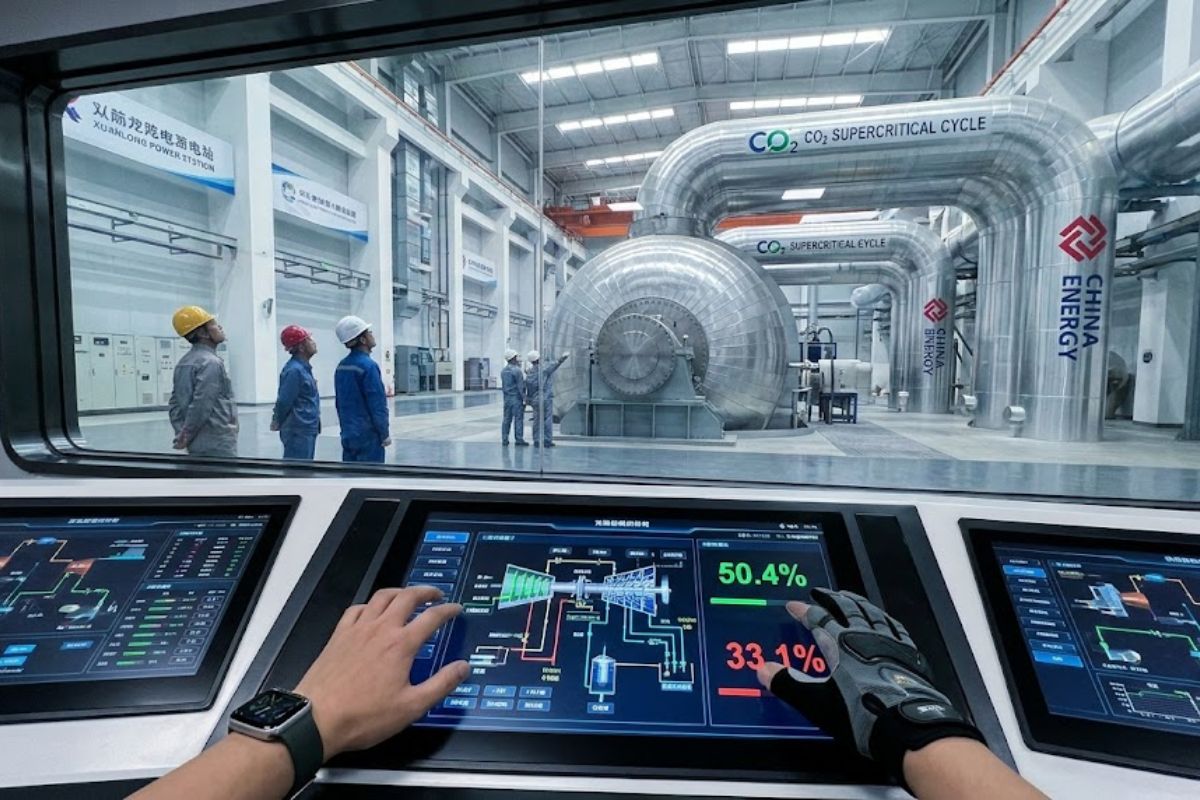


The generation of electricity by steam has dominated the planet since the Industrial Revolution, using the same basic principle: heat water, generate steam, spin turbine. In December 2025, China turned on the Chaotan One, the world’s first commercial supercritical CO2 generator, in a steel plant in Guizhou province, and claims to have increased efficiency by 85% and energy production by 50% without building a new facility.
Supercritical CO2 is carbon dioxide heated above 31°C and compressed above 7.39 MPa, a pressure equivalent to 800 meters below the ocean surface. In this state, CO2 behaves like something between a liquid and a gas: it has the density of a liquid and the flow properties of a gas. This means it spins a turbine with more force and less friction than steam, allowing the use of smaller and more efficient equipment to generate the same amount of energy.
The system operates in a closed loop. CO2 is never released into the atmosphere; it is continuously recycled. It does not require water for cooling and can operate in arid regions. The leap in efficiency comes from replacing the Rankine Cycle (used by steam, with about 33% conversion) with the Brayton Cycle (used by supercritical CO2, with theoretical potential above 50%).
What changes in practice when efficiency jumps from 33% to 50%

According to engineer Darryn Fleming from Sandia National Labs in the United States, an improvement of just 1% in the efficiency of a power plant “translates to millions and millions of dollars, because less fuel is burned to produce the same amount of electricity.”
-
She spent 73 years breathing inside an iron lung, survived the aftereffects of polio, and became the last woman in the United States dependent on the equipment before dying at 78 years old.

-
Brazilian students created a $1 filter using pine bark, cotton, and 3D-printed parts to clean cassava wastewater, reduce the toxicity of a hazardous waste, and transform contaminated water into biofertilizer.

-
Astronaut from Artemis II steps down after mission to the Moon and decision surprises after a record of 406,771 km, a historic 10-day journey, and an unprecedented achievement for Canada.

-
A fossil kept for years in a small museum in Montreal concealed 450-million-year-old soft tissue, a discovery that has only happened once before in history.


If the jump is from 33% to 50%, the impact is not incremental. It is transformative. And since 80% of the world’s electricity still comes from steam generators, the potential market is enormous.
The major practical advantage is that the supercritical CO2 generator can be installed in existing plants, replacing the steam generator without the need to build from scratch.
This is especially important now, when the demand for energy is exploding.
Only the U.S. needs to increase energy production by 165% by the end of this decade to power artificial intelligence data centers, according to industry estimates.
Why China Got Ahead and the U.S. Is Still Testing

The Chaotan One is the result of 17 years of development led by scientist Huang Yanping from the China Nuclear Energy Institute.
The path included 829 days dedicated to developing a welding process that other countries refused to export, with 218 parameters tested and 27 rounds of optimization.
The machine operates using waste heat from the steel mill, heat that was previously simply wasted.
The U.S. has been working with supercritical CO2 since the late 2000s at Sandia National Labs.
In April 2022, they delivered electricity generated by supercritical CO2 to the grid for the first time (10 kilowatts for 50 minutes).
In October 2024, the STEP Demo project generated 4 megawatts synchronized with the grid. But the American commercial target is only aimed for the mid-2030s.
The difference is philosophical: the U.S. tests until all problems are resolved before scaling; China builds, commercially launches, and resolves problems as they arise.
What Are the Risks of a Technology That Promises So Much
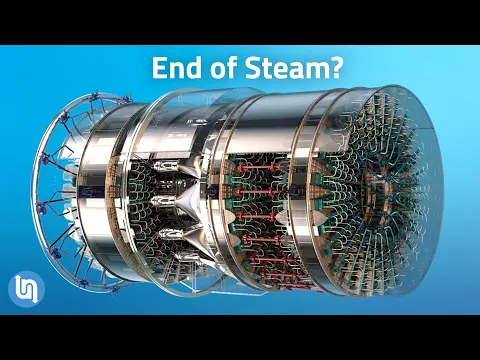

Analyst Michael Barnard from CleanTechnica estimated a 40% to 70% probability of measurable degradation in the performance of Chaotan One within 2 to 5 years.
Precision heat exchangers are practically impossible to repair: if one leaks, the entire unit must be replaced.
The seals suffer from pressure and heat over time.
And contamination from the gases of the steel mill can accumulate residues on the heat transfer surfaces, like limescale in a shower, gradually reducing efficiency.
Barnard’s challenge is straightforward: “If the Chinese and American facilities operate for five years without significant performance reductions and without high maintenance costs, I will be surprised.”
It’s a fair bet. The technology has been promising since the 1960s, but only now has someone managed to get a commercial unit to work.
The next five years will tell if supercritical CO2 is the future of energy generation or just another promise that doesn’t survive in the real world.
And you, do you think Brazil should invest in supercritical CO2 generators to modernize existing plants or is it too early to bet on this technology? Comment below.