Portuguese
  Spanish


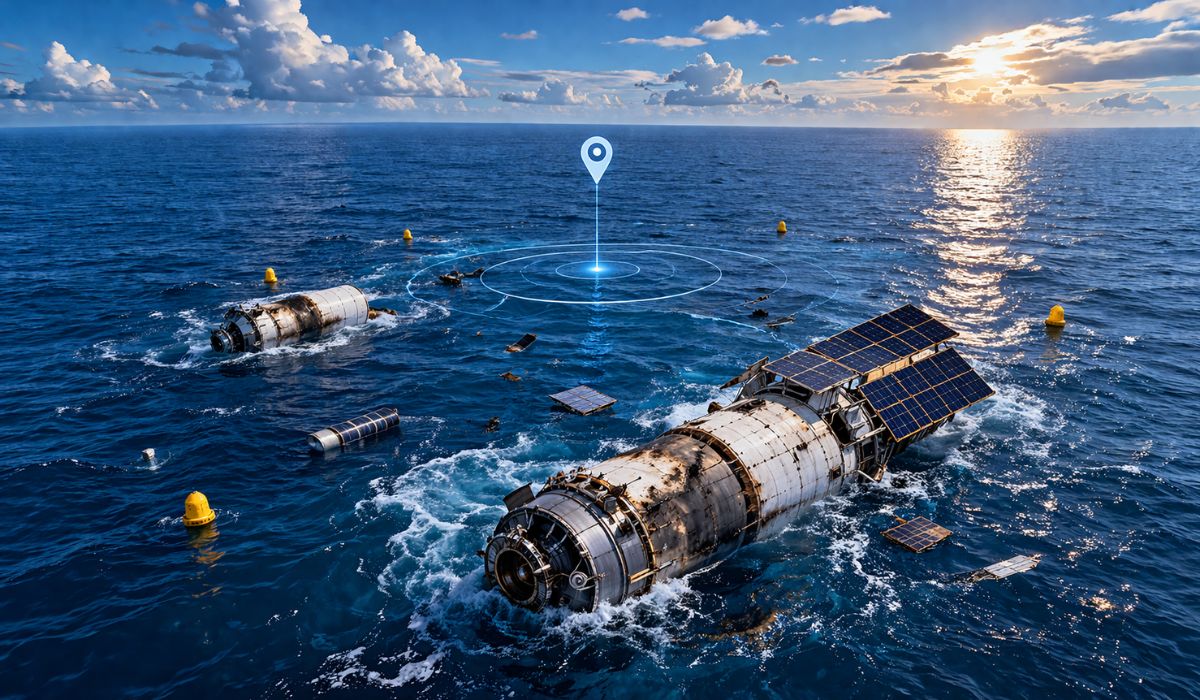


In a remote area of the South Pacific, far from any inhabited region, Point Nemo has established itself as a reference for controlled reentries of space structures and has occupied a unique place in aerospace industry operations.
In the middle of the South Pacific, thousands of kilometers from any inhabited area, there is a point on the planet that has taken on a specific function in the space age.
Known as Point Nemo, it is about 2,688 kilometers from the nearest landmasses and is used as a reference by agencies and operators for the controlled reentry of large space structures that can no longer remain in orbit.
Therefore, the region has become known as the “spacecraft cemetery.”
-
Brazilian Artist Trades São Paulo Apartment for Self-Built Eco-Hut in Southern Brazil, Embracing Low-Impact Living

-
Women Who Faced Death Head-On Break Taboos and Uncover Forgotten Funeral Rituals

-
Elderly Man in His 70s Spends Nearly 30 Years Digging 3 km Canal to Transform Arid Land into Farmland in Rural India
-
Submerged Town Reemerges in São Paulo as Reservoir Levels Drop, Revealing Ruins and Memories of Displaced Families



The expression helps summarize the function of the site, but does not describe the entire technical process.
Not every satellite ends up there, and not every decommissioned mission falls into the ocean.
In many cases, smaller equipment disintegrates almost completely in the atmosphere.
Larger structures, which may leave fragments after reentry, need to be directed to a remote area, away from populated regions and routes with higher maritime traffic.
Where is Point Nemo in the South Pacific
Point Nemo is described by NOAA, the oceanic agency of the United States, as the point in the ocean farthest from any landmass.
Its coordinates are 48°52.6′S and 123°23.6′W, in the South Pacific.
The nearest lands are Ducie Island, in the Pitcairn archipelago to the north; Motu Nui, near Easter Island to the northeast; and Maher Island in Antarctica to the south.
This geographical isolation explains why the area has come to be considered suitable for this type of operation.
In technical terms, the site is classified as the oceanic pole of inaccessibility, a term used to designate the area of the ocean most distant from any inhabited continental or insular portion.
Why is Point Nemo used for controlled reentry
The choice of Point Nemo is linked to safety criteria.
When a large space structure needs to be removed from orbit, the goal is to ensure that the reentry occurs over an oceanic area where any fragments have the least possible chance of hitting people, vessels, or coastal areas.
In these cases, operators calculate the trajectory based on factors such as altitude, speed, material resistance, and the behavior of the structure during its passage through the atmosphere.
In controlled reentries, the goal is to concentrate this risk in a remote and less frequented oceanic area.
In addition to the distance from inhabited areas, the region has low maritime circulation compared to other parts of the planet.
This data increases the safety margin for operations of this type.
Thus, if any fragment withstands the extreme heat of descent, the tendency is for it to reach a section of the ocean with a much lower probability of human impact.
Another aspect mentioned in technical and promotional materials is the position of Point Nemo within the South Pacific gyre, a system of ocean currents that hinders the arrival of nutrients.
Therefore, the area appears in studies and surveys as a zone of low biological productivity.
This factor is mentioned by specialists and institutions when discussing why the region is considered more suitable than other oceanic areas for this type of controlled disposal.
How the so-called spacecraft graveyard works
When a space equipment reaches the end of its useful life, it is not simply abandoned.
The procedure depends on the type of mission, the orbit, and the size of the structure.
In some cases, the object is taken to a graveyard orbit, as happens with some geostationary satellites.
In others, the solution is controlled atmospheric reentry.
During this reentry, friction with the atmosphere causes extreme temperatures.
A large part of the structure usually gets destroyed in this process.
Still, more resilient components, such as tanks and denser structural parts, may partially survive.
That is why larger structures require a remote target in the ocean.
In this context, the so-called “space graveyard” is not a visible deposit of intact ships at the bottom of the sea.
In practice, it is a predefined impact area to receive what remains of structures that do not completely disintegrate in the atmosphere.
Over the past few decades, different space artifacts have been directed to this area of the South Pacific.
Among the most well-known cases is the Russian station Mir, which was deorbited in a controlled manner in 2001.
Cargo missions have also followed the same logic.
The exact and updated number of objects sent to the region, however, varies according to the methodology adopted and has not appeared in a standardized manner in the open official sources consulted for this text.
ISS and the future of the space station at Point Nemo
Ponto Nemo has returned to attention due to the future of the International Space Station.
NASA reported that the station is expected to operate until 2030 and that the safe reentry of the structure is planned for the final phase of this transition, targeting an uninhabited oceanic region.
The agency also confirmed the hiring of the U.S. Deorbit Vehicle, a vehicle that will perform the final controlled descent maneuver.
According to NASA, the operation will be necessary to reduce the risks of debris falling over populated areas.
This case draws attention due to the size of the ISS.
The station is the largest structure ever assembled in space, and the agency itself states that its return will require a complex sequence of steps, with separation of parts and progressive fragmentation during atmospheric reentry.
Still, the principle adopted remains the same: to direct reentry to a remote and uninhabited area.
Space debris and the risks in orbit
The use of areas like Ponto Nemo is linked to a larger problem: the growth of space debris.
According to the European Space Agency, about 40,000 objects are already being monitored by space surveillance networks.
The estimate for fragments larger than 1 centimeter, in turn, exceeds 1.2 million.
According to the ESA, even without new launches, fragmentation events continue to increase the amount of debris in orbit.
This scenario raises the risk of collisions and reinforces the need for measures to remove inactive structures from space in a controlled manner.
In this context, deorbiting has ceased to be merely a mission closure step.
Today, it also integrates the orbital safety strategy adopted by agencies and operators.
The Ponto Nemo fits into this context as a remote area used to reduce risks during the planned descent of large space structures.