






 Portuguese
  Spanish


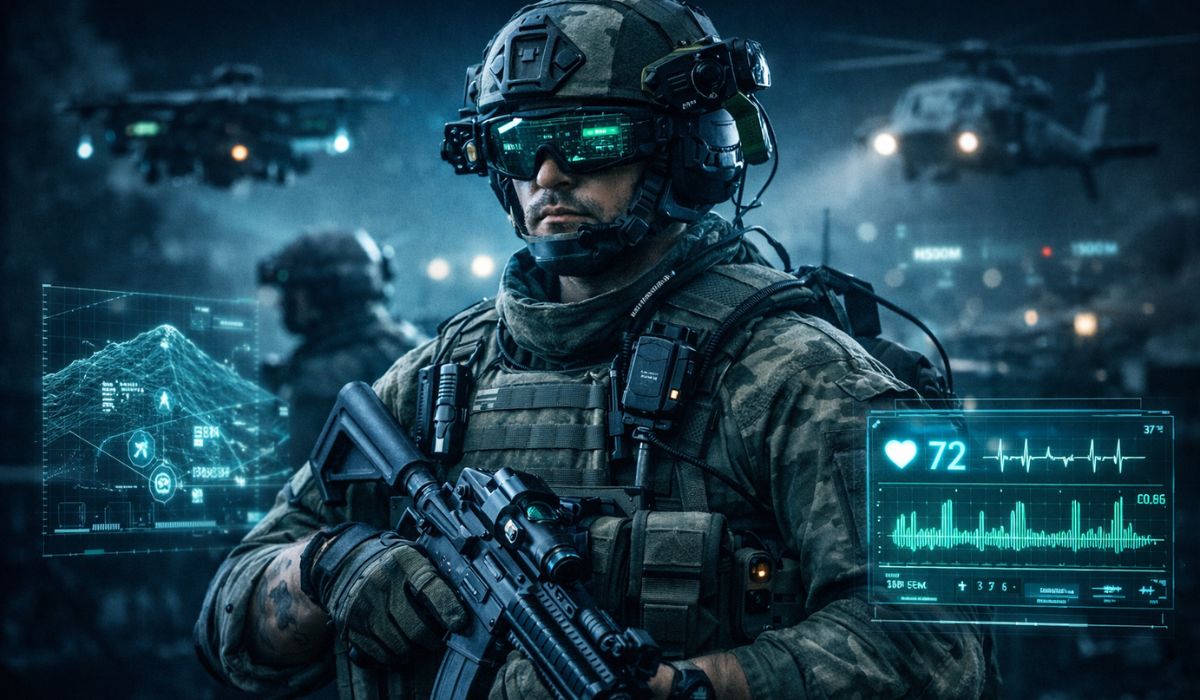

Sensors, tactical networks, and body monitoring advance in the military field and reposition the fighter as part of an integrated system, in a change that blends defense, applied science, and new forms of operation.
The transformation of the modern soldier is no longer limited to more precise weapons, reinforced armor, or lighter radios.
The advancement observed by armed forces and the defense industry involves incorporating the fighter into a technological architecture that combines enhanced vision, real-time data exchange, physiological monitoring, and integration with tactical networks.
In practice, the military operates as a mobile point of information on the ground, capable of receiving, transmitting, and processing data during the mission.
-
China Develops Custom 140-Ton Electric Mining Truck with 770 kWh Swappable Battery, Deploys 290 Units in Xinjiang’s Largest Zinc Mine

-
Meta to Launch Arena, a New Prediction App Targeting 3.56 Billion Users, Competing with Polymarket and Kalshi

-
Scientist Challenges Famous Human Evolution Theory, Argues Homo Sapiens Evolved Gradually Over Thousands of Years
-
15-Year-Old American Builds Ocean Generator with PVC Pipe and 3D-Printed Propeller for $12, Wins National Prize, Presents at White House, and Makes Forbes 30 Under 30 List




This movement draws attention not only for its operational impact but also for what it reveals about the convergence between the human body and digital systems in extreme environments.
Instead of the traditional image of the fighter equipped with separate items, what gains ground is a logic of integration.
Glasses with augmented reality features, sensors attached to the uniform, command and control software, and wearable health platforms begin to operate as parts of the same set.
Military technology integrates vision, data, and command
One of the most well-known examples of this process is the IVAS, which stands for Integrated Visual Augmentation System.
The program was designed to combine daytime and nighttime vision, sensors, mapping, and a visual interface in the soldier’s field of view.
In official material from the United States Army, the system is presented as a platform aimed at situational awareness, training, and decision-making support in combat.
In this context, the difference lies not only in enhancing vision in dark or low-visibility environments.
What the project seeks is to place processed data before the eyes of the soldier at the moment of action.
Therefore, the debate about the “soldier of the future” has focused less on isolated pieces and more on the ability to connect environmental reading, navigation, location, communication, and command within the same operational structure.
Tactical network transforms the soldier into an information link
The same logic appears in programs like Nett Warrior.
In an official report published by the U.S. Army, the system was presented during training as a solution capable of integrating drone control, video sharing, reconnaissance data, troop positions, and real-time task sending.
According to the material, commanders can monitor live images and relay instructions to different levels through a common network.
As a result, individual equipment is no longer just a set of devices used in parallel.
The soldier is treated as a link in a larger digital mesh.
The geographical position is no longer restricted to one system, the image to another, and the message to a third.
The trend is towards convergence between these functions, with a direct effect on the situational awareness of small units in movement or decentralized operations.
Body sensors expand real-time monitoring
The physiological dimension is one of the most visible fronts of this transformation.
Wearable platforms tested and adopted by structures linked to the United States Department of Defense have been used to monitor effort, respiratory changes, fatigue, and risk indicators during training and missions.
In official material released in 2025, the LifeLens program was described as a wearable platform for real-time physiological monitoring, even in GPS-denied environments, focusing on survival, exposure to threats, and combat readiness.
According to the U.S. Army itself, this data has been used not only in health actions but also in decisions related to security and the continuity of activity.
One of the officially cited examples involved the early identification of a case of rhabdomyolysis during activity in intense heat, which led to the withdrawal of the soldier for medical evaluation.
In another case, cardiac changes observed in real-time during an asthma attack helped guide the medical response.
This use indicates a shift in the treatment of physiological information in a military context.
Health, wear and recovery are no longer only assessed post-mission and are now integrated into risk assessment during activity.
Instead of measuring performance only after effort, technology is used to identify signs of physical compromise during the course of operation or training.
Applied science helps anticipate wear and risk
The adoption of wearable technologies is also connected to areas such as physiology, ergonomics, biomechanics, and data science.
The focus, in this case, is not only on determining how much a body can endure but on understanding how to anticipate loss of performance, overheating, exhaustion, or decline in cognitive capacity in extreme situations.
When sensors record bodily signals during prolonged effort, the goal is to relate the physical state of the soldier to factors such as mission demands, weight carried, temperature, and pace of movement.
This reading helps explain why the platform soldier has come to be treated, in recent programs, as part of a broader system of data collection and circulation.
Military exoskeletons are still advancing in the testing phase
The most popular image of the “soldier of the future” is still often associated with motorized exoskeletons and enhanced strength.
However, what is documented points more towards research, testing, and capability planning than to widespread distribution among troops.
A report from Defense News published in October 2024, based on presentations from the U.S. Army, indicated that exoskeletons for dismounted soldiers remained on the horizon of projects linked to robotics strategy and autonomous systems.
This means that the topic is already present in planning, but there is still no confirmation of large-scale adoption as an operational standard.
In known initiatives, the stated goal has been to alleviate load, reduce fatigue, preserve joints, and improve support in repetitive or heavy tasks.
The focus, therefore, is less on creating a fighter with extraordinary capabilities and more on enhancing physical support and endurance under certain conditions.
Integration between body, sensors, and network gains ground
When observing these programs together, what becomes clearer is the change in logic.
The soldier of the future, according to ongoing projects and tests already disclosed, is not defined by a single piece of equipment, but by the integration of devices, software, sensors, and command networks.
The ongoing transformation involves environmental perception, connectivity, and body monitoring within the same technical architecture.





