






 Portuguese
  Spanish


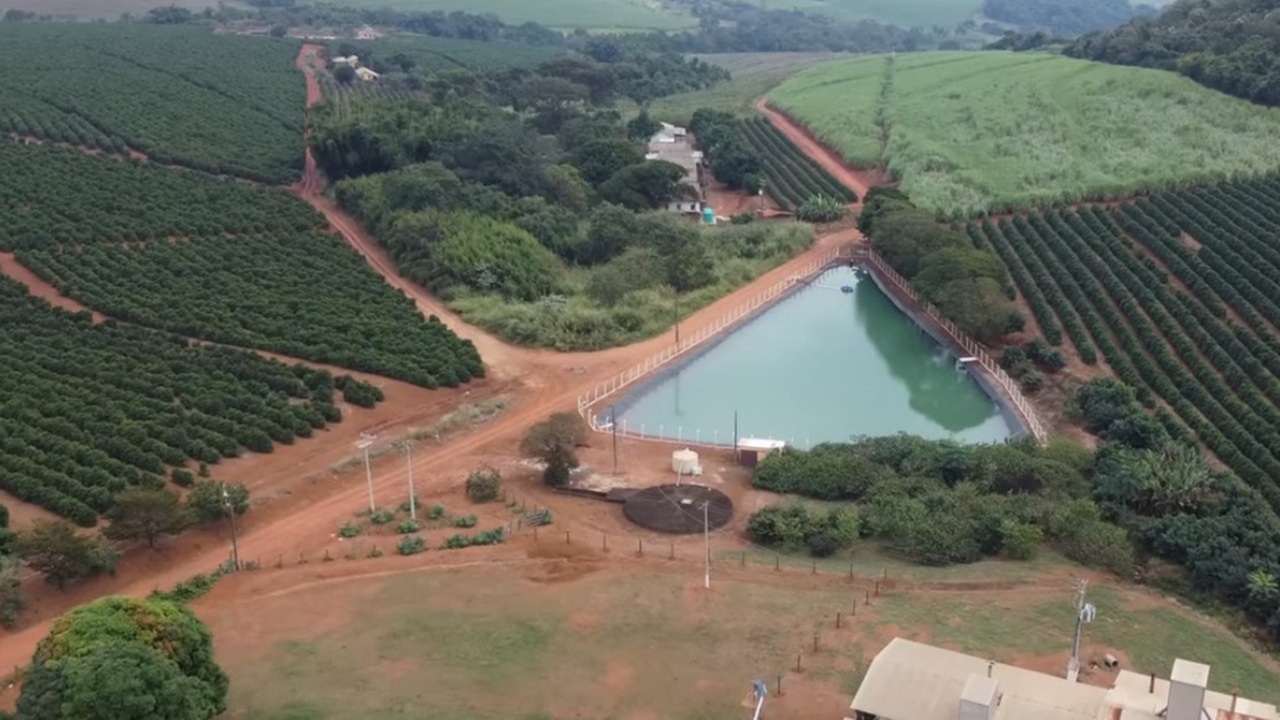

Fazenda São Caetano, in Tambaú, shows how an area that became smaller after a family division began to combine coffee, livestock, solar energy, a 15 million liter reservoir, and hydroponic corn to create a productive model based on circular economy
At Fazenda São Caetano, in Tambaú, in the interior of São Paulo, the story of a family property took a new direction after decades linked to coffee, milk, and livestock.
In the video published on the Lucas Pereira Lima channel, it shows how an area that became smaller after a land division was transformed into a sustainable, intensive farm model based on circular economy.
The property has been in the family since the 1970s. According to Ricardo, the grandfather started working on the site with coffee and milk production. The dairy activity gained strength in the 1980s and continued until the family went through internal changes. After the grandfather’s death in 2012, the land was divided among family members. The part that remained with Ricardo and his mother required a lot of work to remain productive.
-
Workers renovating a playground in northern England uncover 176 World War II bombs buried underground; training artifacts still contained explosives.

-
Brazilian Architect Transforms Waste into Sustainable Homes with Solar Power and Rainwater Systems for 40 Years

-
Security Guard Becomes Doctor at Louisiana Hospital Where He Once Worked, Studied Chemistry Between Shifts

-
Woman Rescued from Luxury Complex in Brazil Worked Without Pay for 55 Years, May Be Entitled to Over $300,000




Instead of abandoning the rural vocation, he decided to preserve his grandfather’s memory and maintain two important fronts: coffee and cattle raising. The transformation, according to him, has been ongoing for almost ten years. The goal is to make a small farm profitable, lucrative, and capable of serving as an example for others.
From industry to the field
Ricardo has a background in mechanical engineering and production engineering. Before taking on the farm challenge, he worked in large companies, including multinationals, and also served as a consultant. In 2017, he decided to leave part of that career to lead, alongside his mother, the property restructuring project.
The change was not just professional. In the video, he states that the field became part of his way of thinking and his lifestyle. The mission now is to make Fazenda São Caetano continue to succeed even with a much smaller area than it had in the past.
Today, the property works with coffee, beef cattle, hydroponic forage production, solar energy, and resource reuse within the farm itself. The central idea is to reduce external dependencies and make each activity support the other.
Circular economy as a strategy
The logic presented by Ricardo is simple: take advantage of by-products and co-products within the farm itself to reduce costs and increase efficiency. Coffee is identified as the main source of income. The post-harvest structure is powered by photovoltaic energy. Meanwhile, beef cattle enter the system as a new stage, capable of generating manure for composting and returning to the coffee plantation.
With this, the farm seeks to reduce the need for external fertilizers. The cattle consume food produced on the property or processed there, convert part of it into weight gain, and leave residues that return to the fields.
Despite the diversity of activities, the personnel structure is lean. Ricardo explains that there are three employees: two related to coffee and one focused on beef cattle. He is involved in coordinating and managing the operation.
Hydroponic corn becomes food for cattle
One of the central points of the visit is the production of hydroponic corn. The process begins with corn kernels placed in boxes with water and quicklime. The mixture helps break the seed’s dormancy and stimulates germination. After 24 hours, the water is drained, and the corn remains moist for another 48 hours until it starts to sprout the first roots.
After that, the germinated grains are taken to trays inside a greenhouse. There they receive controlled water and lighting. According to the video, the system can provide up to 18 hours of light per day, using LED lamps powered by solar energy. In a few days, the corn transforms into a kind of green carpet, similar to dense grass.
After about six days, the carpets are ready for harvest. Each unit can weigh approximately 10 kg. Once harvested, they are shredded in a forage harvester to form a feed base used in the cattle’s diet.
Brick hay is added to balance the diet
The silage produced on the farm also includes the so-called brick hay, made with pressed brachiaria. Ricardo explains that this material functions as an effective fiber for the animals. When hydrated, it expands and helps give structure to the diet.
In the mixture shown in the video, for every approximately 100 kg of hydroponic corn carpets, about 25 kg of brick hay is added. The function is to balance the moisture, increase the dry matter, and improve the final consistency of the feed.
Ricardo compares the material’s function in the animal’s rumen to a kind of catalyst, aiding in the digestive system’s functioning and nutrient passage. He also states that the fiber can help reduce problems such as acidosis, laminitis, and hoof issues.
The final diet is weighed, packaged, pressed, and vacuum-sealed. According to him, the process tries to simulate an ideal silage trench, with good compaction, sealing, and conservation by inoculant. The proposal is to deliver ready silage to small and medium producers, especially useful during the dry season.
Solar energy changes the farm’s account
Another highlight is the photovoltaic plant installed on the property. Ricardo explains that the farm participates in a cooperative energy generation system. The energy produced is sent to a cooperative, which grants discounts to consumers connected to the same distributor.
The structure has 1,600 m² of solar panels. According to Ricardo, this area generates for the farm an income equivalent to the leasing of 35 hectares of sugarcane. For him, the data shows the importance of intensifying and verticalizing production on small properties.
Water, Coffee, and Reforestation
The property also has a water reservoir aimed at irrigating the coffee. It was installed at the lowest point of the farm to receive rainwater directed by the terrain. Ricardo states that the reservoir has 15,000 m³, or 15 million liters, a volume sufficient to irrigate the 15 hectares of coffee existing in the area.
In addition, an area that previously received waste from the former dairy production was transformed into reforestation with native species of the region. The former farm, which once had between 1,000 and 1,100 hectares, now has 73 hectares in Ricardo’s part.
The history of Fazenda São Caetano shows an attempt to respond to a common challenge in the field: how to make a smaller property remain productive. The solution found was to combine technology, planning, solar energy, coffee, livestock, stored water, hydroponic forage, and resource reuse. In the end, the farm seeks to prove that size is not the only decisive factor when there is strategy


