






 Portuguese
  Spanish




After 40 years transforming used tires, bottles, and other waste into self-sufficient houses in the United States, Michael Reynolds inspires a project in Ceará that aims to adapt Earthships to the Brazilian reality
The American architect Michael Reynolds has been drawing attention for about 40 years by transforming waste into sustainable housing in the United States.
In the state of New Mexico, he developed houses known as Earthships, designed to operate autonomously in water, energy, sewage, and food production.
Moreover, Reynolds began using materials that would normally be discarded, such as used tires, bottles, cans, and cardboard, creating a construction model more connected to nature.
-
Security Guard Becomes Doctor at Louisiana Hospital Where He Once Worked, Studied Chemistry Between Shifts

-
Woman Rescued from Luxury Complex in Brazil Worked Without Pay for 55 Years, May Be Entitled to Over $300,000

-
Brazilians in Portugal Face Increased Police Checks as Consulate Advises Carrying Documents; Long-term Resident and Tourist Report Heightened Scrutiny in Porto.

-
Russia Proposes Bold Energy Transition Plan at BRICS, Citing $8 Trillion Annual Cost for 2050 Global Target



Architect created self-sufficient houses in the desert
Michael Reynolds’ proposal was born with a bold idea: to build houses capable of depending less on conventional networks.
Thus, his homes began to capture rainwater, reuse this resource, and utilize renewable sources such as solar and wind energy.
Additionally, the Earthships were designed to offer comfort through natural ventilation, lighting, and cooling.
In this way, Reynolds showed that waste could become walls, structure, and practical solutions for sustainable housing.


How do the Earthships created by Reynolds work?
The houses created by the architect use integrated systems. First, rainwater is captured and stored.
Then, this resource is reused at different stages within the house itself. Next, part of the water undergoes treatment in a black water cell.
Furthermore, energy is produced by renewable sources. As a result, the home reduces its dependence on the traditional power grid.
Another distinguishing feature is the production of food throughout the year, either inside the house or in areas close to the construction.

What does Ceará want to do inspired by this model?
In Brazil, the Casa PAS, under construction in Aquiraz, Ceará, intends to follow the principles of Earthships created by Michael Reynolds.
The project is led by Bernardo Andrade, who interned at the American architect’s company.
Now, the proposal is to adapt this model to the Brazilian reality, maintaining the idea of autonomy and material reuse.
In addition to tires, bottles, and natural materials, Casa PAS intends to use construction waste, steel slag, PET wool, and plastic wood.
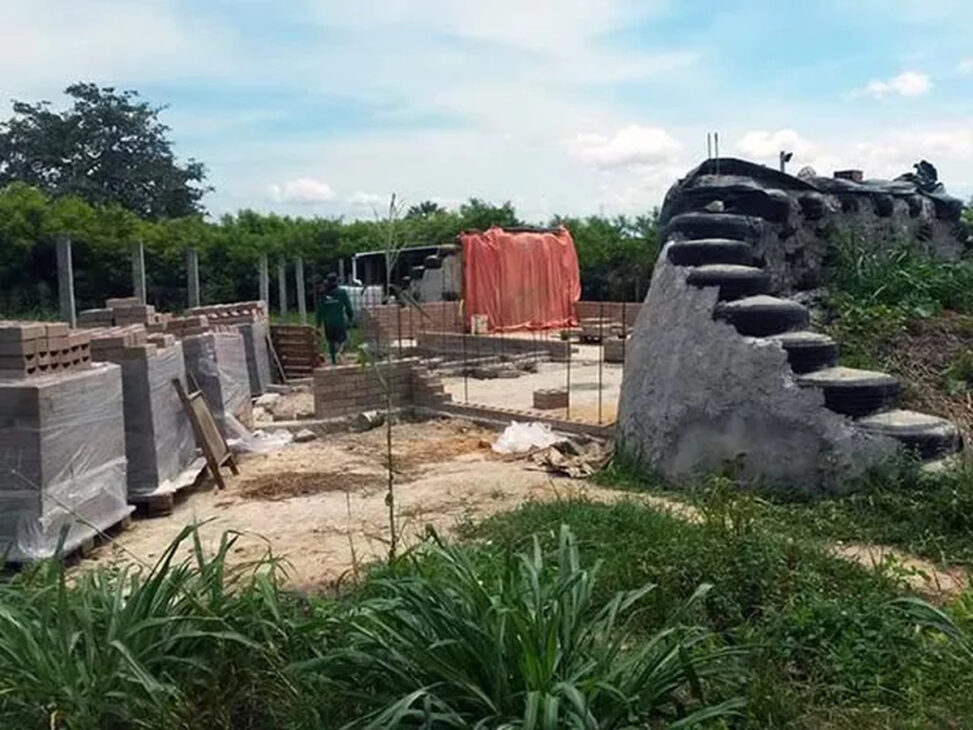
Brazilian project aims to promote bioconstruction
Casa PAS was also designed to introduce bioconstruction techniques to the Brazilian public.
Among the planned solutions are the use of earth, tires, bottles, and soil-cement bricks.
Additionally, the project aims to demonstrate a viable model of autonomy in water, energy, and food production.
Finally, the space will be open for visits, studies, and research by universities interested in sustainable construction.
Thus, the work started by Michael Reynolds four decades ago gains a new stage in Ceará, with local materials and proposals adapted to Brazil.
Would you live in a house made with used tires, reused rainwater, and renewable energy?


