






 Portuguese
  Spanish


The Village of Atule’er in China Can Only Be Reached by 2,556 Vertical Steps on an 800-Meter Cliff. For Decades, It Used a Vine Ladder — Risky and Deadly — Until Winning a Metal One in 2016.
Imagine having to walk more than an hour every day up a vertical ladder 800 meters high just to buy food, go to school, or seek medical care. Now imagine that this ladder, until a few years ago, was made only of vines, bamboo, and wood — precariously hung on a steep cliff, risking death with every step. This place exists. And its name is Atule’er, a village lost in the mountains of Sichuan province in southwest China. The access? A 2,556-step metal staircase dug into the rock, known as the “heavenly staircase” by the few who dare to face it.
A Village Suspended in Time (and Space)
With only 72 families, Atule’er is part of the Yi ethnicity, traditionally isolated in mountainous and hard-to-reach areas. The village is located at the top of an 800-meter gorge, surrounded by rock formations, deep valleys, and dense forests.
There is no road, no cable car, not even viable hiking trails. The only link between Atule’er and the rest of civilization is a brutal sequence of vertical steps, fixed directly to the slope of the cliff.
-
Brazilian Sisters, Aged 103, 104, and 109, Set Guinness World Record as Oldest Sibling Trio, Totaling 316 Years; Attract Scientific Interest for Longevity DNA Study

-
14-Year-Old Australian Entrepreneur Goes Viral After Y Combinator Rejection, Runs Two Startups Including an AI Company After Sock Business Failure

-
100-Year-Old Brazilian Sets World Record by Swimming 50 Meters in 1 Minute and 9 Seconds, Inspired by Tarzan Films
-
Brazil Introduces New Digital ID with Home Delivery, Linked to Unique Tax Number, Amidst Nationwide Notification Campaign.




Until 2016, this access was even more incredible: a tangle of handmade stairs made of vines, bamboo, and wooden planks, built by the residents themselves with materials collected from the forest. Children, the elderly, pregnant women — everyone climbed and descended this improvised maze to reach the valley. Accidents were common. Fatal falls too.
The Photographer Who Changed Everything

The extreme reality of Atule’er only came to light when the photographer Chen Jie, from a Chinese newspaper, visited the village in 2016. He published shocking images of children climbing the vine ladder over 600 meters high, with school backpacks on their backs and expressions of pure effort.
The photos went viral. The national outcry was immediate. Thousands of internet users demanded action from the government, which until then had never undertaken any infrastructure work in the region.
Steel Stairs: The Symbol of a Late Transformation in the Village of Atule’er
In response to public pressure, the local government built a metal staircase with handrails and a reinforced structure, replacing the old organic structure.
The 2,556 steps were manually assembled, step by step, following the irregular contour of the mountain. The work was completed in 2016 and cost the equivalent of hundreds of thousands of dollars, paid with municipal resources and help from NGOs.
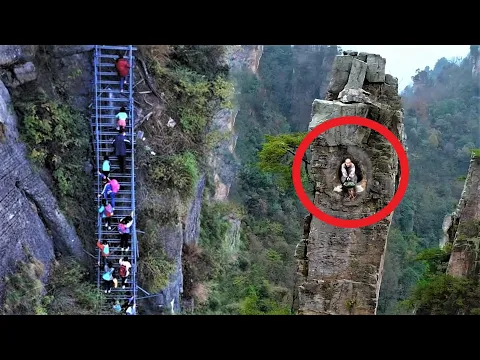
The new stairs improved safety — but did not eliminate the challenge. The climb remains exhausting. It takes between 60 and 90 minutes to complete, depending on the weight carried. Residents still transport food, gas canisters, construction materials, and even children on their backs, balancing on the steep and slippery steps.
Vertical Stairs as a Tourist Attraction
With the sudden fame, Atule’er became an exotic destination for adventurers. Chinese and foreign tourists began to climb the stairs for sport — some with guides, others with drones, all in search of the “impossible photo” at the top of the abyss.
But for the residents, the stairs remain a necessity, not an adventure. They still rely on it for everything. Including evacuating the sick or bringing teachers, since there is no permanent school in the village: children attend classes in the valley and walk back up the mountain.
The village also lacks a hospital, health post, or permanent market. Everything arrives on foot, step by step.
The answer is simple: extreme topography and high costs. Opening a road through the gorge would require tunnels, viaducts, and monumental construction that would exceed millions of dollars. For such a small village, the central government did not consider it economically viable.
The proposal for a cable car was even discussed, but it was also discarded for technical and environmental reasons. Thus, Atule’er remains suspended at the top of the abyss — literally isolated between heaven and earth.
Reflection of a Country with Brutal Contrasts
The story of Atule’er exposes the two faces of modern China. On one side, cities like Shanghai and Shenzhen, with skyscrapers, autonomous subways, and superapps. On the other, villages like Atule’er, where one climbs step by step to buy a sack of rice or take a child to the doctor.
Experts point out that there are thousands of isolated communities like this in the deep interior of China, especially among ethnic minorities, in mountainous regions near Tibet or Vietnam. Some still live without reliable electricity or internet access.
Despite all of the country’s advances in recent decades, rural China still bears scars from the past — and Atule’er is one of the most visible.
The View from the Top: Beauty and Hardship Mixed
At the top, the landscape is breathtaking. Green mountains stretch to the horizon, valleys cut by rivers, clouds below the feet on foggy days. The village is simple, with wooden houses, dirt floors, and long silences.
But daily life is demanding. The economy revolves around subsistence agriculture, small herds, and some handicrafts. Almost everything depends on human transportation. And even with the new stairs, there are few signs that life there will change drastically anytime soon.


