






 Portuguese
  Spanish


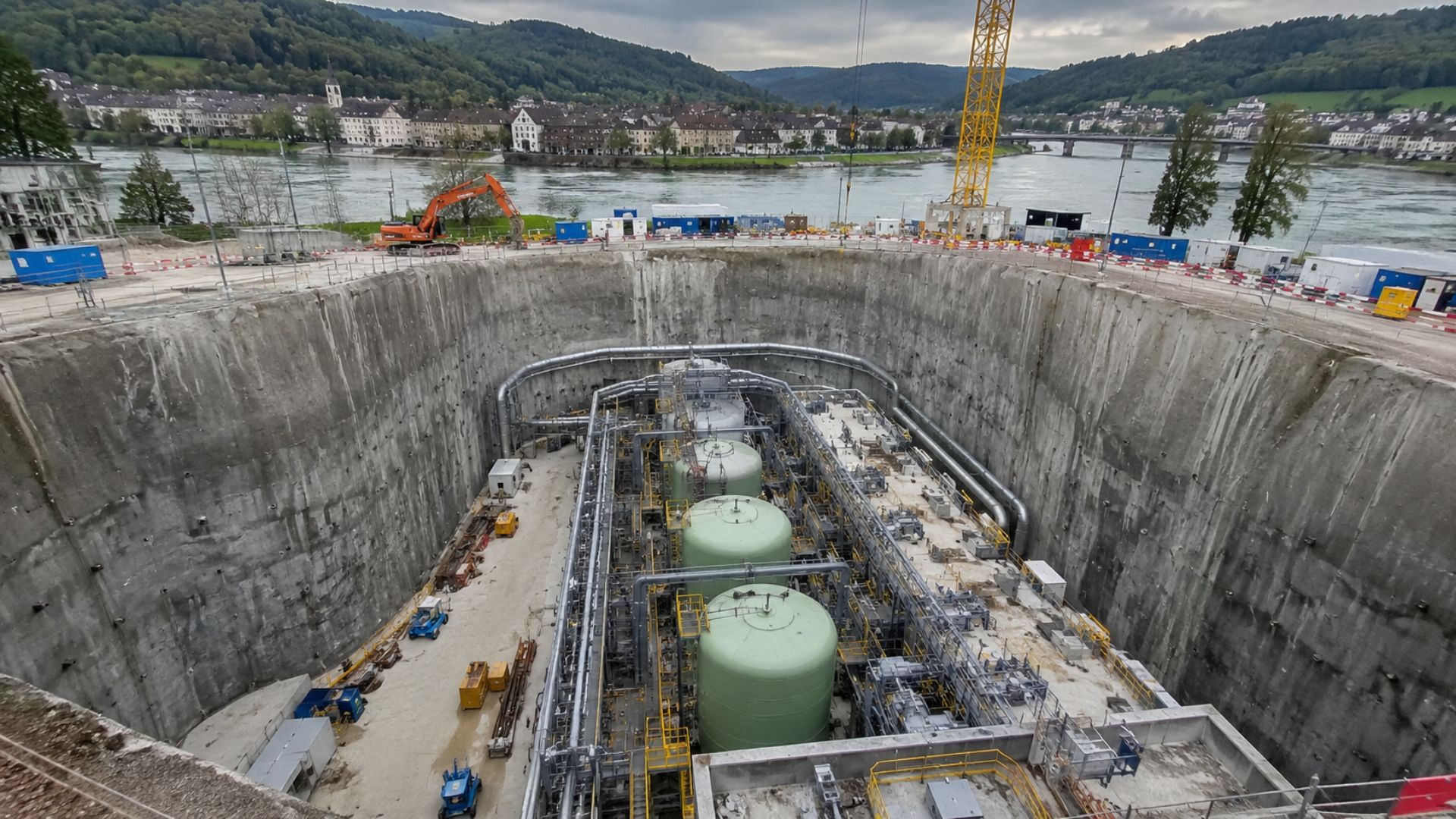


Underground project in Switzerland bets on giant energy storage to stabilize European electrical grids with millisecond response, redox flow technology, and capacity equivalent to a nuclear power plant. Billion-dollar structure will be installed in Laufenburg and is part of one of the largest energy centers planned for the continent.
In the Swiss canton of Aargau, the city of Laufenburg has become the stage for one of Europe’s most ambitious energy projects, with the construction of an underground redox flow battery designed to reach 1.2 GW of power and more than 2.1 GWh of storage.
Responsible for the construction, FlexBase excavated a shaft approximately 27 meters deep and longer than two football fields, a structure intended to house part of the system that will operate in conjunction with the European electrical grid.
In addition to the battery, the project includes the future Laufenburg Technology Centre, a 20,000-square-meter complex that will bring together energy storage, a data center focused on artificial intelligence, corporate offices, and laboratories in an area considered strategic for the continental electrical sector.
-
The Transparent Plastic Pen That Sold Over 100 Billion Units, Becoming the Best-Selling Pen in History Across Five Continents

-
Brazilian Startup Develops Solar-Powered Mobile Factory, Recycles 100,000 Panels in Under a Year, Recovering Silver and Copper
-
Your Door Lock, Gate Padlock, and Hotel Key Card Likely Come from the World’s Largest Lock Manufacturer, the Swedish Group Behind Yale and Brazil’s Papaiz
-
Major Brazilian Ethanol Producer Becomes Largest Owner of Planted Forest in Mato Grosso, Aiming to Power Plants with Renewable Energy Instead of Fossil Fuels


Underground battery in Switzerland will have power comparable to a nuclear power plant
Designed to respond in milliseconds, the installation will be able to absorb or inject electricity almost instantly, a feature considered essential to reduce fluctuations in grids increasingly dependent on renewable sources, such as solar and wind energy.
According to FlexBase, the maximum expected power is equivalent to the capacity of the Leibstadt nuclear power plant, also located in Aargau, a comparison used by the company to demonstrate the energy scale that the system should achieve after the completion of the works.
In the estimate released by the company, the total storage capacity would allow supplying approximately 210,000 homes for 24 hours, a scenario projected for the final phase of operation of the underground structure.
How redox flow battery technology works
Unlike lithium-ion batteries, which store energy in solid components, redox flow technology uses liquid electrolytes stored in tanks and pumped through electrochemical cells.
During charging, electricity is converted into chemical energy in the liquids; during discharging, the process is reversed and the energy returns to the grid as needed.
The advantage of the system lies in its scalability, as increasing capacity mainly depends on the volume of the tanks, while power is related to the size of the conversion modules.
Laufenburg became a strategic point for the European electrical system
Laufenburg has historical significance in European electrical integration for hosting the so-called Star of Laufenburg, a point associated with the connection of networks from different countries since the second half of the 20th century.
This position helps explain the choice of location for a project aimed not only at the Swiss market but also at the stability of regional electrical flows.
The operator Swissgrid plans to connect the complex to the national high-voltage grid, which would make the facility an unprecedented reference for this type of storage in the country.
Renewable energy increases demand for large-scale storage
The expansion of solar and wind energy increases the need for systems capable of storing surpluses during high generation times and delivering electricity during peak consumption periods.
Large batteries like the one in Laufenburg can offer network services, such as frequency control and voltage support, in addition to reducing the need for emergency adjustments from more polluting sources.
In the case of redox flow batteries, FlexBase highlights the use of aqueous, non-flammable, and recyclable electrolytes, a feature presented as a differential compared to lithium systems in urban or underground installations.
Billion-dollar project expected to start operation in 2029
The forecast released by FlexBase is to put the battery into operation in 2029, with private financing and an estimated investment between 1 billion and 5 billion Swiss francs.
The complex is also expected to generate about 300 jobs and utilize residual heat from the data center in a district heating network, with a local estimate of saving 75,000 tons of CO₂ over 30 years.


The Electrochemical🇵🇭used for a grid are safe to this century..🎆🌈⚓🧭⛳