Portuguese
  Spanish


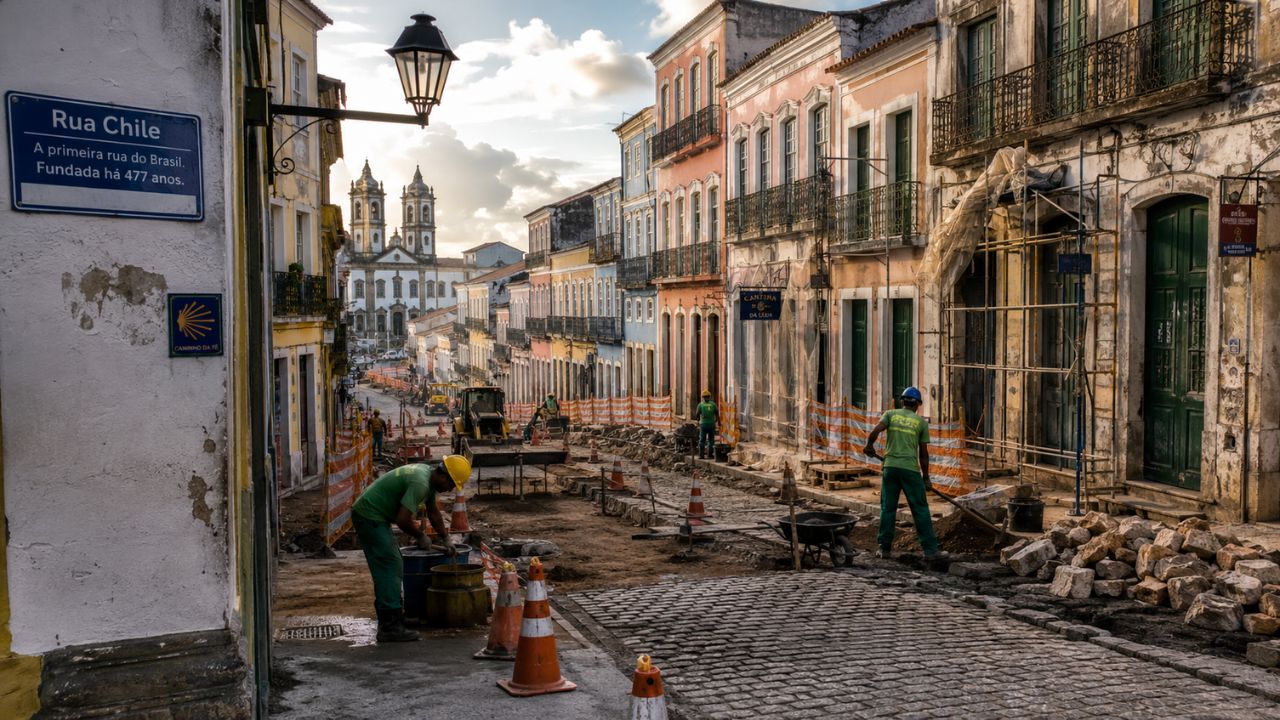

The first street in Brazil is in Salvador and is 477 years old. Discover the history of Rua Chile: from elite glamour to abandonment and rebirth.
With nearly five centuries of existence and about 400 meters in length, Rua Chile, in the Historic Center of Salvador (BA), holds a title that few know: it is considered the first street founded in Brazil.
According to g1, over 477 years, it has accumulated eight different names, hosted international personalities, served as a setting for Bahia’s high society, and, decades later, faced a period of abandonment. Today, with historic hotels reopened and renewed tourist activity, the street is experiencing a new phase — without losing the traits of what it once was.
From “Rua Direita dos Mercadores” to Rua Chile: how this name emerged
The current name of the street has existed for just over 120 years. In 1902, the street was renamed “Chile” as a way to honor the Chilean government, after the death of officials from that country who fell ill while in the Bahian capital.
-
Danger of Technological Hyperstimulation: USP specialists warn that intense use of multiple screens and digital stimuli can gradually reduce essential cognitive abilities, while scientists analyze how technological overload affects memory, concentration, and intellectual performance over the years.

-
After three years living in a van, a couple bought an abandoned historic house and had to deal with mold, damaged plumbing, raccoons, and heavy cleaning before moving in.
-
In the city that the market called “road cockroach,” between Balneário Camboriú and Florianópolis, he launched a planned neighborhood worth R$ 1 billion with a marina for 90 boats and sold 80% of the lots in the first phase in 1 week.

-
At a depth of 5,000 meters, where there is no sunlight, researchers found ancient DNA preserved in the mud of the South Atlantic and discovered signs of organisms that did not match known records.





Before that, the street had been known by eight other titles throughout its history. Among the most remembered are “Rua Direita dos Mercadores” — reflecting its commercial function since the early centuries — and “Rua Direita do Palácio,” a name linked to its proximity to the Rio Branco Palace, which still occupies the address today.

What can be found on the first street in Brazil today
Even with less than half a kilometer in length, Rua Chile holds an extraordinary historical and cultural density. Among the points that can be visited there are:
- The Tomé de Souza and Castro Alves Squares, landmarks of the historic center of Salvador
- One of the entrances to the Elevador Lacerda, a postcard of Salvador
- The Cubana ice cream shop, also a pioneer in the city — and still in operation
- The Salvador City Hall headquarters and the Rio Branco Palace
- The historic hotels Fera Palace and Fasano, which underwent restoration works maintaining the original structures
It is worth noting that the Fera Palace occupies an entire block, sharing facades with Tesouro and Ajuda streets. The reopening of these hotels in recent decades has been one of the main drivers of the street’s renewed attractiveness.
When the street was an open-air shopping mall for the Bahian elite
For much of the 20th century, until the mid-1970s, Rua Chile was the address of luxury in Salvador. It was there that Bahia’s high society met, strolled, dated, and consumed cutting-edge fashion — items that arrived from other countries and could only be found on that street.
According to Bahia History professor Murilo Melo, “Rua Chile was a large open-air shopping mall, which had major brand clothing and fashion stores. It was the place where you found everything modern from Brazil and the world, luxury items.”
Two stores stood out during this period: “Duas Américas” and “Casa Sloper”, both references for clothing and department items for those who wanted to be fashionable. Besides them, “Adamastor” — owned by the father of filmmaker Glauber Rocha — and “Chapelaria Mercouri” — founded by the great-grandfather of singer Daniela Mercury — also attracted a loyal and demanding clientele.

Historian Murilo Melo sums up the spirit of that era well: “All the refinement of Salvador revolved around Rua Chile, both in terms of fashion, flirting, people who came from their neighborhoods further from the center… It was the place to stroll with your girlfriend, have an ice cream at Cubana, and look at the shop windows.”
Writer Jorge Amado also immortalized the street in his work. Describing the Fera Palace, he wrote that “the ladies from Graça and Barra showed off the latest models and some of them, the most sophisticated, in a display of boldness, risked chips on the roulette” — a reference to the noble neighborhoods of Salvador that still exist today. Besides Amado, British singer Keith Richards and American actor Orson Welles were among the illustrious visitors to the street in its prestigious times.
Why did the street lose its shine starting in the 70s?
The decline of Rua Chile did not happen overnight. It was a gradual process, driven by structural changes in the city of Salvador itself. One of the causes was urban expansion towards the so-called “valley avenues,” where workers from the Petrochemical Complex migrated — many coming from the interior of the state — who built houses in regions then distant from the center.
According to Murilo Melo, “the city was very attached to the center, small and modest. What was once the center became somewhat abandoned. So people stopped passing through that street.”
The opening of what is now called Shopping da Bahia, in the Iguatemi region, also redirected the flow of consumers and merchants. Avenida Tancredo Neves emerged as a new shopping corridor, and the transfer of the state government’s headquarters to the Administrative Center of Bahia (CAB) completed the institutional emptying of the central area.
The result, according to the professor, was visible in the buildings themselves: “With this, the houses started to fall apart, be poorly maintained, and people did not frequent the area as often. It began to become deserted, and investment shifted to the newly created locations.”


View of the Bay and new life: the present of the historic street
Those who walk along Rua Chile today find a street that preserves its centuries-old architecture and offers one of the most privileged views of Salvador: the Baía de Todos-os-Santos, visible from different points along the route.
The restoration of historic hotels in recent decades was an important step for the street to regain some of its lost prestige. With renovations that respected the original structures, these establishments have become considered references of Salvador’s historical heritage — and attract visitors who go beyond conventional tourism.
With information from g1