






 Portuguese
  Spanish


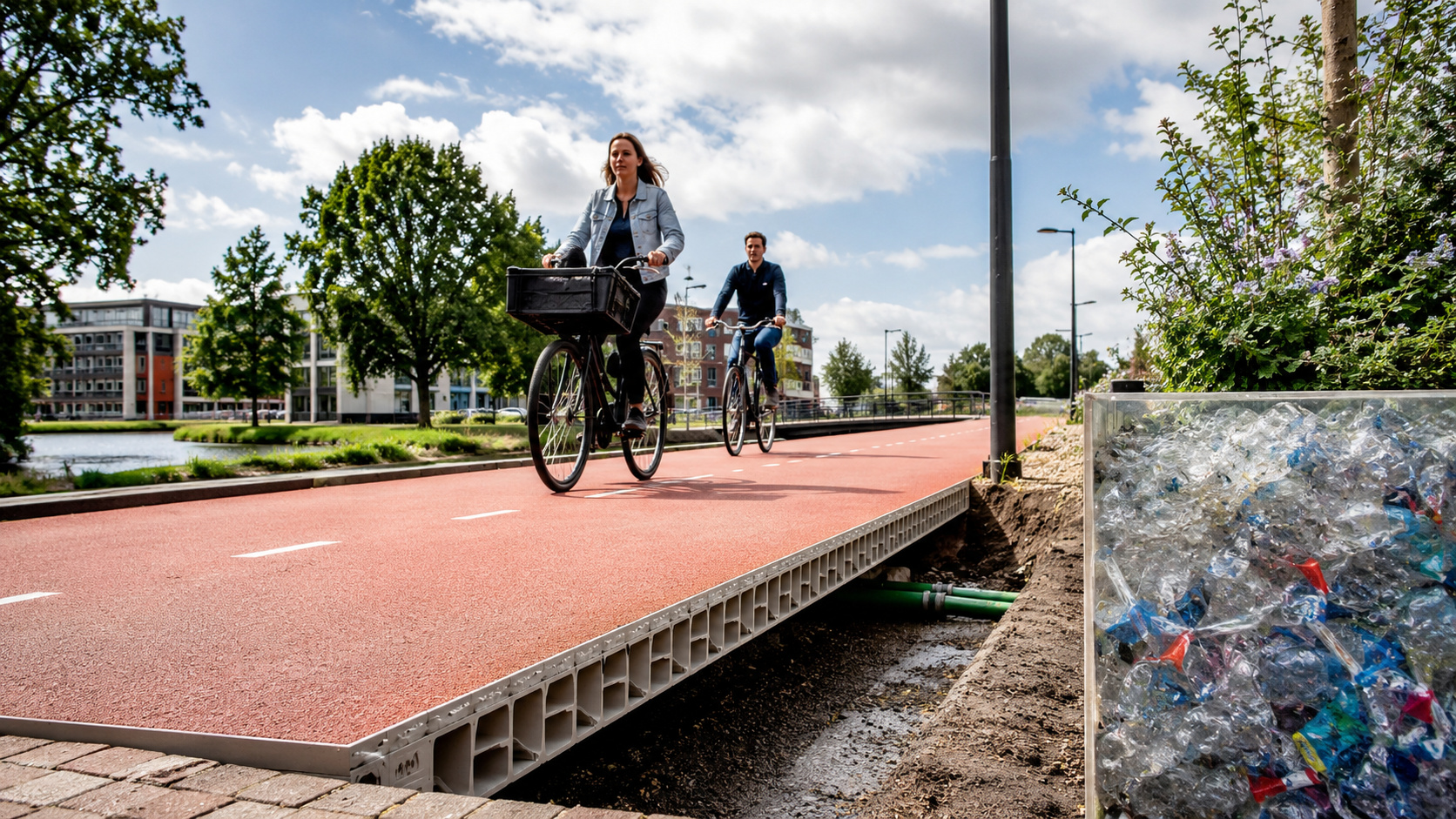


The recycled plastic bike path installed in Zwolle, Netherlands, shows how waste can become urban infrastructure, with hollow modules, integrated drainage, space for cables, and an alternative to common asphalt
While cities face potholes, cracks, and constant construction, the Netherlands has put into operation a recycled and modular plastic bike path. The structure is 30 meters long and uses the equivalent of more than 218,000 recycled plastic cups.
The information was released by Wavin, a participating company in the PlasticRoad project partnership. The bike path was inaugurated on September 11, 2018, in the municipality of Zwolle, and is part of the PlasticRoad project, developed by KWS, Wavin, and Total.
The proposal draws attention because it is not just about replacing one material with another. The path is hollow inside, can accommodate drainage, cables, and pipelines, and was designed to be assembled with industrial pieces, reducing some of the dependency on traditional asphalt.
-
Brazilian Engineers Launch 292 km Power Line to Ease Energy Bottlenecks in Southern Brazil

-
Peru Installs Ocean Intake and Subsea Pipelines in the Pacific to Desalinate 34 Million Liters of Drinking Water Daily Near Lima
-
Rumo Unveils 170-Ton, 45-Meter Rail Machine with Unique Technology in Latin America to Stabilize Freight Train Tracks in Brazil
-
Brazilian Farmer Reflects on 58 Years of Soybean Farming as His Family Continues Legacy with Modern Machinery


PlasticRoad replaces asphalt with recycled plastic in a modular bike path
PlasticRoad was born as an alternative to roads made solely with asphalt. The project was conceived by Anne Koudstaal and Simon Orritsma, inventors associated with KWS, before Wavin and Total joined the partnership.


The first practical application took place in Zwolle, the Dutch city where Wavin is headquartered. The chosen section was a 30-meter bike path, installed as a pilot project to test the solution’s performance in real use.
The structure uses modular components made from recycled plastic. Instead of relying solely on traditional on-site construction, the modules can be pre-fabricated and assembled in a few days.
More than 218,000 recycled cups became a 30-meter path
The most striking fact of the project is the amount of reused material. The bike path contains the equivalent of more than 218,000 recycled plastic cups, turning waste into an urban-use structure.
This number helps to demonstrate the scale of the change. Plastic, which often ends up in landfills or incineration, has gained a new function within a public work.
The ultimate goal of PlasticRoad is to reach 100% recycled material. In the pilot project, the proposal has already demonstrated how waste can be incorporated into road construction with practical and environmental value.
Hollow structure can hide drainage, cables, and pipes within the bike path itself
The most curious difference of the bike path is on the inside. Since the modules are hollow, they can accommodate drainage, cables, and pipes within the structure itself.
This changes the logic of a common road. In many constructions, the passage of wires, pipes, and drainage systems requires cuts, soil opening, and subsequent repairs. In PlasticRoad, these elements can already be planned within the module.
Wavin, a company participating in the PlasticRoad project partnership, detailed the central points of the system. The permeable structure allows excess water to drain quickly and also helps absorb road noise.
Recycled plastic bike path can be assembled in a few days and reduce maintenance
PlasticRoad was designed to speed up installation. Being composed of ready-made modules, the bike path can be assembled in a few days, which reduces the construction time on site.
Another important point is the promised durability. The structure can last up to three times longer than a conventional road, with a lower risk of cracks and potholes.
This feature directly affects urban costs. Fewer potholes mean fewer repairs, fewer interruptions, and less need for frequent maintenance on the roads.

Sensors monitor temperature, road usage, and durability of the pilot project
The section installed in Zwolle received sensors to monitor the behavior of the bike path. They monitor temperature, the number of passages on the road, and durability.
This monitoring is essential because PlasticRoad was still in the testing phase. The data helps to understand how recycled plastic reacts to daily use, weather, and time.
The drainage system also appears as an important part of the project. By allowing water to drain quickly, the structure can help in situations of heavy rain and reduce water accumulation on the road.
New pilot project was planned for Giethoorn after the debut in Zwolle
The Zwolle bike path marked the first step of the PlasticRoad. The partnership also indicated a new pilot project in Giethoorn, in Overijissel, the Netherlands, still in the fall mentioned in the original announcement.
The expansion to new locations aimed to test other applications. Each installation could help improve the design of the modules and expand the use of the technology.
The central idea remains simple: transform recycled plastic into urban infrastructure, with a path that combines circulation, drainage, and technical space for cables and pipelines.
The 30-meter bike path in Zwolle shows how a common waste can become a concrete solution for cities. The equivalent of more than 218,000 recycled cups became a modular, hollow structure prepared for functions beyond the passage of bicycles.
PlasticRoad was born as a pilot project but opened an important discussion about faster construction, material reuse, and reduction of common asphalt problems.
Do you think Brazilian cities could test recycled plastic bike paths in areas with frequent potholes and flooding?




Isn’t Singapore already using recycled plastic in there roads now?, Not bike paths roads.
Good one
What about the microplastics, do you want to cycle on this path a lot? Not me.
Great innovation