Portuguese
  Spanish


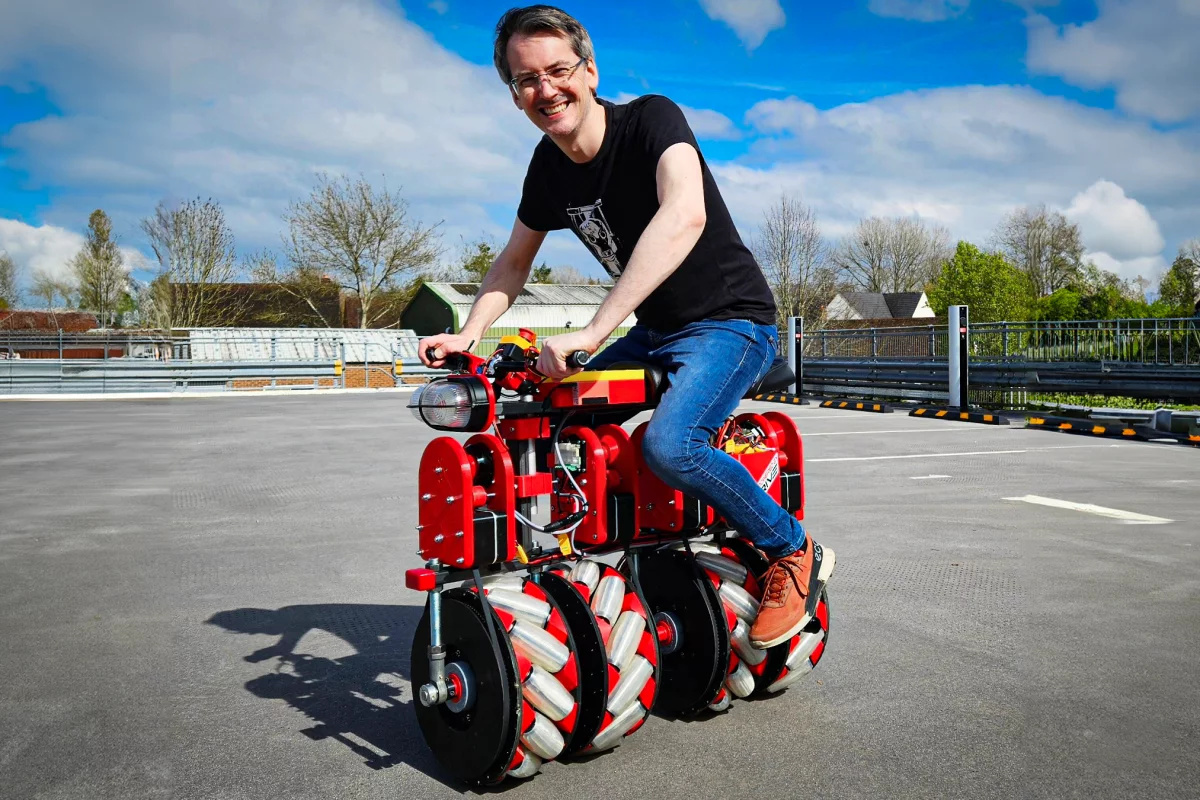


Homemade electric motorcycle with mecanum wheels moves in all directions without turning the handlebars and shows how garage engineering is reinventing mobility.
In 2024, British inventor and engineer James Bruton presented one of the most unusual creations in the maker universe in the UK: the Screw Bike, a self-balancing electric motorcycle capable of moving forwards, backwards, sideways, diagonally, and even rotating on its own axis using four in-line mecanum wheels. The project was detailed by the creator himself and reported by the New Atlas on April 22, 2024, which highlighted the use of 360 mm, or 14.2-inch wheels, with many 3D-printed components, as there was no ready-made solution of this size available for the experiment.
The innovation was also highlighted by RideApart on April 24, 2024, which described the Screw Bike as an omnidirectional electric motorcycle powered by four electric motors, timing belts, and opposing pairs of mecanum wheels, a technology more common in robots and industrial machines than in two-wheeled vehicles.
In practice, Bruton applied principles of robotics and balance control to create a motorcycle that doesn’t rely on conventional turns, doesn’t need to lean like a regular motorcycle, and shows how workshop-fabricated parts, open source, and experimental engineering can transform a laboratory concept into a real machine capable of riding in a parking lot.
-
Renault Kwid Outsider 2023: Affordable Used Hatchback with 1.0L Engine, 15.7 km/l Efficiency, and Ample Cargo Space for Around $11,000

-
Chevrolet SUV Offers 153 hp Engine, 620 km Range, and ADAS Features at a Lower Price Than a New Kwid

-
London buses run on biofuel made from coffee grounds, turning café waste into sustainable public transport fuel without engine modifications.

-
Major Automaker Considers Closing 4 Factories, Putting 45,000 Jobs at Risk Amid Chinese Competition in Brazil




How mecanum wheels allow lateral, diagonal, and 360-degree rotation without steering
The central element of the invention lies in the so-called mecanum wheels, a concept developed in the 1970s by Swedish engineer Bengt Ilon. Unlike conventional wheels, they have small rollers inclined around the rim, typically at 45-degree angles, allowing the force applied by the motor to be distributed in different directions.
In practice, this means that each wheel can contribute to movements that do not depend solely on the vehicle’s longitudinal axis. When combined in pairs with inverted orientation, these wheels can generate lateral, diagonal displacements, and even rotations on their own axis without the need to turn the handlebars or lean the vehicle’s body.

This principle, widely used in industrial robotics and automated platforms, has been transferred to a functional motorcycle, something extremely rare due to the difficulty of control and stability in two-wheeled vehicles. The adaptation requires not only differentiated mechanics but also an electronic control system capable of coordinating multiple movement vectors simultaneously.
Garage engineering applies advanced robotics concepts to a functional and controllable motorcycle
James Bruton’s project is not limited to the use of mecanum wheels. To make the motorcycle usable, it was necessary to develop a complete control system based on sensors and stabilization algorithms.
The motorcycle uses independent electric motors to control the movement of the wheels, in addition to an electronic system that continuously adjusts the rotation of each component. This type of control is similar to that used in autonomous robots and experimental research vehicles, where each movement needs to be calculated in real-time.


The central technical challenge lies in balance, as traditional motorcycles rely on leaning to maintain stability during movement. In the case of the Screw-Bike, the electronic system must constantly compensate for any deviation, adjusting the distribution of force between the wheels to prevent falls.
This type of solution involves inertial sensors, such as accelerometers and gyroscopes, which monitor the motorcycle’s position in space and send data to the control system. Based on this information, the embedded software performs micro-corrections in fractions of a second, allowing the vehicle to remain stable even when moving sideways.
Omnidirectional movement eliminates the need to turn the handlebars and changes the logic of driving
One of the most impressive features of the project is how it completely alters the logic of driving. In conventional vehicles, movement depends on the orientation of the front wheels. In the Screw-Bike, this relationship ceases to exist.
Movement is now controlled by commands that define vectorial direction, not steering angle. This allows the motorcycle to perform maneuvers such as:
- Pure lateral movement, without advancing or retreating
- Diagonal movement with precise trajectory control
- Rotation on its own axis without linear displacement
This behavior transforms the motorcycle into a hybrid platform between vehicle and robot, bringing it closer to systems used in automated logistics, industrial vehicles, and military urban mobility prototypes.
Project shows practical limits and technical challenges of omnidirectional mobility in light vehicles
Despite the innovation, the project also highlights important limitations. Mecanum wheels, due to their geometry, are not efficient for high speeds or uneven terrain. Contact with the ground is fragmented by the rollers, which reduces grip compared to traditional tires.

Furthermore, the control system requires high precision and continuous processing, which increases the complexity and cost of the project. In real environments, factors such as uneven ground, inclines, and obstacles can compromise vehicle stability.
Another critical point is energy efficiency. As part of the force applied by the motors is dissipated in non-useful directions during certain movements, consumption tends to be higher than in conventional vehicles.
These limitations indicate that, despite the conceptual advance, the technology is not yet ready for commercial application in traditional motorcycles, but it opens the way for specific uses in controlled environments.
Real-world applications of mecanum wheels show that the concept is already used in robotics and industry
Although James Bruton’s motorcycle is an experiment, the concept behind it is already widely used in other sectors. Platforms with mecanum wheels are common in industrial robots, automated logistics systems, and material handling equipment in enclosed environments.
Companies use this type of technology to move loads in warehouses, where the ability for lateral movement and precise positioning are essential. In robotics, omnidirectional vehicles are used in competitions, academic research, and the development of autonomous systems.

The difference is that, in these cases, vehicles operate in controlled environments and with four or more support points, which facilitates balance and control. Adapting it for a motorcycle, with only two main contact points, represents a significant leap in complexity.
Technology raises questions about the future of mobility and control engineering
The existence of a motorcycle capable of moving in any direction without turning the handlebars raises important questions about the future of mobility. Although still experimental, the concept suggests alternative paths for urban vehicles, especially in environments where extreme maneuverability is required.
Similar systems could be adapted for service vehicles, rescue equipment, or mobility platforms in confined spaces. However, challenges such as stability, efficiency, and cost still need to be overcome.
The project also highlights the advancement of control engineering as a central element in modern mobility, replacing purely mechanical solutions with intelligent systems capable of making real-time decisions.
Ultimately, the Screw-Bike is not just a technological curiosity, but a concrete example of how robotics concepts can cross borders and arrive in unexpected formats.
And you, do you believe that vehicles capable of moving in any direction can leave garages and hit the streets in the future, or should this technology remain restricted to experiments and industrial applications?