






 Portuguese
  Spanish


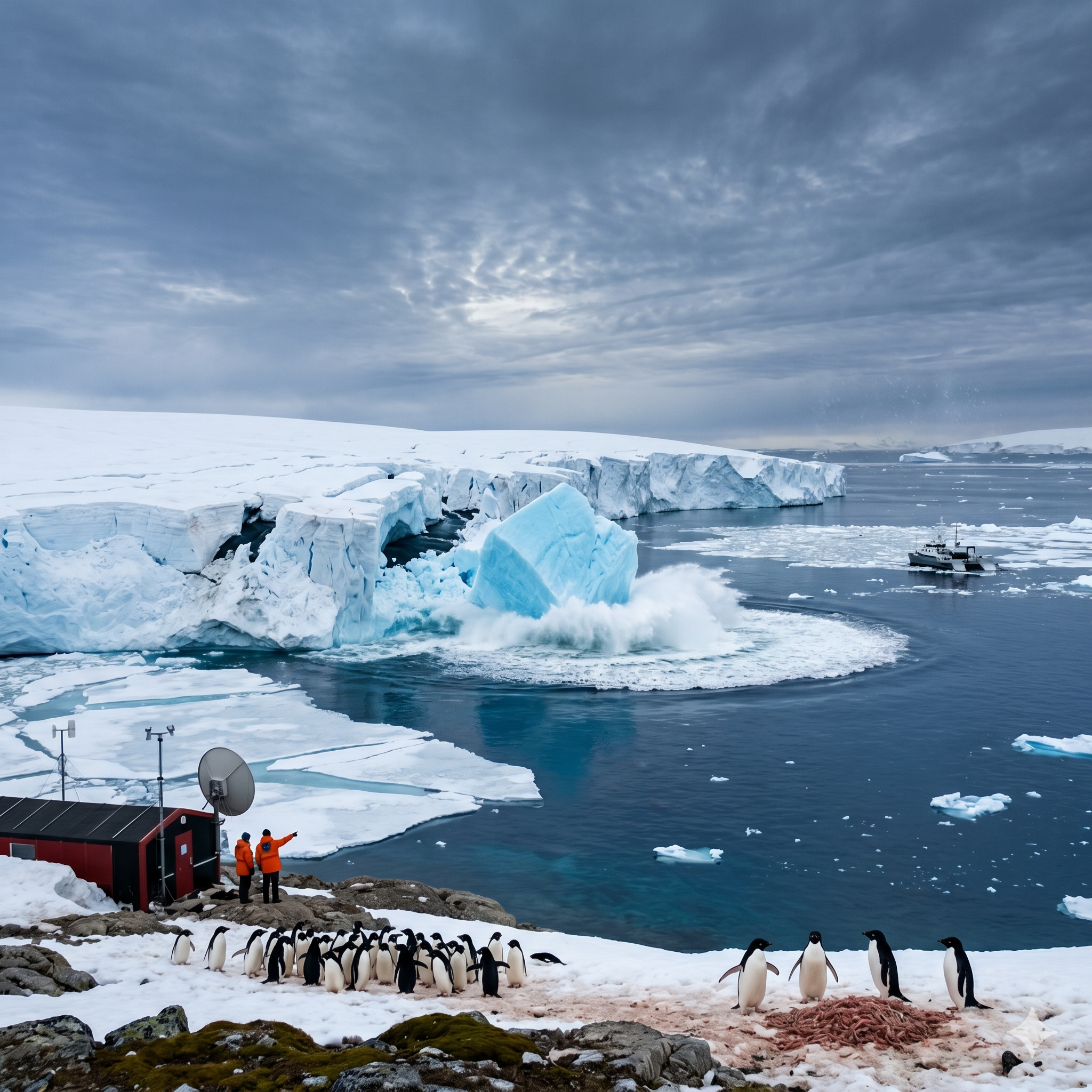

Study indicates Antarctica could warm 1.4x faster, impacting ice, oceans, and the planet’s ecosystems.
Published on December 22, 2025, in the scientific journal Geophysical Research Letters and reported on in March 2026, a study on Antarctica issued a large-scale climate warning: the continent could warm approximately 1.4 times faster than the Southern Hemisphere average under a 2 °C global warming scenario, with potential effects on ice, oceans, and polar ecosystems.
The research, authored by Zihuan Zhang, Sai Wang, Deliang Chen, Xichen Li, Tingfeng Dou, Cunde Xiao, Wen Chen, Dahe Qin, and Minghu Ding, used CMIP6 climate simulations and Polar Amplification Model Intercomparison Project experiments to investigate how the ocean-atmosphere system around the Antarctic continent might react in the coming decades. The result indicates that the so-called Antarctic amplification tends to emerge more clearly as warming progresses, driven primarily by the increase in sea surface temperature around the continent.
The finding corrects the historical perception that Antarctica would remain relatively isolated from global changes due to its oceanic and atmospheric circulation. According to the study, the warming of the oceans around the continent can intensify thermodynamic processes capable of raising the temperature over the continental mass, increasing risks associated with ice stability, sea level, and polar life in a region considered strategic for the planet’s climate balance.
-
Pennsylvania Mine Creates Ice in Summer Heat and Melts in Winter, Turning a Mountain Crevice into a Reverse Natural Refrigerator

-
China Accelerates Global Expansion of Robotics: From Smart Vacuums to Industrial and Humanoid Machines, Millions Exported to Over 150 Markets
-
Polar Air Mass to Hit Brazil: Temperatures to Plummet in Nine States, Near Freezing in the South with Frost Risk Until Monday
-
Chinese “dark factories” produce electric cars 24/7 with minimal human intervention, as Zeekr assembles 800 units daily, raising concerns in Brazil.





Ocean around the continent is the main driver of accelerated warming
One of the central points of the study is the role of the ocean in Antarctica’s climate dynamics. Unlike other regions of the planet, where warming is dominated by the atmosphere, in Antarctica the ocean plays a decisive role.


The research shows that the increase in water temperature around the continent can:
- Increase heat transfer to ice layers
- Accelerate the melting of ice shelves
- Alter ocean circulation patterns
This mechanism transforms the ocean into a direct vector of warming, amplifying the effects of the global climate on the continent.
Ice melt could intensify with direct impact on sea level
Accelerated warming has direct implications for Antarctic ice. As ocean waters warm, greater melting occurs at the base of ice shelves, structures that act as “barriers” to the flow of continental glaciers.
When these shelves weaken or collapse, ice from the continent’s interior can flow more rapidly into the ocean. This process can contribute to global sea level rise.
Loss of sea ice alters climate balance and affects ocean circulation
In addition to glaciers, sea ice is also at risk. The ice that forms on the ocean plays an important role in regulating temperature and reflecting solar radiation. With warming, the reduction in sea ice cover can:
- Increase heat absorption by the ocean
- Alter ocean circulation patterns
- Influence climate systems in other parts of the planet
The loss of this ice creates a feedback effect that can further intensify warming.
Polar ecosystems enter vulnerability zone with rapid changes
The study also highlights impacts on Antarctica’s ecosystems. The region is home to species highly adapted to specific temperature and ice conditions, such as krill, penguins, and seals.
Rapid environmental changes can affect:
- Food availability
- Breeding grounds
- Balance of food chains
These impacts can generate cascading effects that extend beyond the local environment and affect broader marine systems.
Polar warming can influence climate in other regions of the planet
Although Antarctica is geographically isolated, its climate changes have a global reach. Alterations in oceanic and atmospheric circulation can influence patterns of climate in other regions, including rainfall distribution, intensity of extreme events, and temperatures across different continents.

The Antarctic continent functions as a key piece in the global climate system. The study’s results reinforce the idea that polar regions may respond more sensitively to the increase in global temperature.
This phenomenon, known as polar amplification, is already observed in the Arctic and may also be occurring in Antarctica.
In the Antarctic case, the process is more complex due to the ocean’s influence, but the data indicate a similar trend. Greater sensitivity means that small global variations can generate more intense changes in the region.
Scenarios depend directly on the level of emissions in the coming decades
The intensity of projected warming varies according to greenhouse gas emission scenarios.
In high-emission scenarios, warming tends to be faster and impacts more severe. In mitigation scenarios, effects still occur, but with less intensity. This indicates that the future of Antarctica is directly linked to global decisions on emissions.
Given the projections, scientists emphasize the importance of continuous monitoring of Antarctica. This includes:
- Observation of ocean temperatures
- Measurement of ice thickness
- Monitoring of sea ice cover
These data are fundamental for understanding the evolution of the climate system and adjusting future projections. Monitoring allows identifying changes before their impacts become irreversible.
Given this scenario, what happens in Antarctica could redefine the global climate future?
The study indicates that Antarctica may cease to be a relatively stable system and become one of the planet’s most sensitive points to climate change.
With potentially faster warming, impacts on ice, and influence on oceans and atmosphere, the continent takes on a central role in the global climate future.
The question that arises is direct: if Antarctica begins to respond more intensely to warming, to what extent could this accelerate changes across the entire planet in the coming decades?







