Portuguese
  Spanish


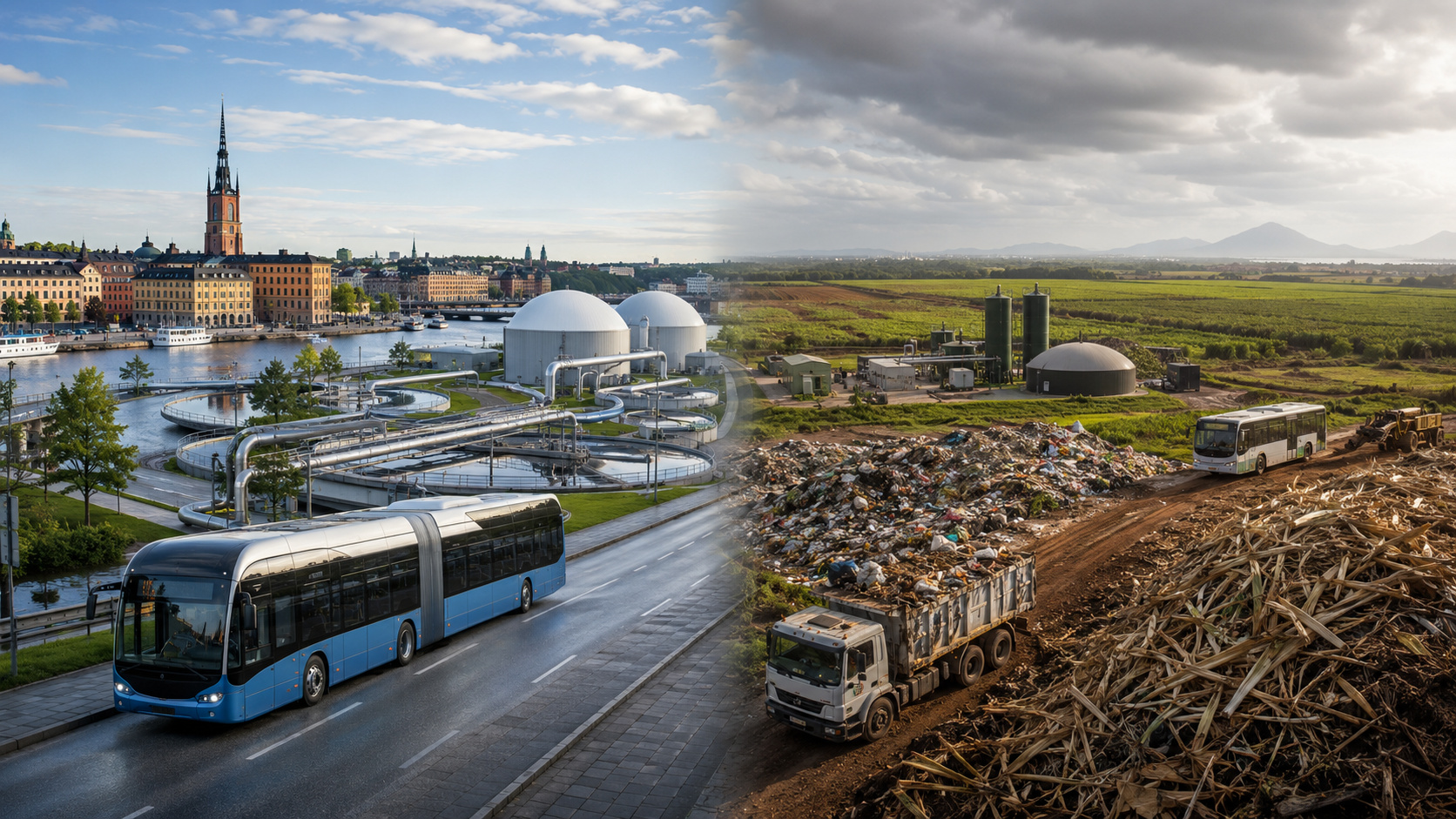

Stockholm uses sewage biogas in public transport, while Brazil has great potential for biomethane still underutilized.
Stockholm has become a world reference in sewage biogas by integrating treatment plants, biomethane production, and public transport. The Swedish capital uses urban waste to generate renewable fuel and reduce diesel use in buses. According to Futuropia, the region’s public bus transport achieved 100% fossil fuel-free operation, with biogas, biodiesel, and ethanol in the mix. Biogas represents about 15% of the bus matrix, with approximately 200 vehicles powered by the fuel.
The model gained prominence because it transforms an urban problem — sewage sludge — into renewable energy, clean fuel, and emission reduction. The European Commission cited the case as an example of a “circular energy cycle” with biogas produced in treatment plants.
Sewage biogas transforms urban waste into renewable fuel
Sewage biogas is born from anaerobic digestion, a process in which microorganisms decompose organic matter without oxygen. Inside treatment plants, sludge turns into gas rich in methane, which can generate electricity, heat, or biomethane.
-
Antarctic Sea Creature Yields Promising Compound Against Melanoma, Captivating U.S. Researchers

-
Underwater Guardian: The Autonomous Robot Monitoring Submarine Cables, Self-Returning, Wirelessly Charging, and Transmitting Data Without Onboard Crew

-
Robots Clean Solar Panels in Desert Power Plants Without Water, Preventing Energy Losses
-
AI Radar Built with Old Camera and $20 Gains Attention After Alleged $317,000 Sale to Chinese Government, But Lack of Documentation and Official Confirmation Raises Questions



When purified, this biogas can reach a quality similar to natural gas. In Stockholm, the upgrading capacity at Henriksdal reached 20 million normal cubic meters per year, with biomethane of approximately 97% methane.
The advantage is twofold: the city reduces emissions and utilizes a waste that already needs to be treated. Instead of releasing or burning methane without energy use, sanitation starts to function as an invisible urban power plant.
Stockholm buses show how biomethane can replace diesel
Stockholm’s progress did not rely solely on biogas but on the combination of biomethane, biodiesel, and ethanol. Futuropia points out that biodiesel accounted for 64% of the mix, while biogas took 15% and ethanol 21%.


The differential lies in the integration between sanitation and public transport. The city created a stable demand for biomethane, allowing investment in purification, distribution, and bus refueling.
This design is essential for the biogas and biomethane market. Without a guaranteed buyer, purification projects become riskier because they require infrastructure, long-term contracts, and operational scale.
Brazil has biogas potential but still uses little of this source
Brazil has the climate, agro-industry, urban sanitation, and organic waste on a sufficient scale to form one of the largest biogas chains in the world. Even so, energy utilization is still far from the national technical potential.

The base text cites a study published in 2026 in the journal Fermentation estimating Brazilian potential of 80 to 85 billion normal cubic meters per year. I cannot confirm this specific study with certainty in the open sources consulted, so the data should be used with caution.
What is confirmed is that the Brazilian sector is growing. The 2024 Biogas Panorama, from CIBiogás/ABiogás, mapped over 1,600 plants in the country and noted an increase in the volume produced.
Biomethane in Brazil gains strength with the Future Fuel Law
The Future Fuel Law, enacted in 2024, created the National Program for Decarbonization of the Producer and Importer of Natural Gas and Incentive to Biomethane. The initial emissions reduction target starts in January 2026.
EPE explains that the target for the natural gas market starts at 1% in 2026 and cannot exceed 10%. In practice, this creates regulated demand for biomethane and can help unlock new projects.
ANP also advanced in regulation in 2026, with rules for certification of biomethane origin, certifying agents, backing, and issuance of CGOB. This point is crucial for providing traceability to the renewable fuel.
Basic sanitation limits the expansion of sewage biogas in Brazil
The biggest bottleneck in Brazil is sanitation. According to IBGE, 62.5% of the population lived in households connected to the sewage collection network in 2022, while 75.7% had a collection network or septic tank.

This means that a significant portion of urban waste still does not reach stations capable of generating sewage biogas. Without collection, treatment, and digesters, the energy potential remains dispersed and difficult to convert into fuel.
There are also challenges of cost, scale, and infrastructure. Purifying biogas to biomethane requires technology, quality control, connection to a gas network, or compression logistics for vehicular use.
Biogas is firm energy and complements solar, wind, and hydroelectric power
Sewage biogas has a strategic advantage: it can be produced continuously. Unlike solar and wind energy, it does not directly depend on sun or wind to generate energy.
This characteristic makes biogas useful for complementing the Brazilian electricity matrix, especially during drought periods or increased pressure on hydroelectric plants. It can also reduce the energy consumption of the treatment plants themselves.
The difference is that biogas does not require creating the waste: it already exists in sewage, agro-industry, landfills, and livestock. The challenge is to capture, treat, purify, and transform this material into electricity, heat, or biomethane.
Stockholm shows the path that Brazil still needs to scale
The case of Stockholm shows that biogas, sanitation, and public transport can function as an integrated chain. The city transformed sewage into fuel and used long-term contracts to provide investment security.

In Brazil, the Future Fuel Law and biomethane regulation create a window to replicate part of this logic on a national scale. The country has waste, an energy market, and a demand for decarbonization.
The difference is that Stockholm built this chain over decades. Brazil still needs to expand sanitation, reduce purification costs, create stable contracts, and transform technical potential into real production of biogas and biomethane.