Portuguese
  Spanish





At 23 Years Old, A Licensed Electrician From The United States Interrupted His College Path During The Pandemic, Entered A Technical Career, And Started His Own Business, Which Quickly Began To Record Annual Revenue In The Six-Digit Range.
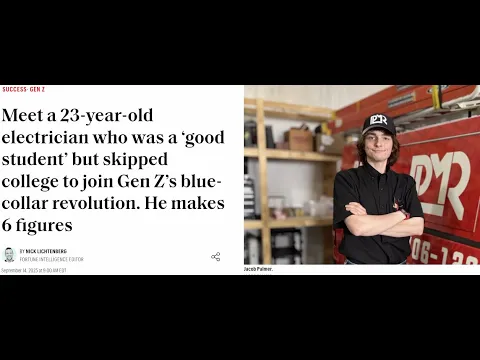
At 23 years old, Jacob Palmer, a licensed electrician and resident of Concord, North Carolina, interrupted his college course during the remote learning phase adopted during the pandemic and later opened his own business in the electrical sector.
Active since 2024, the business has begun to register annual revenue in the six-digit range in dollars, according to information declared by the entrepreneur in interviews with the U.S. press.
Before the change in direction, Palmer was following a common path among students in his area.
-
Workers renovating a playground in northern England uncover 176 World War II bombs buried underground; training artifacts still contained explosives.

-
Brazilian Architect Transforms Waste into Sustainable Homes with Solar Power and Rainwater Systems for 40 Years

-
Security Guard Becomes Doctor at Louisiana Hospital Where He Once Worked, Studied Chemistry Between Shifts

-
Woman Rescued from Luxury Complex in Brazil Worked Without Pay for 55 Years, May Be Entitled to Over $300,000




He participated in school activities, took on leadership roles, and planned to complete his higher education.
“I was a good student,” he said in an interview with Fortune, describing the period before the changes imposed by the pandemic.
With the adoption of remote classes, his relationship with the university changed.
According to Palmer, the distance format made it difficult for him to adapt to the higher education system.
In a report to Fortune, he stated that he quickly realized that this model did not meet his academic expectations, which led him to reconsider his continued enrollment in the course.
The Moment College Ceased to Be a Priority
After leaving college, Palmer did not immediately start a technical career.
He sought experiences in the job market and went through different roles.
He worked at a FedEx distribution center and later worked at a factory located in a rural area of Virginia, where his grandparents lived, as reported in interviews.
His interest in the electrical field emerged in a routine situation, during a job performed at his family’s home.
The professional hired for the installation explained details of the work and talked about the profession’s routine.
The conversation led Palmer to seek more information about the sector and the formal requirements to work in the field.
According to the electrician himself, the structure based on certifications and licenses was one of the determining factors in his choice.
He also mentioned that he had prior contact with basic electricity concepts acquired in high school, which contributed to his decision to enter as an apprentice.
Technical Training and The Requirements of The Electrical Trade
The beginning of his professional journey was marked by operational activities and limited initial pay.
Palmer reported to Fortune that he started earning around US$ 15 an hour while accumulating the practical hours required to apply for the state license exam.

During this period, he performed tasks considered basic within the routine of an electrical company.
In interviews, he stated that he spent years working in support roles, under supervision, before taking on more complex tasks.
Career advancement depended on both practical experience and performance in mandatory technical evaluations.
The professional license was obtained in January 2024.
Subsequently, Palmer registered Palmer Electrical and began to work independently, primarily addressing residential demands and small contracts.
At the start of operations, according to him, the company operated with a reduced structure, limited to the electrician himself.
Revenue, Autonomy, and Routine as An Independent Professional
The first services came from people close to him and residents in the area where he lives.
Over time, new referrals expanded his client base.
Palmer stated that, in this work model, income is directly linked to the volume of services performed.
“If I stop, the checks will go to zero,” he said, describing the dynamics of working for himself.
A survey presented by Fortune, based on earnings documents analyzed by the report, indicates that the company earned nearly US$ 90,000 in 2024.
The following year, the amount would have reached approximately US$ 175,000.
Palmer declared that he aims to reach US$ 250,000 annually by 2026, maintaining individual operations in the short term.
When commenting on his financial situation, he mentioned that he does not have student debt, unlike some of his peers who continued in higher education.
The comparison was made in interviews and reflects a personal assessment, without generalizations about the outcomes of each professional choice.
Young People, Technical Education, and Changes in The Job Market
According to experts consulted by Fortune, trajectories like Palmer’s are part of a broader movement among Generation Z youth.
Data from the National Center for Education Statistics indicates a 15% drop in enrollment in undergraduate courses between 2010 and 2021, with a significant portion of this reduction concentrated during the pandemic period.
Analysts cited by the magazine point out that factors such as the high cost of universities and uncertainty regarding the financial return of a diploma have contributed to increased interest in technical careers.
In this context, programs based on certifications and licenses have come to be seen as viable alternatives by students.
Educator Marlo Loria, who works in technical education programs at public schools in Arizona, told Fortune that many young people have begun to broaden the concept of professional education.
According to her, there is a growing understanding that different educational paths can lead to job market insertion, depending on the chosen sector.
Digital Presence and Perspectives for Continuity
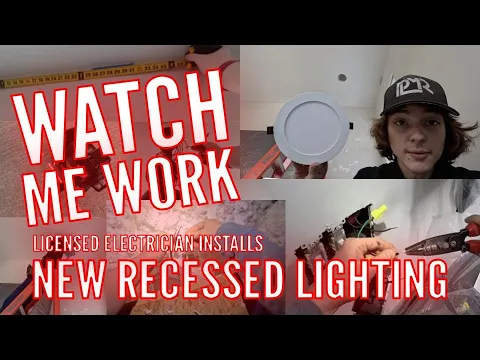
In addition to working as an electrician, Palmer stated that he intends to invest in digital content production.
The plan involves publishing videos about the routine of the work and seeking monetization through advertisements, a strategy already adopted by other professionals in technical fields, as reported in interviews.
He told the press that the initiative aims to diversify income and increase the visibility of the services provided, without abandoning the main activity.
In reflecting on his own journey, he compared the expectations he had in high school with the current reality of managing his own business at a young age.