






 Portuguese
  Spanish


Robotic system uses artificial intelligence to help archaeologists reassemble fragmented frescoes of Pompeii, in a European project that combines computer vision, mechanical arms, and analysis of patterns preserved in ancient pieces.
A two-armed robotic system, guided by artificial intelligence, was developed to assist archaeologists in the reassembly of Roman frescoes from Pompeii preserved in thousands of fragments.
The technology combines computer vision, reconstruction algorithms, and sensitive robotic hands to handle ancient pieces without compromising fragile surfaces.
The project was named RePAIR, an acronym for “Reconstructing the Past: Artificial Intelligence and Robotics Meet Cultural Heritage”.
-
New Law in Brazil Requires Breaks for Type 1 Diabetes Management at Work, School, and Public Exams

-
Scientists Confirm “Greening” of Antarctica: Ice on the World’s Coldest Continent Turns Green as Mosses Multiply Over Tenfold in Four Decades

-
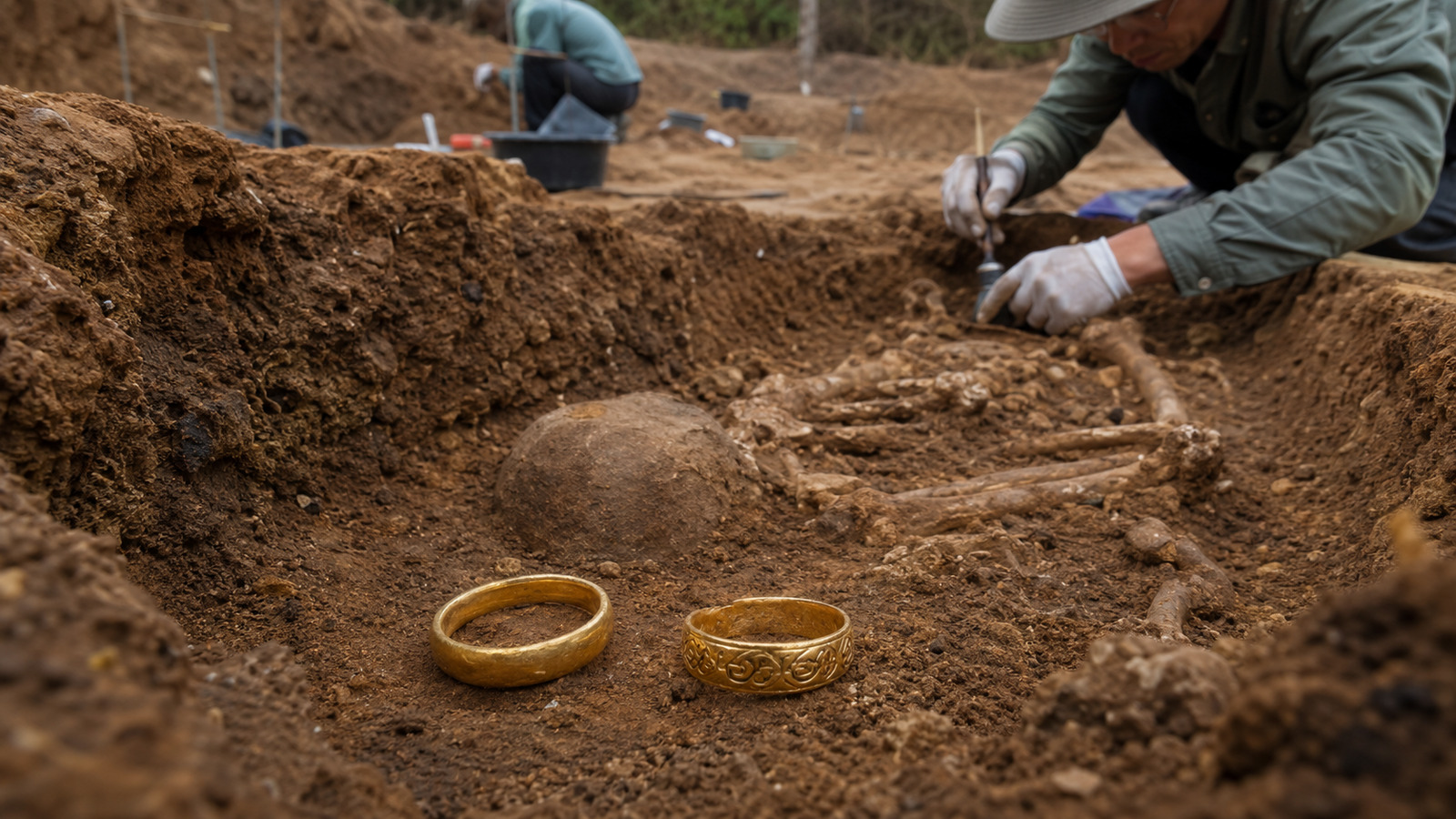
2,000-Year-Old Gold Rings Found with Human Bones in Thailand Reveal Rare Burial and Feature Ancient Indian Inscription

-
Lenovo Unveils Legion Y700 Tablet with RGB Backlighting, 5G, and SIM Card Support



Coordinated by the Ca’ Foscari University of Venice and funded by the European Union, the initiative began on September 1, 2021, and concluded on October 31, 2025, according to data from the European Commission.
The public demonstration took place at the Archaeological Park of Pompeii, in Italy, on November 27, 2025.
The system was presented as a result of international research focused on a specific stage of archaeological conservation: identifying, comparing, and reassembling fragments of ancient works without a complete reference image.
According to researchers involved in the project, the challenge is similar to assembling several mixed puzzles, with missing pieces and damaged parts.
In this context, artificial intelligence is used to search for relationships between colors, patterns, shapes, and textures that may indicate possible fits.
How the two-armed robot used in Pompeii works
The robot operates with two mechanical arms, flexible hands, and vision sensors.
Before physical assembly, the fragments are scanned into high-resolution images and three-dimensional models, allowing automated analysis of visual and geometric characteristics.
From these records, the algorithms calculate possible combinations between the pieces.
Then, the robotic platform receives the suggested positions and manipulates the fragments according to the hypotheses evaluated by the system.
Archaeologists and restorers monitor the process to validate the proposed associations, correct any errors, and decide which fits make sense from a historical and material perspective.
The Ca’ Foscari University informs that the prototype was designed to work in cooperation with human experts, without replacing the technical decision of heritage professionals.
This distinction avoids assigning the machine a role that the sources do not confirm.
The AI participates in large-scale screening and visual analysis, while archaeological interpretation still relies on specialized knowledge, field documentation, and conservative evaluation.
The director of the Pompeii Archaeological Park, Gabriel Zuchtriegel, told Reuters that the project was born out of a concrete need: to reassemble fresco fragments destroyed during World War II.
In a publication by Ca’ Foscari, he also stated that no technology replaces human work, although it can offer support when dealing with large amounts of data.
Pompeii frescoes affected by eruption, war, and collapse
The tests focused on frescoes kept in deposits of the Pompeii Archaeological Park.
Among the studied sets are ceiling paintings from the House of the Painters at Work, in the Insula of the Chaste Lovers, damaged by the eruption of Vesuvius in 79 AD and later fragmented by bombings during World War II.
Another group analyzed came from the Schola Armaturarum, a building also known in some descriptions as the House of the Gladiators.
The construction collapsed in 2010, and part of the frescoes remained in a fragmentary state after the incident.
The selection of these materials is linked to the technical objective of RePAIR.
The project aimed to test the system on real sets of archaeological fragments, with worn, incomplete, irregular pieces separated from their original context.
Pompeii is located near Naples, in southern Italy, and was buried by volcanic ash after the eruption of Vesuvius.
The burial preserved buildings, objects, and paintings for centuries, but many materials have reached the present broken, worn, or stored in parts.
When damage from different periods overlaps, recomposition becomes more complex.
In the case of some of the studied frescoes, the paintings were first affected by a natural disaster in antiquity and, centuries later, by bombings during the war.
To reduce risks during the initial phase, researchers worked with replicas of the fragments.
This measure allowed them to calibrate the robot, test movements, and assess the system’s accuracy without exposing the original pieces to experimental handling.
The use of replicas is also important because archaeological restoration involves irreplaceable materials.
An incorrect fit, a poorly calculated pressure, or inadequate movement can damage pigments, edges, and preserved surfaces.
Artificial intelligence analyzes colors, patterns, and ancient fragments
Marcello Pelillo, professor of artificial intelligence at Ca’ Foscari University and project coordinator, compared the task to buying four or five boxes of puzzles, mixing everything, discarding the boxes, and trying to solve them all at once.
He used the comparison to explain the technical difficulty of recomposition.
Researchers do not work with a ready final image, but with different sets of works, worn surfaces, missing fragments, and patterns that may repeat.
Unlike a common puzzle, archaeological pieces have irregular shapes, corroded edges, and incomplete visual signs.
Often, the physical outline is not enough to indicate the correct position of each fragment.
Therefore, algorithms analyze elements such as pigments, line continuity, painting traces, decorative patterns, and spatial relationships.
This data helps reduce the number of possible combinations before validation by specialists.
The scientific basis of RePAIR also resulted in the creation of a dataset aimed at real problems of 2D and 3D reassembly.
According to an academic article associated with the project, the material gathers fragments with varied dimensions, missing pieces, erosion, and fractures linked to the collapse of a fresco during World War II bombing at the Pompeii Archaeological Park.
Researchers state that this type of database allows testing computational methods in conditions closer to archaeological reality.
Instead of artificial and regular scenarios, the system deals with damage, gaps, and irregularities present in materials preserved in deposits.
Technology can support cultural heritage restoration
The European Commission describes the physical reconstruction of broken works as one of the most labor-intensive stages in archaeological research.
RePAIR was created to facilitate this process through the integration of artificial intelligence, robotics, and cultural heritage conservation.
According to the official project description, the proposal is to support the recomposition of fragmented artifacts, such as vases, amphoras, and frescoes.
The technology seeks to accelerate comparison and assembly tasks that, in large sets, may require long periods of manual work.
Reuters reported that researchers associated with the project see potential for the application of the technology in restoration practices outside Pompeii.
The evaluation, however, appears attributed to the specialists and not as an independent conclusion about the system’s reach.
Museums, archaeological sites, and research centers maintain collections with broken objects that have not been fully reassembled.
In many cases, the volume of fragments complicates manual sorting and limits the possibility of testing all viable combinations.
Even with the results presented, the institutions involved treat the system as a research prototype.
Ca’ Foscari reported that the project demonstrated the feasibility of an integrated approach between robotics and artificial intelligence but pointed out the need to improve algorithms and safely define which steps can be automated.
This limitation also appears in the way the technology was tested.
Until the demonstration described by the consulted sources, the initial phase used replicas, and there is no secure confirmation that the original fragments are already being physically reassembled by the robot in a definitive restoration routine.
Human participation remains planned in all decisive stages.
It is up to the specialists to assess whether a combination proposed by the system makes sense given the painting technique, the state of the material, the archaeological context, and the available historical information.
The case of Pompeii shows a specific application of artificial intelligence in cultural heritage: organizing large volumes of fragments, suggesting fits, and allowing restorers to focus the analysis on more probable hypotheses.


