






 Portuguese
  Spanish


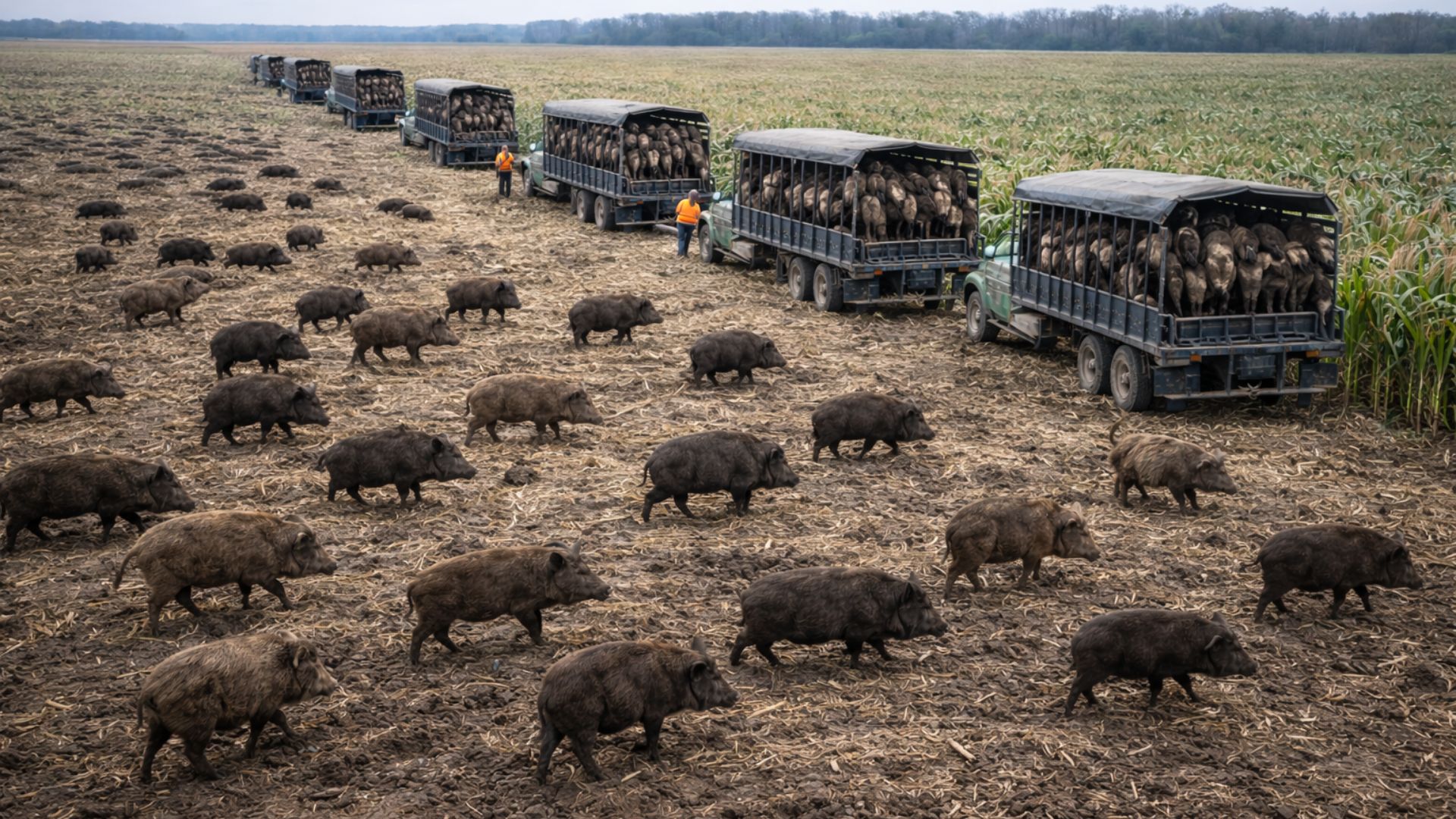


Coordinated Strategies, Technology, and Continuous Pressure Have Changed the Way Texas Faces Wild Hogs, a Plague That Causes Agricultural Losses, Invades Urban Areas, and Challenges Producers for Decades, Forcing the State to Combine Smart Traps, Aerial Management, and Chemical Control Under Strict Rules.
Texas is trying to contain the expansion of wild hogs through technology and coordinated operations, after years of accumulated losses in crops, pastures, and urban areas.
According to estimates used by local agencies and institutions, the population has already reached millions, with impacts that include direct agricultural losses, increased control costs, and recurring damage to property.
The presence of these animals is not recent in the southern United States.
-
Billionaire says the most valuable skill will help overcome job elimination caused by AI, following Bill Gates’ fears

-
A Dutchman created a ‘box’ that makes trees grow in the desert almost without water and without irrigation: the invention has already brought seedlings to dozens of countries and achieves up to 90% survival where common planting did not exceed 10%.

-
Abandoned warehouse hid a giant collection of rare computers, with over 2,000 artifacts from the 1930s to the 1980s.
-
Scientists warn that melting ice is triggering an alarming chemical transformation in preserved areas, and the first signs are already concerning researchers worldwide.




However, in Texas, the problem has scaled up due to a combination of factors, such as favorable climate, abundance of water, large areas of cover, and a high reproductive capacity, as pointed out by researchers.
In light of this scenario, the state has begun to adopt strategies that integrate connected traps, aerial management, and chemical control under stricter regulations.
Origin of Wild Hogs and Expansion in the Southern U.S.
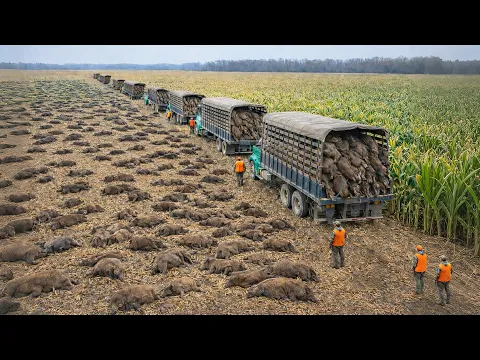

Wild hogs are not native to North America, although they are now widely distributed.
Over centuries, pigs brought by explorers and settlers were released or escaped during movements and territorial occupations.
In later phases, there were also crossbreeding with European wild boars introduced for sport hunting.
From this process, highly adaptable feral populations emerged, capable of surviving in different environments and rapidly exploiting new food sources.
With the advancement of farming and the transition between rural and suburban areas, the animals began to circulate easily between vegetation cover and agricultural fields.
Besides consuming crops, their digging habits exacerbate the damage by compromising fences, ponds, internal roads, and soil stability.
Economic Impact on Farms and Cities
In agricultural areas, producers report concentrated losses primarily in corn, although soybeans and wheat are also affected.
There are records of entire crops being degraded in a matter of hours, requiring replanting and new investments.
Farmer Jay Norman reported seeing dozens of animals unearthing freshly planted seeds in his field in Fannin County.
According to him, such episodes have changed production routines and significantly increased fuel and labor costs.
At the state level, estimates reproduced by environmental authorities indicate annual agricultural losses around US$ 118.8 million.
When infrastructure damage, pastures, gardens, and control costs are included, broader surveys indicate losses that reach hundreds of millions of dollars.
Over time, the problem has ceased to be restricted to the countryside.
Cities have begun to report frequent occurrences in parks and residential neighborhoods.
In Irving, in the Dallas–Fort Worth metropolitan area, wild hogs circulated in areas close to parks and residences, leading to the adoption of specific control actions.
Why Isolated Actions Did Not Work
For years, the confrontation occurred in a fragmented manner.
Each farm set up traps on its own, while owners resorted to spot hunting as an immediate response.
In practice, this model showed clear limitations.
The sounders simply migrated to areas with less pressure and returned when surveillance diminished.
Another obstacle was the animals’ adaptive behavior.
Wild hogs quickly learn to avoid traps, change their movement times, and adjust to changes in their environment.
As a result, spot actions reduced damage for a short period but did not keep pace with the rapid population growth.
Smart Traps and Scale Capture
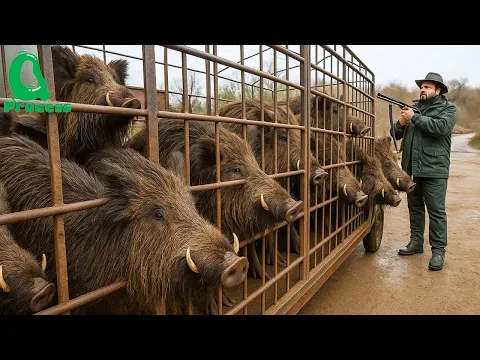
The introduction of traps equipped with cameras and connectivity changed the logic of capture.
With real-time monitoring, operators can wait until the entire sounder is inside the corral before triggering the closure.
This strategy reduces the chance of survivors alerting the group and compromising future operations.
Despite the initial cost, these systems also require an adaptation period.
For days or weeks, the animals get used to gradual access to food, until their trust is established.
Producers report that the main gain is not just in technology but in the precision of the capture moment, which reduces recurring losses.
Helicopters and Quick Pressure on Large Areas
In extensive regions, aerial hunting has become a complementary tool.
Helicopters can cover thousands of hectares in just a few hours, something unfeasible for ground teams.
In this model, the high mobility of wild hogs becomes a vulnerability.
Pilots and teams identify resting areas, movement routes, and crossings inaccessible by land.
The method works as a shock attack, aimed at rapidly reducing pressure in critical areas.
Experts emphasize, however, that effectiveness depends on integration with traps and constant monitoring.
Chemical Control with Strict Rules
Meanwhile, Texas has advanced in the controlled use of chemical methods.
Among the options adopted is the application of formulations with warfarin in feeding systems specifically designed for wild hogs.
These devices require strength and behavior characteristics of the species, which limits access for non-target animals.
Authorities emphasize that the success of the method depends on well-defined protocols, training, and continuous supervision.
The debate about environmental impact and animal welfare remains active.
Still, proponents of the strategy acknowledge that chemical control only shows consistent results when integrated with other actions.
Regional Coordination as a Turning Point
The main change pointed out by technicians and producers was the coordination between properties and counties.
Programs began to synchronize traps, hunting, and surveillance across large areas.
As a result, the refuge zones used by sounders to escape pressure were reduced.
Studies indicate it would be necessary to remove between 60% and 70% of the population each year just to maintain stable numbers.
Historically, this level has rarely been reached continuously.
Since the implementation of regional campaigns, some areas have begun to report reduced damage and lower presence in critical points.
Nonetheless, the challenge remains sustaining pressure for long enough and increasing adherence to the model.
If the state needs to eliminate such a large portion of the animals just to prevent population growth, what still needs to change to turn this fight into a lasting result?





Absurdo isso… Eles ainda acham que estão certo eles invade o território dos bichos criando fazendas e ainda acha que eles que manda no espaço que é deles… O mundo tá perdido mesmo e tem muita gente apoiando esse tipo de crime ambiental… Bando de ignorante logo logo virá as consequências.
Acho que você fez esse comentário, sem entender que essa espécie foi introduzida , dizimando espécies locais, e alterando o ciclo de animais, prejudicando a produção de alimentos, etc….
Exatamente! Sempre tem o pessoal do mi mi mi pra falar pelos cotovelos
Apaga que ainda dá tempo.
Mais um **** passando vergonha na Internet.
Mais um P T ista, Es-quer-da passando vergonha na Internet
Até agora não entendi qual é a desse site. Nenhuma das belas reportagens que ele pública pode ser confirmada. As fotos sao sempre produzidas por IA. Parece uma tentativa de escrever sobre possíveis boas iniciativas que ainda não foram realizadas. Gostaria de ter uma resposta dos senhores. Obrigada.
Se já existem um Trump para matar estrangeiros, logo, javalis e estrangeiros. Isto é a era Trump sem direitos humanos e animais.
Pelo menos gastou poucas palavras para dizer muita ****.
Kkkkk se fosse no Brasil pelo menos teríamos javali a vontade, já que não temos picanha 🤣
Aqui o problema já existe e é muito pior pois não temos autorização para abater os javalis pois o Ibama não proibe
Correção – O Ibama proibe
Vem pra o mato grosso que vc vai ver porcos selvagem a vontade que também causa danos e prejuízo nas lavouras