






 Portuguese
  Spanish


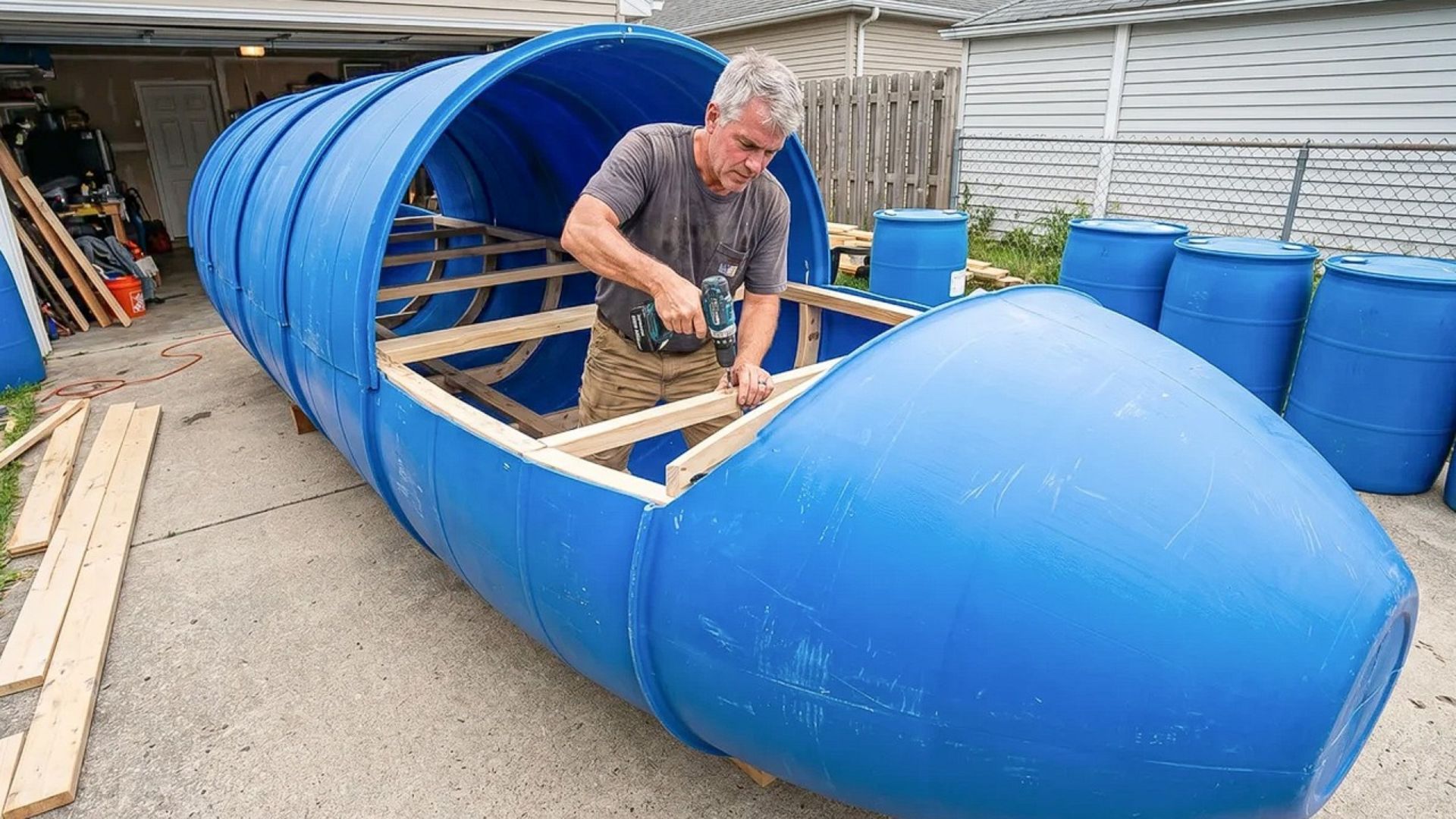


Araújo, from the araujocaiaque channel, showed in a step-by-step video how he cut, sanded, heated, and screwed drum panels onto a wooden structure until he assembled a vessel capable of carrying three people and accommodating a 5-horsepower Mercury outboard motor, in a curious and inexpensive example of recycling.
The image is improbable, but it works. Instead of discarding eight plastic drums, Brazilian builder Araújo, from the araujocaiaque channel on YouTube, transformed this material into a full-sized boat, capable of carrying three people, accommodating an outboard motor, and cutting through the water with surprising stability.
The process, recorded in video from start to finish, shows that what appears to be improvisation is, in fact, sharp technique. Araújo had been perfecting this boat building method with drums for years and helped popularize the format in Brazil, now documented in one of his most ambitious assemblies.
How the transformation of drums into a hull begins


It all starts on the workshop floor. The eight plastic drums are opened one by one, and the first step is to flatten their curved surfaces, transforming each into useful panels for the future structure.
-
28-meter, 156-ton titans traveled 20,000 km from China to the port of Santa Catarina: Portonave received 7 fully electric megacranes, part of a R$ 210 million package, to double container handling.

-
They exchanged the idea of a large house for a 35 m² warehouse, spent US$ 12,000 on the structure, and created a tiny house in Colorado with space to live and work.

-
A newly opened terminal in the middle of the Amazon has begun transporting soy and corn through Amapá, eyeing the queue of ships that is congesting the ports in the South.

-
Goodbye to old tiles: renovation technique without construction transforms bathrooms in a few hours, eliminates debris, and reduces costs with coverings using special paints, high-resistance adhesives, and modern finishes that completely renew the space.


To make an accurate cut, Araújo uses a tube passed through the drum as a guide, tracing a clean diagonal before grabbing the saw. The circular saw then cuts the thick plastic following the marking, splitting each piece into two symmetrical halves.
As this type of cut throws shards everywhere, safety becomes an obligatory rule. He wears a full face shield throughout the stage, an attitude that is often ignored in DIY videos and that makes all the difference here.
Each resulting panel becomes the raw material for the future boat’s outer shell. The secret lies in ensuring that the cut is uniform, because any excessive twisting of the plastic can compromise the fit of the pieces later, when assembling the structure.
The wooden structure that shapes the boat
With the panels ready, attention turns to the skeleton. Wooden ribs are cut, organized, and fixed in the correct sequence, forming the structure that will give volume and resistance to the hull.
The intelligence of the project appears in a small and very Brazilian detail. The supports that hold these ribs are cut from the plastic drums themselves, meaning none of the original material goes to waste during construction.
Before receiving the outer panels, the edges of the ribs must be absolutely smooth. Any irregular point turns into a stress zone, a weak point, or a potential focus for leakage after the boat enters the water.
Therefore, Araújo spends hours with an angle grinder leveling each edge. It’s a slow and repetitive job, but it is precisely this stage that separates a hull that lasts for years from one that sinks on the first more lively outing.
Bicycle inner tube as a sealing secret

Here enters one of the project’s most unexpected tricks. Before nailing the panels onto the structure, the builder stretches a bicycle inner tube along the outer edges of the ribs and fastens the material with nails.
The function is twofold and quite ingenious. The rubber creates a flexible layer between the wood and the plastic, acting as both a shock absorber and a seal against leaks at the same time, without increasing the project cost.
This type of solution is typical of those who develop techniques outside industrial manuals. Replacing expensive seals with something recovered from a bicycle shop shows how practical knowledge often achieves efficient results with trivial items.
From there, the hull truly begins to take shape. The flat panels from the drums are nailed onto the ribs, overlapping with small, calculated gaps, precisely so that each subsequent layer fits without forcing.
Heat, patience, and the difficult curve of the bow
The most complicated part of the construction is the bow. It’s there that the rigid plastic needs to be bent to follow a structure of smaller ribs, forming the front tip that cuts through the water.
Each front panel is manually bent, adjusted, checked, and rechecked before receiving any definitive nails. A wrong angle at this stage can compromise all subsequent navigation of the boat, so haste is left out of the plan.
To overcome the natural resistance of the plastic, Araújo uses a hot air gun. The heat softens the material enough for it to mold to the structure instead of fighting against it, a technique that only works with practice and a steady hand.
After shaping, naval nails are driven into the wood from underneath, locking the panel into the desired shape. Stubborn edges that still insist on lifting are heated again and pressed until the front part of the hull is completely smooth and continuous.
Stern, gunwale, and the reinforcement of the breast hook
With the bow ready, the focus shifts to the back. The stern is closed with a wide sheet of plastic that covers the rear ribs, receives the same air chamber treatment for sealing, and is nailed with extra care.
This region has direct responsibility for the final performance. The stern not only closes the hull, it also defines direction, balance, and supports the engine, so any misalignment here translates into navigation problems later.
With the hull closed, the boat is turned upside down to receive the gunwale, the upper outer edge that runs along the entire vessel. Long strips of wood are positioned, secured with clamps, and nailed in due course.
Another decisive structural detail is the breast hook, a V-shaped piece installed in the bow, where the two gunwales meet. Without this piece, the hull could open under wave pressure, which would compromise the entire integrity of the project.
Varnish, seats, and the moment of water
With everything in place, the final construction stage focuses on wood protection. The builder applies several layers of marine-grade varnish, formulated to resist water, sun, and prolonged exposure to the elements.
The use of a foam roller ensures thin and uniform layers, applied more quickly than traditional brushstrokes. The satin finish is smooth, with robust protection against the main enemies of any outdoor wooden structure.
While the varnish dries in the sun, Araújo finishes the seats. Drum lids cut in half are fixed to wooden supports with nails, creating three uniform benches to accommodate the boat’s passengers.
Then comes the most anticipated test of the entire endeavor. The vessel is carefully placed in the water and floats immediately, without tilting to either side, without any sign of sinking, and without water entering through the joints.
The 5-horsepower Mercury and the family trip
Stable flotation would, by itself, be a technical victory. Even so, the project is only complete when it receives the mechanical heart that will transform it into real transport for future outings on the water.
Araújo installs a 5-horsepower Mercury outboard motor, considered light, affordable, and suitable for boats of this size. As soon as the engine is started, the vessel cuts through the water with surprising speed for a hull assembled from recycled drums.
The real test of approval comes when the builder takes his family aboard. Seeing the boat carrying people and moving steadily across the lake confirms that all the improvised engineering delivered exactly what it promised from the start.
The result is a practical demonstration of how creativity, patience, and manual skill can become raw material of immense value. With items that would go straight to disposal, the araujocaiaque channel shows a real path for recycling applied in informal Brazilian naval construction.
And you, would you embark on a trip inside a boat assembled from eight old plastic drums? Do you think this type of artisanal construction could yield significant savings for fishermen and riverside dwellers?
Tell us in the comments if you’ve seen a similar project in your region, if you would trust a recycled vessel for family outings, and what discarded material from your home could become the basis for a construction as creative as this. The discussion helps to value the work of those who do a lot with a little.








Brilliant work and skills that most people will envy. Very impressive design and process to bring it to a fabulous result . A boat made from recycled materials that performs so well !