






 Portuguese
  Spanish


Funerary complex found in Sirolo, on the Italian Adriatic coast, includes ceremonial carriage, weapons, bronze vessels, female burial with preserved fabrics, and a circular wooden structure considered unprecedented among the Piceni
Archaeologists have identified in Sirolo, in the Italian region of Marche, a 6th-century BC funerary complex that expands the understanding of the Piceni elite, a pre-Roman civilization that occupied part of central Italy before the expansion of Rome.
The find includes the tomb of a high-status man, a two-wheeled ceremonial carriage, weapons, large bronze containers, and the burial of an aristocratic woman with traces of fabrics, footwear, and brooches still in their original positions.
According to the Superintendence of Archaeology, Fine Arts, and Landscape of the Provinces of Ancona and Pesaro-Urbino, the complex was identified during preventive excavations conducted with ArcheoLab and the Municipality of Sirolo, near the Piceni necropolis of Conero. The official statement was published on July 1, 2026.
-
Instructor Jumps Out of Plane Mid-Flight in Argentina, Leaving 22-Year-Old Pilot Alone in Cockpit, Prompting Aviation Safety Investigation

-
What Seemed Like Drizzle on Radar Was Actually a Swarm of Ants: Heatwave Causes Massive Swarms to Appear in UK Skies, Surprising Meteorologists

-
Pacific Ocean’s Garbage Patch Now Larger Than France, Covering 1.6 Million km², Accumulating Millions of Tons of Plastic and Posing an Invisible Threat to Marine Life
-
Shorter Workdays and 14-Month Parental Leave: How Brazilian Women in Norway Experience a New Standard of Quality of Life



The tomb was not isolated and this changes the interpretation of the 2020 find
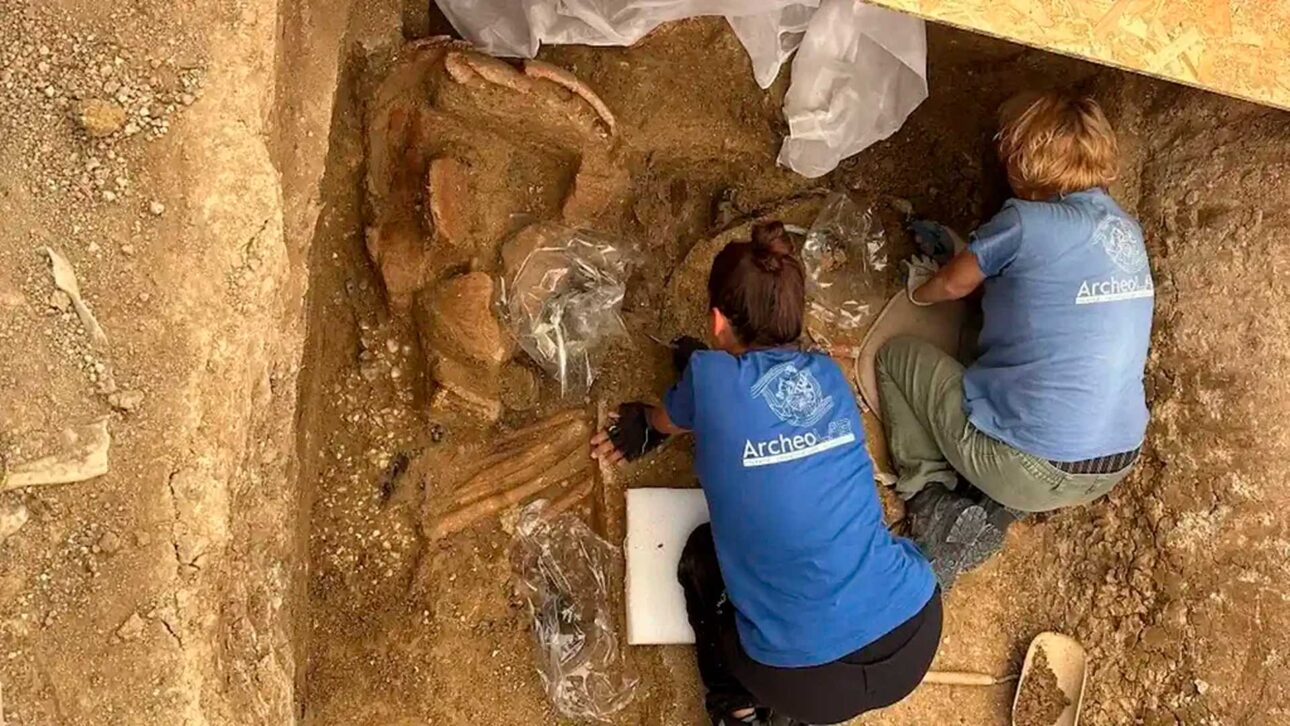
The central point of the discovery is that the new set helps reinterpret the so-called Warrior’s Tomb, found in 2020 in the same area, on Via del Leccio. Until then, that burial attracted attention for its weaponry and prestigious objects, but it is now seen as part of a broader aristocratic family cemetery.
This warrior lived in the second half of the 6th century BC and was buried with a helmet, spear, long sword, dagger, and a bronze jug of Greco-Etruscan tradition.
Among the rarest items was a diphros, a folding stool associated with symbols of power in pre-Roman Italy.
The new princely tomb, located at the center of the newly identified funerary site, indicates a hierarchical organization of space. It was not just a set of rich graves. It was a planned landscape to show authority, lineage, and continuity of power across generations.
The two-wheeled chariot was placed in the tomb as a sign of power
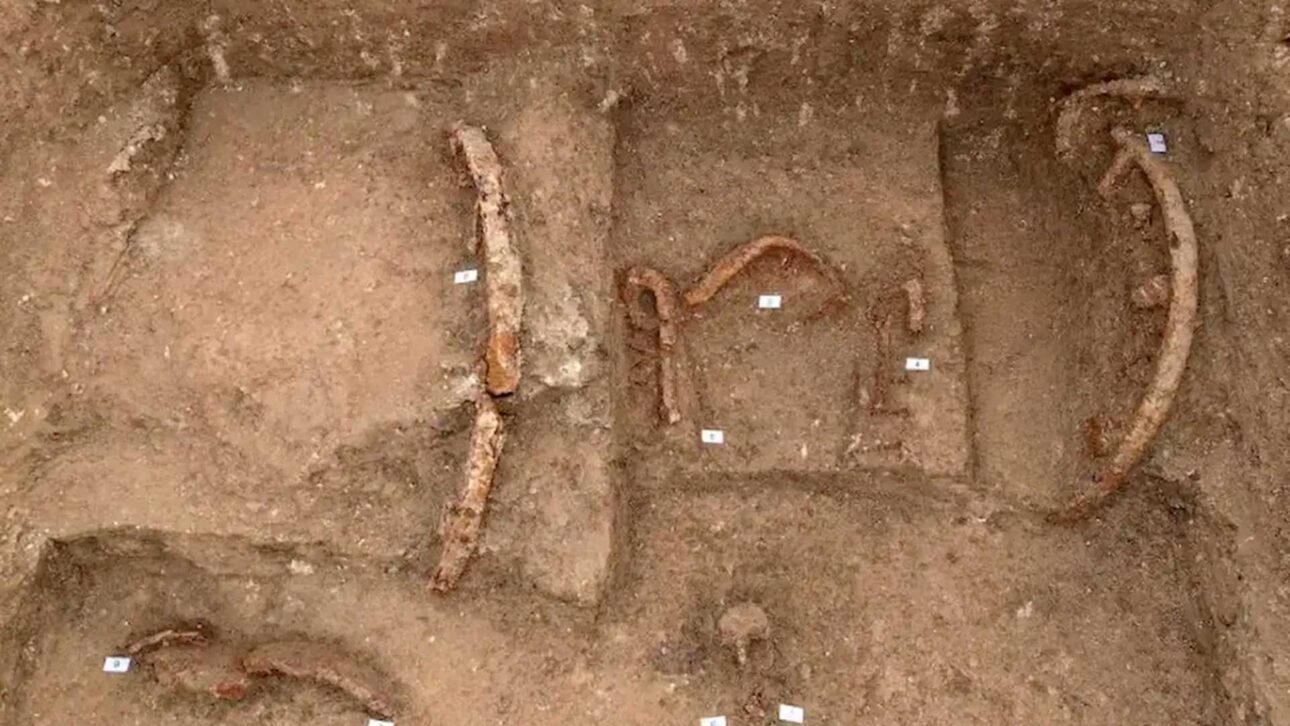
At the center of the monument, archaeologists found a large male grave with traces of a currus, a two-wheeled chariot that was likely deposited whole within the burial pit. This type of vehicle appears in very rich aristocratic contexts of ancient Piceno and pre-Roman Italy.
The chariot did not function there as a mere means of transport. In elite burials, such objects marked social position, military or ceremonial authority, and connection with prestige networks. The deceased was also accompanied by a helmet, axe, and other offensive weapons.
According to Live Science, the tomb is part of a 6th-century BC cemetery and shows that the Piceni left few written records, making archaeological excavations crucial for reconstructing their social organization.
Many artifacts are still undergoing restoration and analysis. This care is necessary because metal, wood, fabric, and organic matter objects require slow treatment, especially when buried for about 2,500 years.
The wooden structure drew attention for deviating from the Piceno standard
One of the most unusual details was not inside the tomb, but around it. The large Piceno funerary circles are usually delineated by ditches dug into the ground, generally interpreted as a symbolic separation between the space of the living and the dead.
In Sirolo, however, researchers identified a circular wooden palisade. The structure disappeared over time but left a regular sequence of holes where the posts were.
At the bottom of these marks, fragments of ceramics were found selectively deposited. For archaeologists, this pattern suggests ritual actions during the construction of the funerary monument.
The architectural difference makes the Sirolo complex especially relevant. It shows that Piceno elites did not always follow the same funerary model and could adapt the space to reinforce the uniqueness of a family or leader.
Bronze vessels still held remains of banquet or offerings
Inside the tomb with the carriage, archaeologists also found large bronze containers sealed with ceramic lids. The contents drew attention because they still preserved organic material, ceramic fragments, and animal bones.
The main hypothesis is that these remains are linked to a funeral banquet or food offered to the deceased. In ancient societies, this type of practice could mark both the public farewell and the idea of symbolic accompaniment to the afterlife.
As reported by Heritage Daily, the sealed vessels found in the tomb may preserve evidence of food rituals performed during the burial.
This type of material is of interest for two reasons. First, it helps to understand funeral rites. Second, it can reveal data about diet, animals consumed, ceramics used, and cultural contacts maintained by the region’s elite.
The female burial preserved clothes, footwear, and brooches in the original place
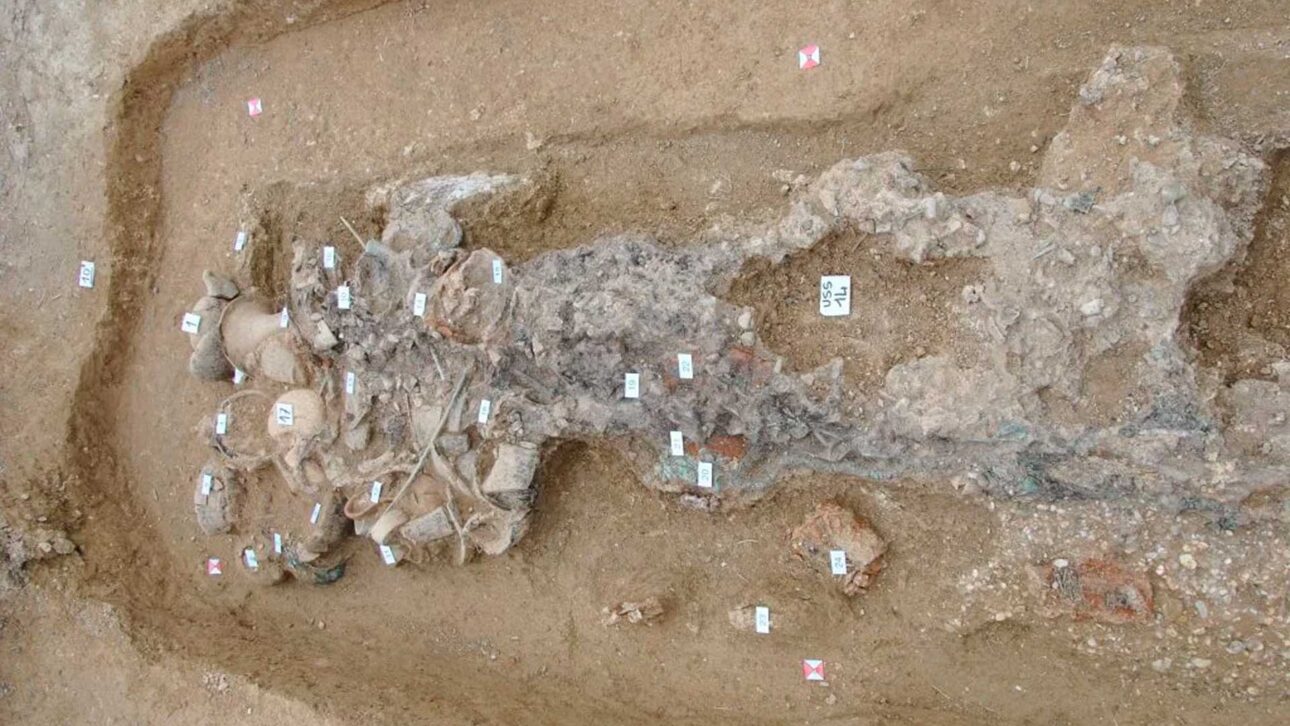
Next to the princely tomb, archaeologists found the burial of a high-status woman. The state of preservation surprised the team because there were traces of fabrics, footwear, and metallic elements still in the position they were placed during the funeral.
Several fibulae, pieces similar to ancient brooches or pins, were distributed over shoulders, chest, pelvis, and feet. This indicates how the clothes and shroud were fastened to the body.
Behind the head, researchers found a large fibula with an amber core. The piece may have been part of a hair ornament, a type of head covering, or a ceremonial composition used in the burial.
The presence of these objects shows that prestige was not only expressed by weapons and carriages. In the female case, fabrics, footwear, adornments, and the position of the brooches help reconstruct how the Picene elite represented identity, wealth, and social status.
Who were the Picenes before the arrival of Rome
The Picenes, also called Piceni or Picentes, lived in the central Adriatic region, in areas today mainly associated with the Marche region and part of Abruzzo. Their period of flourishing predates the Roman consolidation over the Italian peninsula.
A study published in the journal Genome Biology in 2024 describes the Picenes as one of the pre-Roman Iron Age civilizations in central Italy, present between the 9th century BC and the 3rd century BC, until the Romanization of the region.
As there are few written records left by this people, tombs, weapons, ornaments, ceramics, and imported objects end up functioning as material documents. Each rich burial helps to map trade relations, political alliances, and status differences.
In the case of Sirolo, the presence of objects of Greco-Etruscan tradition and a ceremonial chariot suggests that the local aristocracy participated in contact networks that connected the central Adriatic to important centers in central Italy.
The cemetery may be larger than imagined
Investigations in the surroundings indicate that the funerary complex does not end at the already excavated graves. Geophysical surveys and non-invasive methods point to the existence of other structures distributed across the landscape.
The enclosure was built on a gentle elevation, making it visible in the region. This choice was hardly casual. In aristocratic funerary spaces, the location also communicated power.
The proximity to the so-called Queen’s Tomb, discovered in 1989 in the Pini necropolis, reinforces the importance of Sirolo as one of the richest funerary areas linked to the Picenes. That tomb became known for gathering an elite woman, chariots, animals, and many personal objects.
With the new find, researchers are now observing not just isolated tombs, but an organized set. This allows the study of the Picene elite as a family, political, and ritual group, not just as separate characters buried with valuable objects.
What is still to be discovered about the princely tomb
A good part of the answers depends on the next stages of laboratory work. The organic materials from the vessels, animal remains, fabric fragments, metal pieces, and objects still under restoration may reveal details that do not appear at the time of excavation.
Future analyses may indicate what foods were deposited, which fibers formed the clothes, how the objects were produced, and whether there were materials from other regions. This data helps to separate local prestige from broader commercial contacts.
The discovery in Sirolo can also guide new excavations in the Conero necropolis. If the geophysical surveys are confirmed, the cemetery may reveal other elite tombs and again change the understanding of Picene power before Rome.
The 2,500-year-old tomb draws attention for the chariot, but the greater find is in the set. Weapons, wood, bronze, fabrics, amber, and animal bones tell a more complete story about how an aristocratic family wanted to be remembered.
What do you think of this discovery in Italy? Does the entire buried carriage impress you more, or do the preserved fabrics and footwear after 2,500 years catch your attention more? Leave your comment and tell us which detail of this archaeological find most sparked your curiosity.


