Portuguese
  Spanish


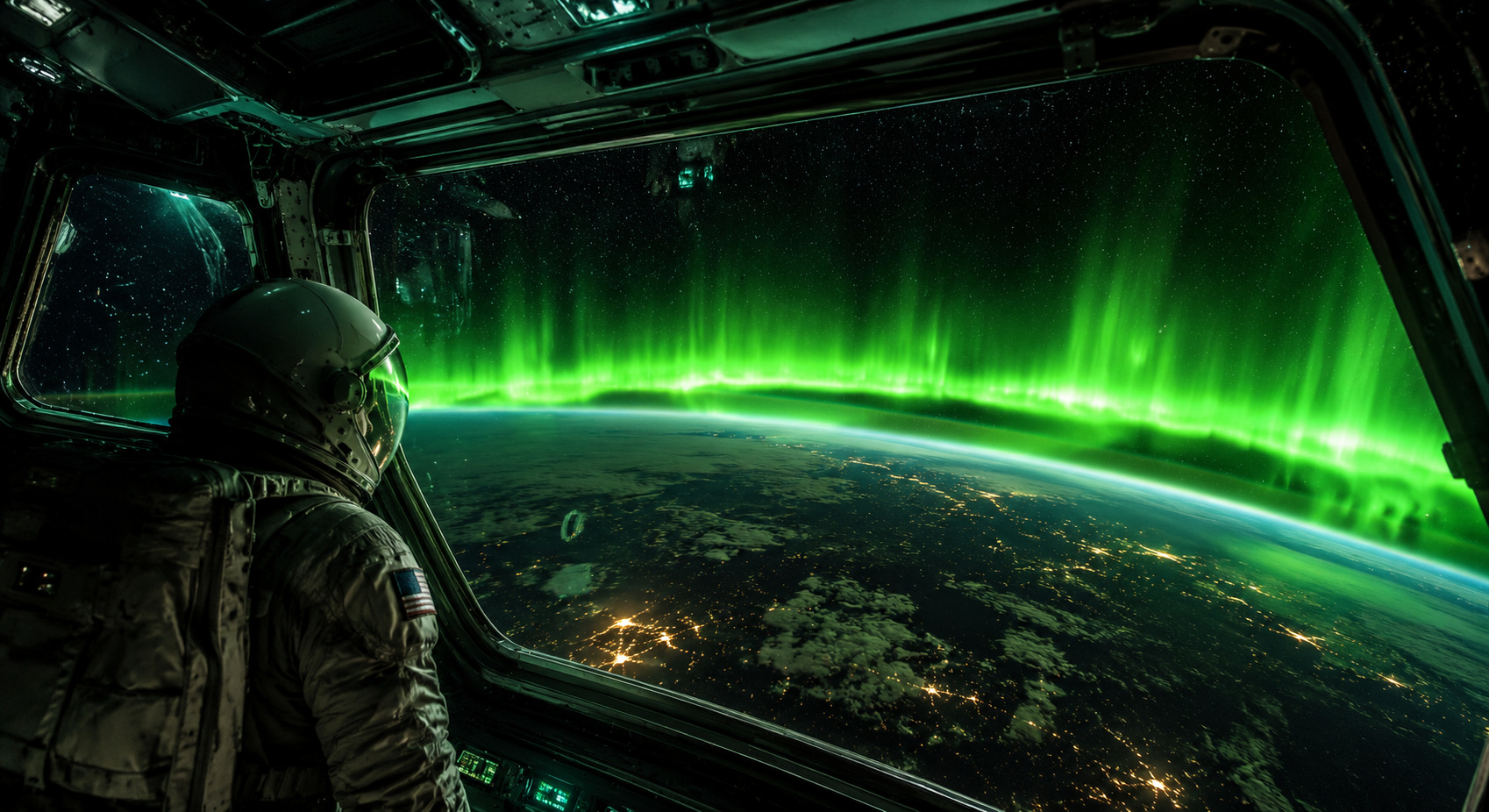

Image taken from the International Space Station shows southern aurora shining over Earth at 431 km altitude in a scene compared to science fiction.
An image captured from the International Space Station has once again drawn attention to one of the most impressive phenomena of Earth’s atmosphere. In May 2026, French astronaut Sophie Adenot, from the European Space Agency, recorded a southern aurora shining intensely over the Indian Ocean while the ISS orbited about 431 kilometers above Earth’s surface.
The photograph was taken during a nighttime pass of the space station over the region near the coast of Perth, Australia. The record shows huge green and pink bands crossing Earth’s atmosphere against the dark backdrop of space, creating a scene that international media compared to science fiction images.
Most impressively, seen from space, the aurora does not appear just as light on the horizon. The image clearly shows the interaction of solar particles with the upper layers of Earth’s atmosphere, revealing a phenomenon that is usually seen only from below by observers on the surface.
-
Antarctic Mystery: Study Uncovers Over 500 Hidden Earthquakes 150 km Deep, Challenging Traditional Theories

-
Excavation for Solar Park in Germany Uncovers Rare Celtic “Princely Tomb” with Elite Warrior Buried with Gold, Weapons, Etruscan Jug, and Two-Wheeled Chariot in Bad Camberg

-
NOAA Scientists Discover Mysterious, Perfectly Aligned Holes on the Mid-Atlantic Ridge Seafloor, Origin Still Unknown

-
California Startup Develops Giant “Space Sling” to Launch Vehicles at Mach 6, Reducing Fuel Use and Enabling Thousands of Satellite Deployments





The southern aurora was recorded from the International Space Station 431 kilometers from Earth
According to information released by the portal Space.com, Sophie Adenot took the photograph on May 7, 2026, while the International Space Station was orbiting approximately 268 miles, about 431 kilometers, above Earth.
The image shows the curvature of the planet partially illuminated by an extremely bright green band, accompanied by pinkish tones higher up in the atmosphere. The record quickly gained attention because it reveals the aurora from an angle rarely seen by the public.

While observers on the ground usually see the phenomenon as luminous curtains in the night sky, astronauts can view the auroras almost laterally, perceiving the thickness of the atmospheric layer where the energetic interaction occurs.
This aspect makes orbital images extremely valuable scientific and visual records.
The phenomenon occurs when solar particles hit Earth’s magnetic field
Auroras are produced by the interaction between charged particles emitted by the Sun and Earth’s magnetic field. When these particles reach the upper atmosphere, they collide with oxygen and nitrogen molecules, releasing energy in the form of light.
According to NASA and ESA, green hues are usually associated with oxygen at lower altitudes in the ionosphere, while reddish and pink tones appear at higher altitudes or under different energetic conditions.


The aurora australis, also called the Southern Lights, occurs mainly in the southern hemisphere, especially in regions close to Antarctica. During periods of higher solar activity, the phenomenon can be observed in areas of Australia, New Zealand, and the far south of South America.
The record made from the ISS helps to show how these particles literally “draw” luminous bands over the planet when interacting with Earth’s magnetosphere.
The view from space reveals details invisible to those observing auroras from the surface
One of the reasons why orbital images are so impressive is the completely different perspective of the phenomenon. From the Earth’s surface, the aurora appears to occupy the sky above the observer.
From space, however, astronauts can see the aurora almost as a luminous layer surrounding the planet. This allows for visualization of the extent of the phenomenon along Earth’s atmosphere and identification of regions where solar particles are interacting more intensely.

According to Space.com, this perspective helps to better understand how the phenomenon actually occurs on a planetary scale.
The images also clearly show the division between the darkness of space, Earth’s atmospheric glow, and the energetic bands created by solar activity.
Astronaut Sophie Adenot participates in the Crew-12 mission on the ISS
Sophie Adenot arrived at the International Space Station in February 2026 as part of the Crew-12 mission, launched by SpaceX in partnership with international space agencies.
According to information released by ESA and reported by Space.com, the French astronaut shares the mission with NASA astronauts Jessica Meir and Jack Hathaway, as well as Russian cosmonaut Andrey Fedaev.
During missions on the ISS, astronauts frequently capture images of Earth for scientific studies, climate observation, and documentation of rare atmospheric phenomena.
Auroras are among the most photographed events because they combine high light intensity, large dimensions, and constant shape changes during geomagnetic storms.
Auroras also help scientists study space weather and solar activity
Besides the visual impact, auroras have enormous scientific importance. They function as visible signs of the interaction between solar activity and Earth’s magnetic field.
More intense solar storms can significantly increase the brightness and extent of auroras. In extreme cases, these events can also affect satellites, communication systems, GPS, and power grids.
Therefore, monitoring auroras helps researchers better understand the so-called space weather, a science area dedicated to the effects of solar activity on Earth and orbital technologies.
The ISS has become an important platform for this type of observation because it orbits above the clouds and offers a privileged view of the upper atmosphere.
The record shows how Earth looks different when seen from orbit
Images taken from the International Space Station often transform common phenomena into almost unreal scenes. Storms, lightning, deserts, fires, and auroras take on a completely different appearance when observed from Earth’s orbit.
In the case of the southern aurora recorded by Sophie Adenot, the visual effect drew attention because the green light seems to cross the planet like a gigantic fluorescent band amid the darkness of space.
The scene reinforces a common perception among astronauts: many of Earth’s natural phenomena only fully reveal their scale when seen from outside the planet.
And precisely by showing Earth’s atmosphere glowing green over the Indian Ocean at hundreds of kilometers altitude, the image became one of the most impressive space records released in 2026.