






 Portuguese
  Spanish


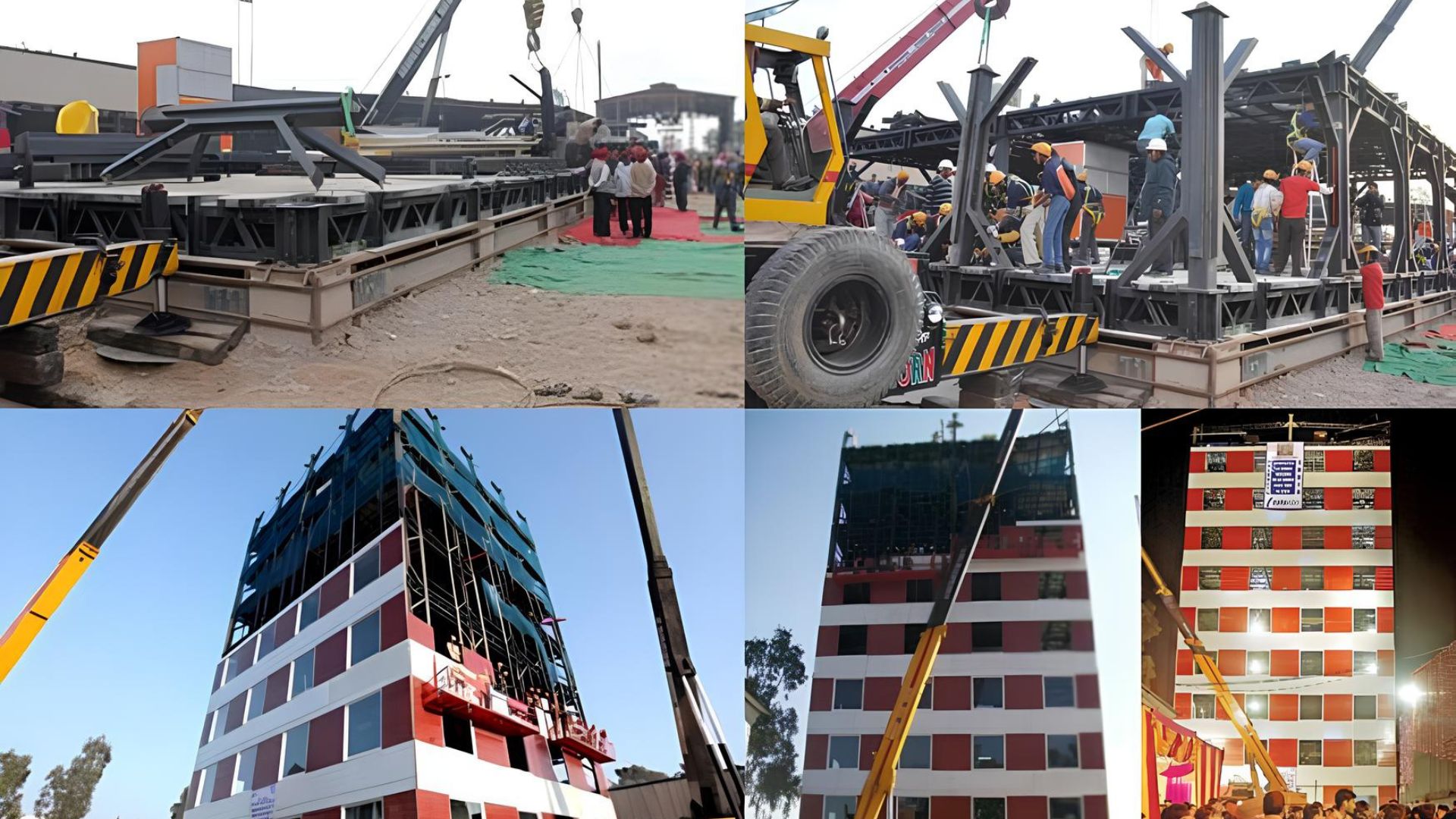


India built a 10-story commercial building in just 48 hours using steel modules and four cranes in Punjab. Meet Instacon.
On December 1 and 2, 2012, the city of Mohali, in the state of Punjab, India, made construction history by receiving a 10-story commercial building completed in just 48 hours. The project was named Instacon and was developed by the company Synergy Thrislington, led by businessman Harpal Singh. The structure attracted international attention because it had about 25,000 m² of built area, capacity for approximately 600 people, and was erected practically from scratch in just two days using prefabricated steel modules. The feat was recorded in the Limca Book of Records, a traditional Indian publication similar to the Guinness World Records.
According to information released by the company and later technical records, the operation mobilized about 200 technicians, 24 supervisory engineers, and four cranes working simultaneously to complete one of the fastest constructions ever carried out in India.
Instacon was built in Mohali and entered the Indian record book
The project was executed in Mohali, a city located near Chandigarh, one of the fastest-growing urban regions in northern India at that time.
-
Australia Builds Entire Airport from Scratch to Spark Development of New City

-
17-Story Building with 112 Apartments Opens in Australia to House Homeless Population, Offering Fully Equipped Units with Daily On-Site Support

-
81-Meter Bridge Made from Over 7 Tons of Recycled Plastic Connects Isolated Communities in Panama Canal Basin, Allowing Safe Passage for Over 300 Residents
-
Australia’s First Two-Story 3D-Printed House Built in 18 Hours, 22% Cheaper Than Traditional Methods, Uses Concrete That Hardens in 3 Minutes




According to records from the Limca Book of Records, Instacon officially entered the publication as the commercial building constructed in the shortest time ever recorded in the country.
The case gained enormous repercussion because India historically dealt with long construction periods, complex bureaucracy, and significant delays in urban projects.
Instacon emerged precisely as a demonstration that the industrialization of construction could drastically reduce timelines considered normal in the Indian real estate sector.
Structure used prefabricated steel modules to speed up assembly
The secret to the speed was the use of structural components manufactured beforehand off-site.
According to technical information released by Synergy Thrislington, most of the metal parts had already been produced in an industrial environment before the official assembly began.

This allowed the project to be transformed into a large structural fitting operation. Pillars, beams, panels, and metal modules arrived ready for installation, drastically reducing traditional steps of conventional construction, such as long concreting, manual cuts, and on-site fabrication.
Project mobilized 200 technicians, 24 engineers, and four cranes operating simultaneously
The operation was planned as an extremely coordinated logistical action. According to project records, about 200 technicians participated directly in the construction, in addition to 24 engineers responsible for structural and operational supervision.


Four large cranes worked simultaneously hoisting metal pieces and structural modules over the two days of assembly.
The fast pace required continuous coordination between transport, hoisting, installation, and structural alignment. Each team had specific tasks executed in precise sequence to avoid any interruption in the assembly.
Building has 10 floors, 25 thousand m² and capacity for about 600 people
Despite the extreme speed, the Instacon was not a small or symbolic structure. According to data released by the company, the building has 10 floors, approximately 25 thousand m² of built area, and operational capacity for about 600 occupants.
The project was conceived as a functional commercial building and not just as a temporary technical demonstration.
The metal structure allowed for reducing the total weight of the construction and accelerating the installation of components without the need for the long typical cycles of reinforced concrete.
India was trying to show technological advancement of modular construction at the beginning of the last decade
When the Instacon was completed, modular construction was still beginning to gain greater global visibility.
At that time, countries like China, the United Kingdom, Singapore, and Japan were beginning to invest heavily in the industrialization of civil construction.
The Indian project emerged precisely as an attempt to show that the country also had the capacity to execute fast projects using large-scale modular technology.
Synergy Thrislington began using the case as a technological showcase to advocate for the expansion of industrialized metal construction in India.
Metal structure helped reduce time, weight, and waste of the construction
According to industry experts, one of the main advantages of steel construction is the reduction in assembly time.
Unlike conventional concrete, metal structures can be manufactured simultaneously while the site is still receiving foundations and initial preparation.
Moreover, metal parts arrive ready at the construction site, reducing material waste, the need for forms, and structural curing time.

In the case of Instacon, the combination of prior manufacturing and coordinated assembly allowed for an extremely uncommon timeframe for a building of this size.
Modular construction tries to transform sites into industrial operations
Instacon became an important example of the transformation of civil construction into an increasingly industrialized process.
Instead of relying exclusively on manual manufacturing on-site, companies have started transferring an increasing part of the work to specialized factories.
In this model, buildings begin to be treated as sets of components produced industrially before final assembly.
The logic brings civil construction closer to the automotive industry, based on repetition, standardization, and operational speed.
Project showed that commercial buildings could also be modularized
For many years, modular constructions were mainly associated with warehouses, temporary accommodations, and simple structures.
Instacon helped demonstrate that the concept could also be applied to multi-story commercial buildings.
This increased market interest in industrialized solutions for hotels, offices, hospitals, and urban residences. In the following years, different countries began investing in increasingly larger and more complex modular buildings.
Rapid construction drew attention in a country marked by major urban delays
India has faced enormous challenges related to urban infrastructure and accelerated population growth for decades.
Many public and private works in the country have historically experienced long delays, bureaucratic disputes, and logistical difficulties.
In this context, Instacon gained symbolic value because it demonstrated an extremely fast execution alternative compared to traditional methods.
The project also helped to strengthen the debate on the use of prefabrication to meet the growing demand for offices, housing, and urban infrastructure.
Record helped to put Mohali on the international map of accelerated construction
The city of Mohali began to be frequently mentioned in international reports on modular construction after the 2012 record.
Although the building did not achieve global notoriety comparable to later Chinese projects, it remained an important reference within India.
The case also helped to consolidate Harpal Singh and Synergy Thrislington as names associated with the industrialization of metal construction in the country.
Modular construction continues to grow driven by cost and speed
More than a decade after Instacon, the global modular construction market continues to expand rapidly. The growth is mainly driven by the need to reduce costs, accelerate delivery, and decrease the urban impact of works.
Today, there are already hotels, hospitals, schools, student residences, and skyscrapers partially manufactured off-site in different countries.
Even so, few projects manage to impress as much as a 10-story commercial building completed in just 48 hours.
The question that continues to drive the sector is straightforward: if a 25,000 m² building was already completed in two days in 2012, how much longer until entire cities are assembled as large prefabricated industrial structures?


Steel construction may cause heat dissipation inside in hot season thereby demanding more energy requirement