






 Portuguese
  Spanish
  3 min of reading
  0 comments


A Galaxy Considered ‘Dead’ Surprised Scientists by Emitting Repeating Radio Bursts. Understand the Mystery Behind This.
The recent discovery of repeating radio bursts coming from a distant ‘dead’ galaxy puzzled the scientific community.
These extremely intense and short-duration radio explosions that come from distant regions of the universe (FRBs) are typically associated with young, highly magnetized neutron stars, which expend a massive amount of energy in their formation.
However, the presence of these explosions in a dormant galaxy challenges existing theories about their origin. The study was published in The Astrophysical Journal Letters and opens new perspectives on the behavior of the universe.
-
Helicopter Drops 180 Tons of Sand and Gravel on Swedish River to Revive Ecosystem Damaged by Decades of Exploitation

-
Brazilian Company Launches Retro Smartphone with 48 MP Camera, T9 Keyboard, and Privacy Features for Social Media-Free Use

-
Self-Taught Chinese Farmer Builds 5-Ton Submarine from Scrap, Launches It in Anhui River
-
Invisible Induction Technology Enables Wireless Power for Blenders, Coffee Makers, and Air Fryers, Reducing Countertop Cables





The Mystery of FRBs and the Distant Galaxy
The massive elliptical galaxy where these FRBs were detected is located approximately 2 billion light-years from Earth and has an estimated age of 11.3 billion years.
Being a galaxy considered ‘dead’, meaning there is no active formation of new stars, it was not expected to find such energetic radio explosions in this region.
The research, conducted by Vishwangi Shah and her team from McGill University, revealed that the bursts, named FRB 20240209A, are located outside this galaxy, raising questions about their true origin.
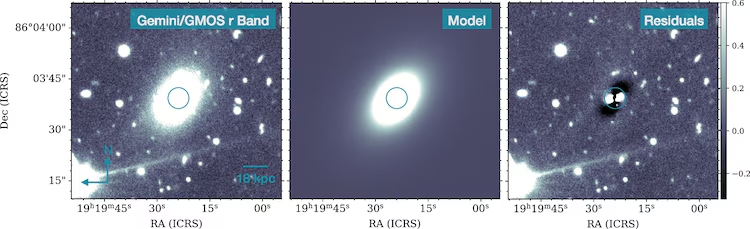
The massive and quiescent elliptical host galaxy of the repeating radio burst FRB 20240209A, T. Eftekhari et al 2025 ApJL 979 L22
How the Discovery Was Made?
The scientists used the CHIME (Canadian Hydrogen Intensity Mapping Experiment) telescope to detect multiple bursts originating from the same location. However, since this telescope does not have enough resolution to precisely identify the exact location of the waves, the team combined their data with a smaller telescope to refine the measurements.
Subsequently, images captured by the Gemini North telescope in Hawaii confirmed that there are no other nearby galaxies, solidifying the association of the FRB with the elliptical galaxy.
Possible Explanations for the Phenomenon
The scientists speculate that these radio bursts may be related to the merging or collapse of remnants of supernovae, known as neutron stars.
This scenario would explain how a galaxy with no young star formation can still generate such energetic explosions.
This hypothesis, if confirmed, could redefine the understanding of the conditions necessary for the occurrence of FRBs.
The Importance of the Study for Astronomy
Since the first detection of FRBs in 2007, thousands of occurrences have been recorded, but only about 100 of them have had their precise locations identified.
All of these were in regions with intense star formation, which makes FRB 20240209A a true exception.
Because of this, studying these events can provide valuable clues about distant regions of the universe and the conditions under which these explosions can occur.
The discovery of radio bursts in the dead galaxy represents a challenge to current theories and suggests that there is still much to explore in the cosmos.
Future investigations may reveal crucial details about the mechanisms behind these mysterious explosions and open new frontiers in astronomical knowledge.





Be the first to react!