






 Portuguese
  Spanish


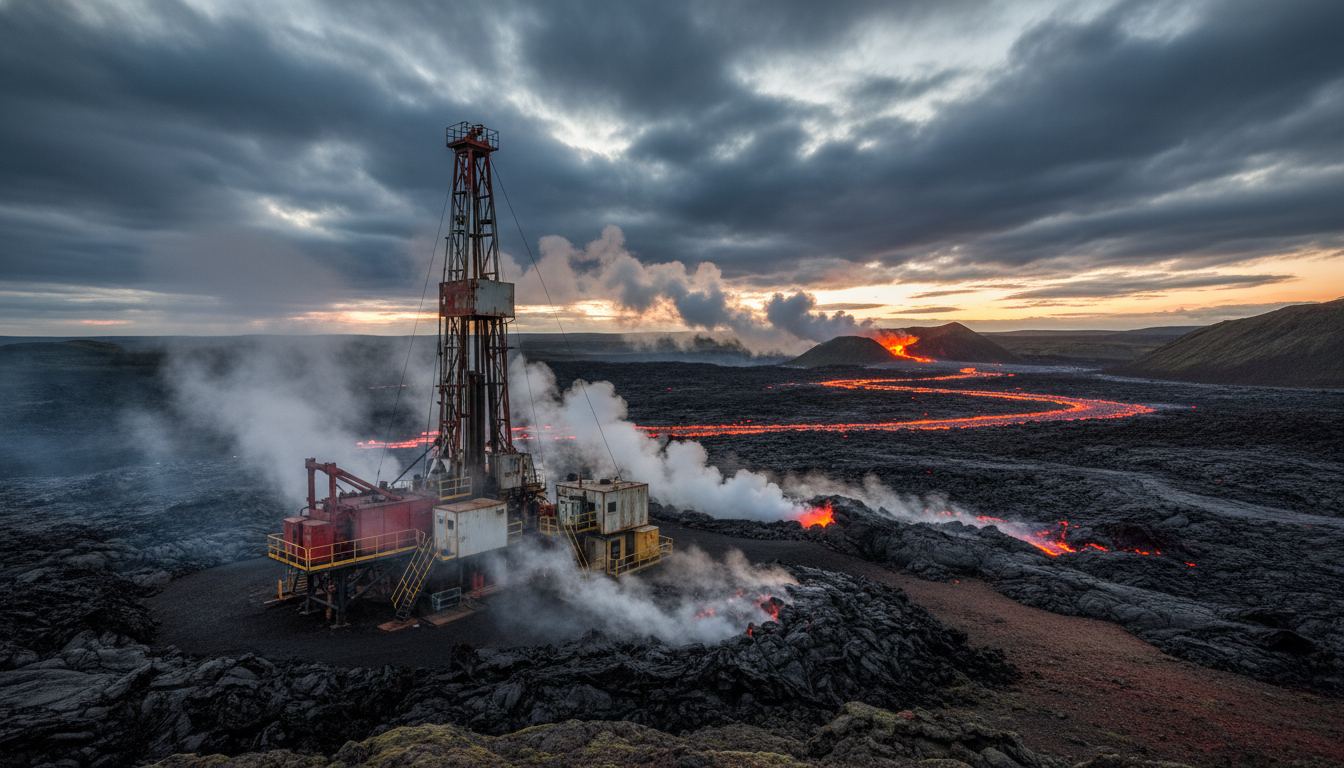

Imagine a group of scientists who, by accident, opened a hole directly into the glowing heart of a volcano — and instead of retreating, decided to go back to do it all over again. Only this time, on purpose. That’s exactly what is happening in Iceland with the Krafla Magma Testbed (KMT), the boldest project in the history of geothermal energy.
While most renewable energy projects seek predictable sources like sun and wind, an international team is preparing to drill into magma directly — the molten rock at nearly 1,000 °C that fuels volcanoes and earthquakes. The goal? To produce clean energy up to 10 times more powerful than a conventional geothermal plant.
The accident that changed everything: when the drill hit magma
It all began in 2009, during the drilling of the Iceland Deep Drilling Project (IDDP). The team aimed to reach supercritical conditions at 4,500 meters deep in the Krafla volcano in northeastern Iceland. But at 2,096 meters, the rock fragments coming up the drill changed appearance: they were pieces of fresh volcanic glass. The drill had hit a pocket of rhyolitic magma at about 900 °C.
-
Spain Launches World’s Largest Floating Dry Dock: 56-Meter Giant Produces Massive Concrete Structures in A Coruña Using Technology Proven in Brazil

-
AI-powered toys that talk, recognize faces, and collect data face scrutiny from Brazilian government over children’s privacy concerns

-
4,000-Year-Old Child’s Skull Unveils Ancient Burial in 7,500-Year-Old Norwegian Rock Shelter, Impressing Archaeologists

-
Norway Defeats Brazil in World Cup but Invests Billions to Preserve the Amazon, Strengthens Amazon Fund, and Joins Brazil in Leading Global Effort Against Tropical Deforestation



It was only the second recorded case in history where a drilling hit magma — the first occurred in Hawaii in 2007. Instead of abandoning the well, the engineers decided to investigate. They installed a perforated steel casing at the bottom and transformed IDDP-1 into the world’s first magma-enhanced geothermal system.
The result was surprising: the well produced superheated steam at 450 °C with an estimated power of 36 MW — about ten times more than the conventional wells at the Krafla plant. The accidental discovery proved that proximity to magma could revolutionize clean energy generation.
Back to the volcano: the Krafla Magma Testbed comes into play
If the 2009 accident was the spark, the KMT is the planned fire. Officially launched as an international consortium with over 40 research institutes and companies from 11 countries, the Krafla Magma Testbed has three ambitious goals:
- Study magma in situ — how it interacts with the surrounding rock and transfers heat to the Earth’s crust
- Monitor a volcanic system from within — which could radically improve eruption forecasting
- Explore the direct use of magma heat to generate geothermal energy on an unprecedented scale
The project is divided into two phases. The first well, named KMT-1, will be drilled in 2026. It is a volcanological research and monitoring well, which will descend to approximately 2,100 meters — the same point where magma was found in 2009. The big difference? This time, temperature and pressure sensors will be placed directly inside the magma.

The second well, KMT-2, is scheduled for 2028 and will be dedicated to energy research. If everything goes as planned, it will demonstrate that it is possible to safely and efficiently extract energy directly from the vicinity of magma.
Why drilling into magma could change the clean energy game
Conventional geothermal energy works by drilling wells 1 to 3 km deep to access hot water reservoirs heated by the Earth’s internal heat. The typical temperature ranges from 150 to 300 °C — enough to generate electricity, but limited.
What the KMT proposes is to access what geologists call super-hot conditions (superhot): fluids above 400 °C, close to the supercritical state. Under these conditions, water behaves completely differently — neither liquid nor vapor — carrying an absurd amount of thermal energy.

The practical result? A single well operating in super-hot conditions can generate the same energy as ten conventional wells. This means:
- Fewer wells drilled for the same output
- Lower environmental impact on the surface
- Significantly lower cost per megawatt
- Base load energy, available 24 hours a day, 365 days a year — something solar and wind cannot guarantee
The challenges of placing sensors inside a volcano
If the idea seems simple — drill down to the magma and harvest the heat — the execution is anything but trivial. The main obstacle is the survival of the equipment. At 970 °C, most metals soften, conventional electronics melt, and even drilling fluids decompose.
To tackle these challenges, the KMT consortium has been working with the sensor community to develop extreme temperature-resistant technologies. The sensors need to operate in environments above 500 °C — and ideally survive long enough to transmit data from inside the magma.
In addition to the sensors, the KMT aims to recover rock cores from the transition zone between the hydrothermal system and the magma. This will be the first time scientists have direct samples from this interface, allowing them to understand how heat migrates from magma to the geothermal reservoirs that are already commercially exploited.
More than energy: forecasting volcanic eruptions
The KMT is not just an energy project. By placing instruments inside an active volcanic system, scientists will gain unprecedented access to the behavior of magma in real-time. This could transform how we predict and prepare for eruptions.
Currently, eruption forecasting relies on indirect signals: seismic tremors, ground deformation, gas emissions. These are valuable but imprecise indicators. With sensors operating directly in the magma reservoir, it will be possible to detect changes in pressure and temperature at the source, potentially anticipating volcanic events with much greater accuracy.
For a country like Iceland — which deals daily with volcanic activity and is still recovering from recent eruptions on the Reykjanes Peninsula — this monitoring capability could save lives and protect critical infrastructure.
The future of geothermal energy lies in magma
The Krafla Magma Testbed is not an isolated experiment. It is part of a global movement to unlock the potential of super-hot geothermal energy. Countries like Japan, Italy, New Zealand, and the United States are also investigating extreme heat sources — but none are as close to drilling directly into magma as Iceland.
If the KMT is successful, the implications will go far beyond the Arctic. The technology developed could be applied in any volcanically active region of the world — and there are many. From the Pacific Ring of Fire to the East African Rift, billions of people live over heat reservoirs that could be transformed into clean, reliable energy sources.
In 2009, Iceland stumbled upon magma by accident. In 2026, it is returning to the same volcano with a plan. And if that plan works, the way the world produces energy may never be the same.
Sources
- Krafla Magma Testbed — Official website
- New Atlas — Drilling into magma
- Landsvirkjun — KMT Secures Key Support
- ThinkGeoEnergy — Exploring new frontiers of magma energy
- Phys.org — World first magma-enhanced geothermal system






Your work continues to inspire positive change in so many lives worldwide 🚀
Quality work here