






 Portuguese
  Spanish


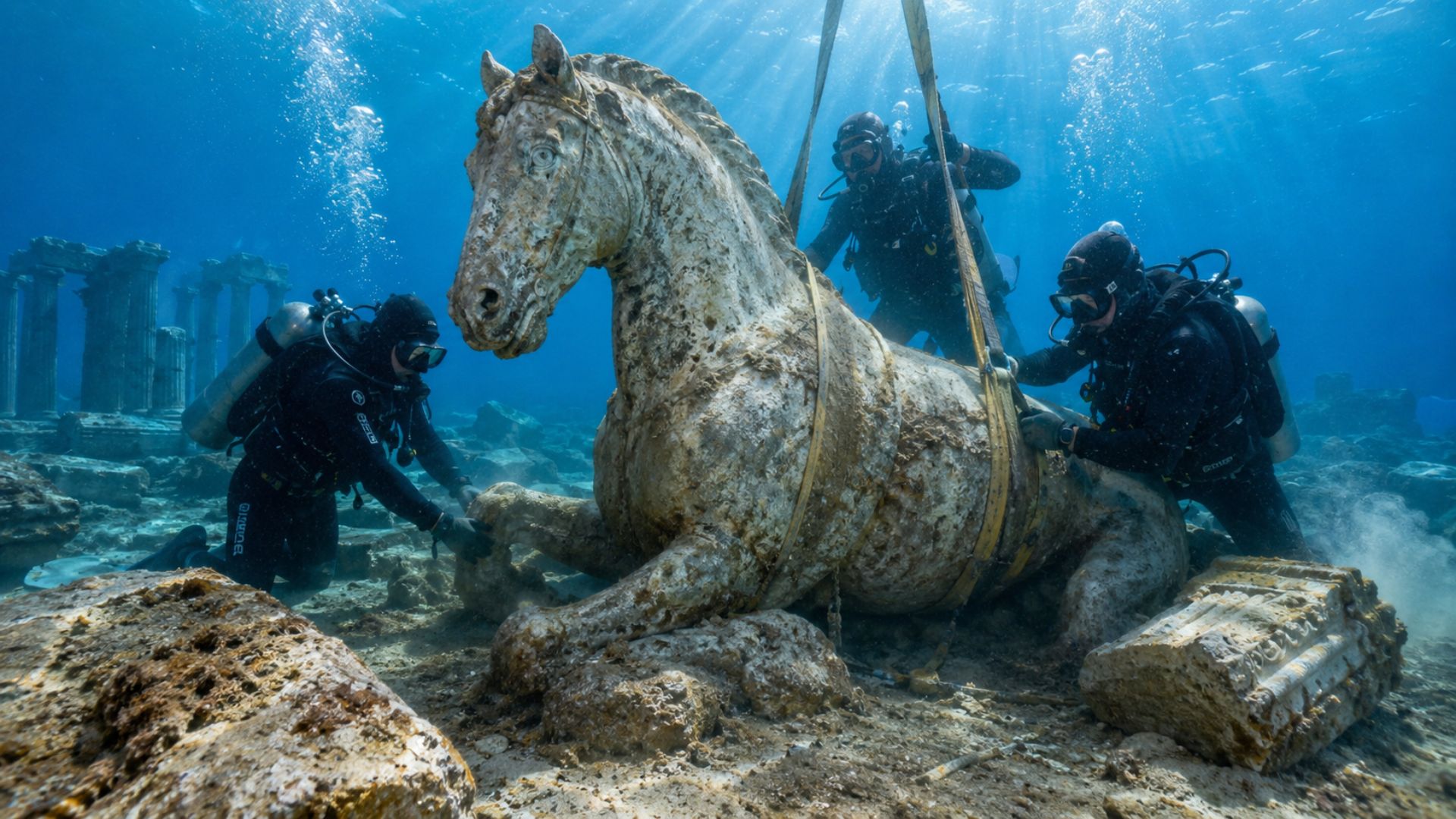


The block shows a rearing horse, a classic motif of Greek art, and was hoisted by a task force of Carabinieri divers and volunteers. The attribution to the temple is still a hypothesis to be confirmed after cleaning and restoration, but if proven, it rewrites a chapter in the history of Agrigento.
About 9 meters deep in the sea of Sicily, Italy, divers recovered a marble horse about 2,500 years old, attributed to the colossal Temple of Olympian Zeus in Agrigento. The piece, according to researchers, may be part of the decoration of one of the largest and most extraordinary temples of the ancient Greek world and, if the hypothesis is confirmed, it would be the greatest archaeological discovery in the region in a century.
The recovery of the fragment took place in February 2024, about 300 meters from the coast of San Leone, near the mouth of the Akragas River. The rescue was conducted by a task force that brought together the Diving Unit of the Carabinieri Command, responsible for the protection of submerged cultural heritage, the Superintendence of the Sea of Sicily, and the Diving Group of BCSicilia, a volunteer organization dedicated to preserving the island’s heritage.
How the marble horse was found

The block was already generically cataloged as a submerged archaeological artifact in the region, but its real value was only realized in October 2022, when engineer Gaetano Lino, from the BCSicilia subgroup, conducted photogrammetry studies, a technique that creates detailed three-dimensional images from photographs.
-
Billionaire says the most valuable skill will help overcome job elimination caused by AI, following Bill Gates’ fears

-
A Dutchman created a ‘box’ that makes trees grow in the desert almost without water and without irrigation: the invention has already brought seedlings to dozens of countries and achieves up to 90% survival where common planting did not exceed 10%.

-
Abandoned warehouse hid a giant collection of rare computers, with over 2,000 artifacts from the 1930s to the 1980s.
-
Scientists warn that melting ice is triggering an alarming chemical transformation in preserved areas, and the first signs are already concerning researchers worldwide.




This meticulous work revealed, under the marine encrustations, the figure of a rearing horse sculpted in stone, a classic motif of Greek sculpture, symbolizing strength and power. Recognizing the potential of the piece, the authorities were notified and, after facing climatic challenges at sea, the team finally managed to hoist the heavy fragment to the surface in a delicate technical operation.
The characteristics of the piece
The fragment impresses with its dimensions and raw material. The block measures about 2 meters in length by 1.6 meters in height and 35 centimeters in thickness, and it is believed to have been sculpted in Proconnesian marble, originating from the island of Proconnesus, in the Sea of Marmara, in present-day Turkey, thousands of kilometers from Sicily.
This detail of the marble’s origin is one of the most revealing aspects of the discovery, as it proves the existence of complex trade routes in the ancient Mediterranean. Bringing such a heavy block from so far required large vessels, money, and organization, which reinforces the wealth and importance of the ancient Greek colonies of Sicily, capable of financing monumental sacred projects with material imported from distant regions.
The Temple of Zeus, the most bizarre in the Greek world
The temple to which the piece is attributed has its own fame. The Temple of Olympian Zeus in Agrigento is considered the largest Doric temple ever built, about 112 meters in length by 56 meters in width, and is described by experts as the most extraordinary and bizarre of all Greek temples, due to a unique feature in its architecture.
Unlike traditional sanctuaries, it was supported by 38 colossal stone human figures, called Atlantes or Telamons, which helped support the structure, some of which can still be seen fallen on the ground at the site. It is believed that the temple was erected by the tyrant Theron after the victory at the Battle of Himera in 480 BC, possibly with labor from Carthaginian prisoners, according to accounts by the ancient historian Diodorus Siculus.
A temple that was never finished
Despite all its grandeur, the monument holds a historical irony. The Temple of Olympian Zeus was never completed, probably due to wars that interrupted the construction work, and today it lies in ruins in the Valley of the Temples, one of the most important Greek archaeological sites outside Greece, recognized by UNESCO as a World Heritage Site.
Precisely because it was never finished and is in ruins, there are many doubts about what its complete decoration would have been like. This is why the discovery of the marble horse is so valuable: it can offer concrete clues about the artistic elements that were planned or already executed for the temple, helping researchers to reconstruct, at least in part, the original appearance of that monumental work.
The necessary caution: it is still a hypothesis
Here comes a point that deserves honesty, and which the researchers themselves make a point of emphasizing. The attribution of the piece to the Temple of Zeus is not yet a certainty, but a hypothesis that needs to be confirmed after the cleaning and restoration of the block. The marine encrustations accumulated over the centuries need to be carefully removed before experts can date and thoroughly analyze the sculpture.
In this sense, Alfonso Lo Cascio, regional president of BCSicilia, considered that if, after cleaning and restoration, the hypothesis that it is a frieze from the Temple of Zeus is confirmed, it would be the greatest discovery of the last hundred years in the archaeological history of Agrigento. Lo Cascio also raised the possibility that the block ended up in the sea due to a shipwreck, perhaps linked to looting, near the mouth of the Akragas River. In other words, the enthusiasm is great, but science still needs to have the final word.
Underwater Archaeology and the Treasures of the Sea
The case reinforces the growing role of underwater archaeology in the recovery of historical heritage. The seabed acts as a true submerged museum, where sediments and the absence of oxygen in certain conditions help preserve artifacts for millennia, protecting them from degradation and vandalism by looters.
Along the ancient Mediterranean trade routes, shipwrecks carrying marbles, statues, and goods created numerous archaeological sites on the seabed, many still unexplored. Researchers believe that other fragments may remain buried under the sand near Agrigento, keeping alive the expectation of new discoveries and stimulating investment in deep-water exploration technology.
The marble horse rescued from the waters of Sicily is one of those discoveries that unite adventure, history, and science. Sculpted about 2,500 years ago in marble from as far away as present-day Turkey, it may be a rare window into understanding the decoration of one of the most impressive temples of the ancient world, although confirmation depends on the patient work of cleaning and analysis. More than a beautiful piece, it is a reminder that the past still holds secrets, many of them hidden at the bottom of the sea, waiting for those with the curiosity and technique to bring them back to light.
And you, were you impressed by this 2,500-year-old marble horse rescued from the bottom of the sea in Sicily? What fascinates you most about underwater archaeology and the treasures the sea still hides? Leave your comment, tell us what you thought of this discovery, and share the article with those who love history, archaeology, and the mysteries of the ancient world.





