Portuguese
  Spanish


Flying at 185 km/h Without Airports and 30% More Efficient Than Planes, the AirFish Voyager Debuts in 2026 and Revives Secret Soviet Technology.
Imagine a vehicle that flies at 185 km/h but doesn’t need an airport. That glides just 2 meters above the water, so close that you can see the fish below. That consumes 30% less fuel than a plane but is 3 times faster than any ferry. It sounds like science fiction, but this vehicle exists and will start operating commercially in September 2026 on the route between Singapore and Batam, Indonesia. Its name: AirFish Voyager. And it resurrects a technology that the Soviet Union secretly developed in the 1960s, the same one that terrified the CIA when it was discovered by spy satellites in 1967.
AirFish Voyager, The Vehicle That Is Neither Boat Nor Plane
The AirFish Voyager operates in a completely new territory of transport. It is too fast to be a boat, too cheap to be a plane, it doesn’t need airport infrastructure, and is technically registered as a ship, despite flying.
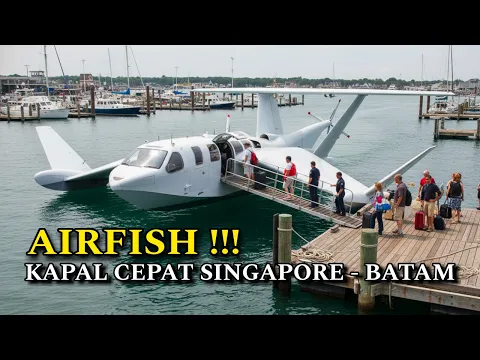

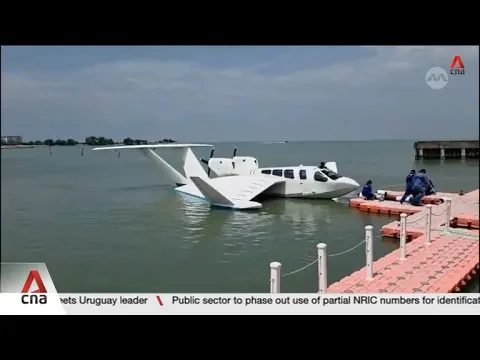
At 17 meters long and 15 meters wide, the vehicle carries 10 people (8 passengers plus 2 crew members) and reaches speeds of 185 km/h. Its range is 555 kilometers, enough to connect distant islands without refueling.
-
The Trap of Modern Technology: How Screen Overload and Digital Connections Can Impact Your Mental Health and Well-being

-
Wyoming Couple Grows Tropical Fruits Year-Round in -40°C Using Geothermal Greenhouse, Demonstrating Earth’s Heat Can Produce Oranges and Lemons in Snow Without Traditional Heating

-
Ship Returns from Brazilian Coast with Thirty Newly Discovered Life Forms
-
Nigerian Professor Invents Electricity-Free Refrigerator Using Clay Pots and Wet Sand, Extending Shelf Life of Vegetables to 27 Days; 7,000 Units Distributed in Energy-Deprived Villages



The crucial difference lies in altitude. While planes fly thousands of meters high, the AirFish glides between 0.5 and 2 meters above the water in calm conditions. When there are 2-meter waves, it rises to 3 to 4 meters. Never higher than that.
The company behind it is ST Engineering AirX, a joint venture between technology giant ST Engineering and startup Peluca, both from Singapore. And they already have signed contracts for commercial operations starting in the second half of 2026.
The Physics That Soviets Mastered
The secret of the AirFish lies in a phenomenon called “ground effect”. When any wing flies very close to a surface, air gets compressed between the wing and the ground, creating extra lift. At the same time, the turbulence that normally forms at the wing tips is blocked by the surface below.
The result is 40-50% reduced drag and 2.3 times increased lift. That’s why pilots feel the plane “float” just before landing.
Normal planes only take advantage of this for a few seconds. The AirFish is designed to fly permanently in that zone of maximum efficiency.
But there’s a problem: flying 2 meters above water at high speed is extremely difficult. Any oscillation can make the wing hit the water. The design must be specific. And you can never rise above 7 meters without losing efficiency.
That was exactly the problem the Soviets solved in the 1960s.
The “Caspian Sea Monster” That Terrified the CIA
In 1967, American spy satellites captured shocking images over the Caspian Sea: a gigantic machine 92 meters long gliding over the water at over 500 km/h.
It had wings. But the wings were too short to fly. CIA analysts were terrified. What the hell was that?
They named the object “Caspian Sea Monster”.
What the CIA had discovered was the KM (Korabl Maket), the first large-scale ekranoplan ever built. Ekranoplan comes from Russian and literally means “surface glider”.
At 544 tons and 10 turbojet engines, the KM was the largest “plane” in the world. But it technically wasn’t even a plane; the Soviet Navy registered it as a ship. Before the first flight, they broke a bottle of champagne on its nose. Naval tradition, not aviation.
The KM had an operational speed of 430-500 km/h and flew just 5-10 meters above the water. It was invisible to radar (too low to be detected), immune to naval mines (it didn’t touch the water), and could carry hundreds of tons of cargo faster than any ship.
The idea: to move troops and equipment across the ocean faster than any ship while remaining invisible to anti-air defenses that couldn’t aim that low.
The KM was tested in the Caspian Sea from 1966 to 1980. In 1980, during a test flight, the pilot made a mistake: he thought he was higher than he actually was. During a turn, the wing hit the water. The KM collided and sank. No one died, but the machine was destroyed.
The Soviets didn’t attempt to rebuild it.
The Second Generation That Became a War Weapon
But the project didn’t die. In 1975, designer Rostislav Alexeyev created the Lun, a smaller, more refined version that was in active military service from 1987 to the late 1990s.
The Lun was larger than an Airbus A380, reached 550 km/h, and carried 6 anti-ship missiles — earning the nickname “aircraft carrier killer”. It is the only ground effect vehicle ever operated as a warship.
But it had a critical flaw: it only worked in calm seas. With waves of just 1-2 meters, it became unstable. After the dissolution of the Soviet Union in 1991, the program was canceled. The only Lun built was abandoned for 30 years until it became a tourist attraction in 2020.
And the Americans? They tried to copy it. They never managed to get it to work.
The technical knowledge died with the Soviet engineers.
How Singapore Resurrected the Lost Technology
Here comes the fascinating part. In the 1960s, while the Soviets were making gigantic military ekranoplans, Western Germans were making small civil versions.
Alexander Lippisch, an aerospace engineer who worked on Luftwaffe planes during World War II, moved to the US and began experimenting with the ground effect. In 1963, he created the X-112 — a revolutionary design with an inverted delta wing that proved to be incredibly stable.
Lippisch sold the patents to German companies that created larger prototypes. Hanno Fischer took that work and founded Fischer Flugmechanik, completing models for 2 and 6 people.
But in the 1990s-2000s, the project failed.
In 2010, a Singapore company called Wigetworks bought the patents, the prototype, and all the accumulated technical knowledge. For 15 years, they tested exhaustively. They crossed the Strait of Malacca, one of the busiest maritime routes in the world. They proved that the concept worked.
In 2024, Wigetworks partnered with ST Engineering — one of the largest technology conglomerates in Asia. Result: ST Engineering AirX, the joint venture that is bringing the AirFish Voyager to the commercial market in 2026.
Singapore-Batam in 30 Minutes
At the Singapore Airshow 2026, ST Engineering announced two strategic contracts.
First: The operator BatamFast will lease and operate an AirFish Voyager on the Singapore-Batam route. Currently, conventional ferries take 45-60 minutes at 55 km/h. With the AirFish: 25-30 minutes at 185 km/h. Start of operations: second half of 2026.
The target audience is tourists heading to resorts in Batam who want to save time. The price will be higher than the normal ferry (which costs S$76 round trip), but much cheaper than air taxis. You pay a premium for speed, cutting the time in half.
Second: Wings Over Water Ferries (WOW) will operate up to 4 AirFish in India, connecting archipelagos such as Andaman and Nicobar (572 islands) and Lakshadweep (36 islands). Start: end of 2026.
The differentiator: local manufacturing in India — assembly, pilot training, and maintenance. If successful, India could become a production hub for all of Asia.
Why It Might Work Now

Soviet ekranoplans were military giants over 90 meters long, extremely expensive, very unstable in rough seas, and designed for war.
The AirFish is small (17 meters), uses a Chevrolet V8 car engine instead of military turbojets, has a much more stable inverted delta wing design, can fly from 0.5m to 7m depending on the waves, and was designed from the outset for commercial use.
Compared to ferries, it is 3 times faster and flies above the waves without rocking. Compared to planes, it does not need an airport, consumes 30% less fuel, and is much cheaper to operate. If the engine fails, it lands gently on the water — it’s a boat too.
The technology makes sense for archipelagos with thousands of islands: Indonesia (17,508 islands), Philippines (7,641 islands), Greece, the Caribbean, and the Brazilian coast of 7,491 km.
It makes sense where building an airport is impossible or too expensive, where ferries are too slow, and where demand does not justify large commercial flights.
The Challenges That Still Exist
Confusing regulation. The AirFish is classified as a ship, but it flies in the air and crosses maritime airspace. Who regulates it? Maritime authority or civil aviation? Each country may have different rules. Certification by Bureau Veritas is expected by mid-2026.
Limitations in rough seas. The AirFish can take off and land in waves up to 1 meter. But seas with waves above 2 meters limit operation. Storms are prohibitive. Low visibility is also a concern.
Uncertain costs. How much does it cost to buy an AirFish? How much per hour of flight? Is maintenance more expensive than a ferry? Nothing has been publicly disclosed. BatamFast and WOW will lease, not buy — suggesting that the acquisition cost is too high.
Limited capacity. Only 8 passengers per trip is very small compared to ferries carrying 200-300 people. This means high cost per passenger and a niche market — only those willing to pay a premium for speed.
Future competition. China launched the Xiangzhou 1 in 2017. Russia announced a descendant of the Caspian Sea Monster in 2018. In the US, startups are working on ground effect drones for cargo. If the technology proves lucrative, there will be competition.
2026: When the Future Becomes Reality
In September 2026, something historic will happen: for the first time in 40 years, a ground effect vehicle will enter regular civil commercial operation.
When the first AirFish Voyager takes off from Singapore to Batam, carrying 8 paying passengers, crossing the strait in 25 minutes at 185 km/h, gliding 2 meters above the waves — it will be proof that the technology the Soviets developed in secret has finally found its purpose.
Not as a war weapon. But as a transport solution for a world with thousands of disconnected islands, people who value time, and places where building an airport is prohibitive.
The AirFish won’t replace planes or ferries. It will create a completely new category: high-speed transport over water without heavy infrastructure.
If it works, we will see AirFish connecting Greek islands in 20 minutes instead of 2 hours, Brazilian coastal communities without airports, Caribbean resorts directly from Miami, and offshore oil platforms for crew swaps.
The technology that was a Soviet military secret may finally democratize fast access to remote places.
And it all begins in 2026 with a futuristic vehicle from Singapore that looks like it came out of a science fiction movie, but is 100% real.