






 Portuguese
  Spanish
  6 min of reading
  0 comments


Submerged technology installed in the Naru Strait expands the use of tidal energy in Japan and shows how predictable marine currents can complement renewable sources in island regions, without relying on constant wind, direct sunlight, or large visible structures in the coastal landscape.
The British company Proteus Marine Renewables installed the AR1100 tidal turbine in the Naru Strait, Japan, a 1.1-megawatt equipment presented by the company as the country’s first megawatt-scale unit connected to the power grid.
Deployed near the Goto Islands in southwestern Japan, the machine began exporting electricity after receiving certification from Japan’s Ministry of Economy, Trade and Industry, METI, in June 2025, according to Proteus.
Installed below the sea surface, the turbine harnesses the flow of currents caused by the rise and fall of tides, in a generation model that does not rely on constant wind or direct sunlight.
-
Space technology used to search for water on Mars is now hunting for invisible leaks under the streets of São Paulo, using satellites, AI, and chlorine signals to help Sabesp recover up to 6.7 billion liters of water.

-
Japan sends ship to extract mud rich in rare earths at nearly 6,000 meters deep in the Pacific, attempts to lift 350 tons per day from the seabed, and transforms sediments near Minamitori Island into a strategic weapon to reduce dependence on China.
-
Venus Aerospace promises a rotating detonation hypersonic engine that takes the Stargazer to Mach 9 and crosses oceans in 1 hour, but the flight that made history barely surpassed the speed of sound.

-
Brazilian student creates a cheap formula that makes plants grow up to 90% faster and wins an award in a global scientific competition.


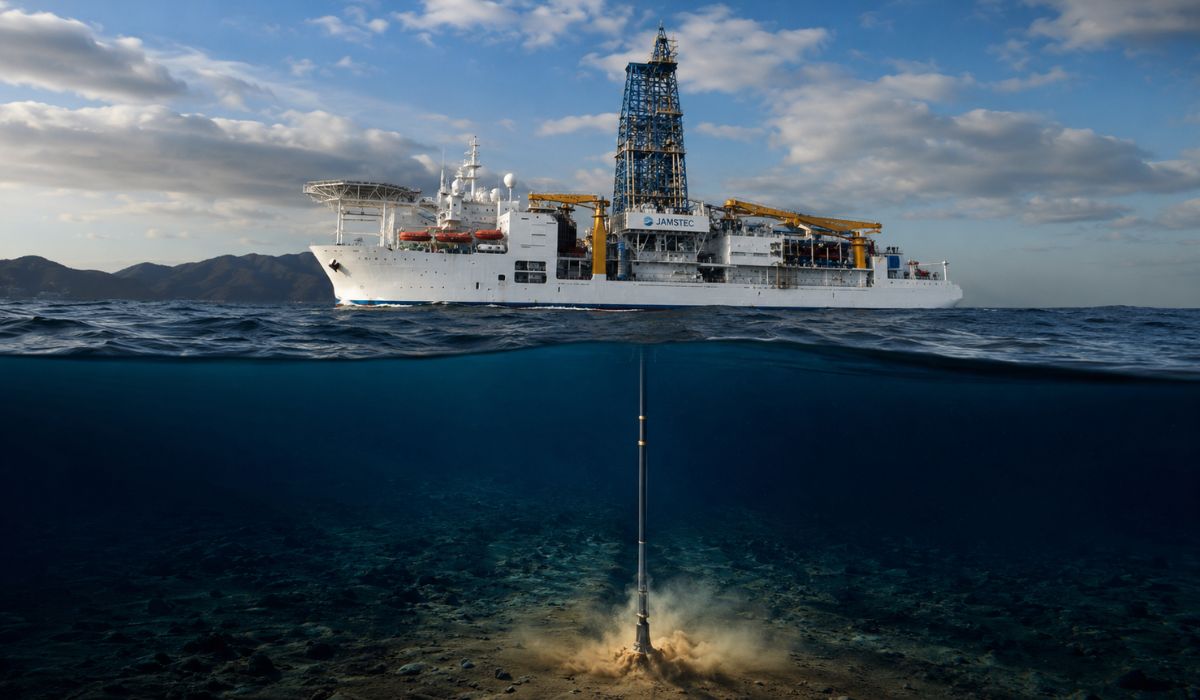


By following known natural cycles, tidal production can be estimated in advance, a characteristic that differentiates it from renewable sources more subject to weather variations, such as solar and wind.
Proteus reported that the equipment was placed in the Naru Strait in February 2025 and that the project is part of an expansion phase of tidal technology in real operation in Japan.
In the presentation of the AR1100, the company stated that the turbine should help reduce emissions in the electricity supply of the Goto Islands, without publicly detailing a reliable estimate of annual energy generated or the number of consumers served.
How the tidal turbine generates clean energy at sea
The operation of the AR1100 follows the conversion principle used in flow turbines, with blades moved by the current and a generator responsible for transforming part of the mechanical energy into electricity.

Unlike a wind turbine installed on land or at sea, the equipment operates submerged, in a region where water displacement occurs according to tidal cycles.
When the currents pass through the blades, the rotor spins and activates the generator, while the electricity produced follows an electrical connection to the network infrastructure connected to the coast.
The density of water allows suitable marine currents to carry significant kinetic energy even at lower speeds than many wind flows used in wind generation.
For this reason, straits and ocean passages with strong flow are often analyzed by developers and industry bodies as potential areas for tidal energy projects.
In the Japanese case, the equipment operates below the waterline and does not occupy the coastal landscape with towers, solar modules, or blades visible above the surface.
The turbine remains positioned in a natural current corridor, while the associated electrical systems transport the generated energy to the existing distribution structure.
In island regions, this type of configuration can be considered by operators when there is limited land space, high logistical costs, and maritime conditions compatible with installation.
Still, the viability of tidal energy depends on specific technical and environmental factors, such as adequate depth, strong currents, and the possibility of a secure connection to the grid.
Project in the Naru Strait expanded previous test
The AR1100 was developed from a previous experience by Proteus itself in the Naru Strait, where the AR500 turbine, with 500 kilowatts, had already been tested in a real environment.
According to information released by the company and specialized industry outlets, the previous equipment operated on-site with 97% availability, an indicator used to measure the period a system remains ready to operate.

The data obtained from the AR500 operation served as a basis for increasing the power and updating components applied to the 1.1 megawatt version.
Among the changes reported by Proteus are pitch and yaw control mechanisms, known in the industry as pitch and yaw systems, which adjust the position of the blades and the alignment of the turbine in front of the currents.
The installation of the new unit took place after a contract was signed with Kyuden Mirai Energy, a Japanese company involved in the renewable sector and participating in the local implementation of the project.
In maritime ventures, the involvement of local companies is usually necessary for stages such as port logistics, licensing, navigation, offshore operation, and connection with the available electrical infrastructure.
Ocean energy projects generally progress in phases, with smaller equipment installed first to record performance data, maintenance, and structural response in real operating conditions.
After this stage, the collected information guides engineering and control adjustments before more powerful versions are placed in the same environment or in areas with similar characteristics.
Predictability of Tides Strengthens Renewable Generation
Solar generation varies according to time of day, cloud cover, and available radiation, while wind production depends on the intensity and consistency of winds throughout the day.
In the case of tides, the cycles follow astronomical patterns associated with the gravitational interaction between Earth, Moon, and Sun, allowing for the estimation of periods of higher and lower flow in advance.
This predictability does not eliminate the technical challenges of submarine operation, but it can aid in the planning of the electrical system when the source is integrated with other forms of renewable generation.

For islands and isolated coastal areas, a renewable source with more regular behavior can complement already installed technologies and reduce the need for generation based on fuels transported from outside.
Japanese geography helps explain the interest in this type of solution, as the country is made up of thousands of islands and has an extensive coastline.
At the same time, Japan seeks to diversify its renewable matrix with sources capable of operating alongside solar, wind, hydroelectric, biomass, and other low-emission alternatives.
In the Naru Strait, Proteus states that the goal is to contribute to the decarbonization of the electricity supply of the Goto Islands through a renewable source associated with the movement of tides.
The company also reported that, with the implementation in Japan, it began operating megawatt-scale devices in two countries, a fact used by the company to position the technology outside of exclusively laboratory tests.
Submarine environment requires specialized operation
The operation of turbines at sea requires different solutions from those used in land-based equipment, because the submarine environment exposes components to corrosion, pressure, current variations, and limited access for maintenance.
In addition to structural resistance, such projects need to consider safety during interventions, operational availability, vessel costs, navigation conditions, and compatibility with local environmental and maritime regulations.
For this reason, Japanese certification played a significant role in the equipment’s integration stage into the network, according to information released by Proteus after the approval granted by METI.
In June 2025, the company reported that the AR1100 received authorization from the Japanese agency and began exporting energy to the national grid, following the installation and commissioning phases.
Even with the operation in the Naru Strait, tidal energy is not applicable to any stretch of coast, as the technology requires locations where the water movement is intense enough to justify the installation.
The electrical infrastructure also needs to allow the transportation of the produced energy to consumers or distribution systems, a point that may limit deployment in remote areas or with insufficient grid.
The experience in the Goto Islands indicates that the sea can be incorporated into electricity generation in areas with favorable natural conditions and technical planning focused on submarine operation.
For island regions, the combination of tide predictability, renewable generation, and submerged operation expands the set of alternatives evaluated to reduce emissions without relying solely on sun or wind.


Be the first to react!