Portuguese
  Spanish


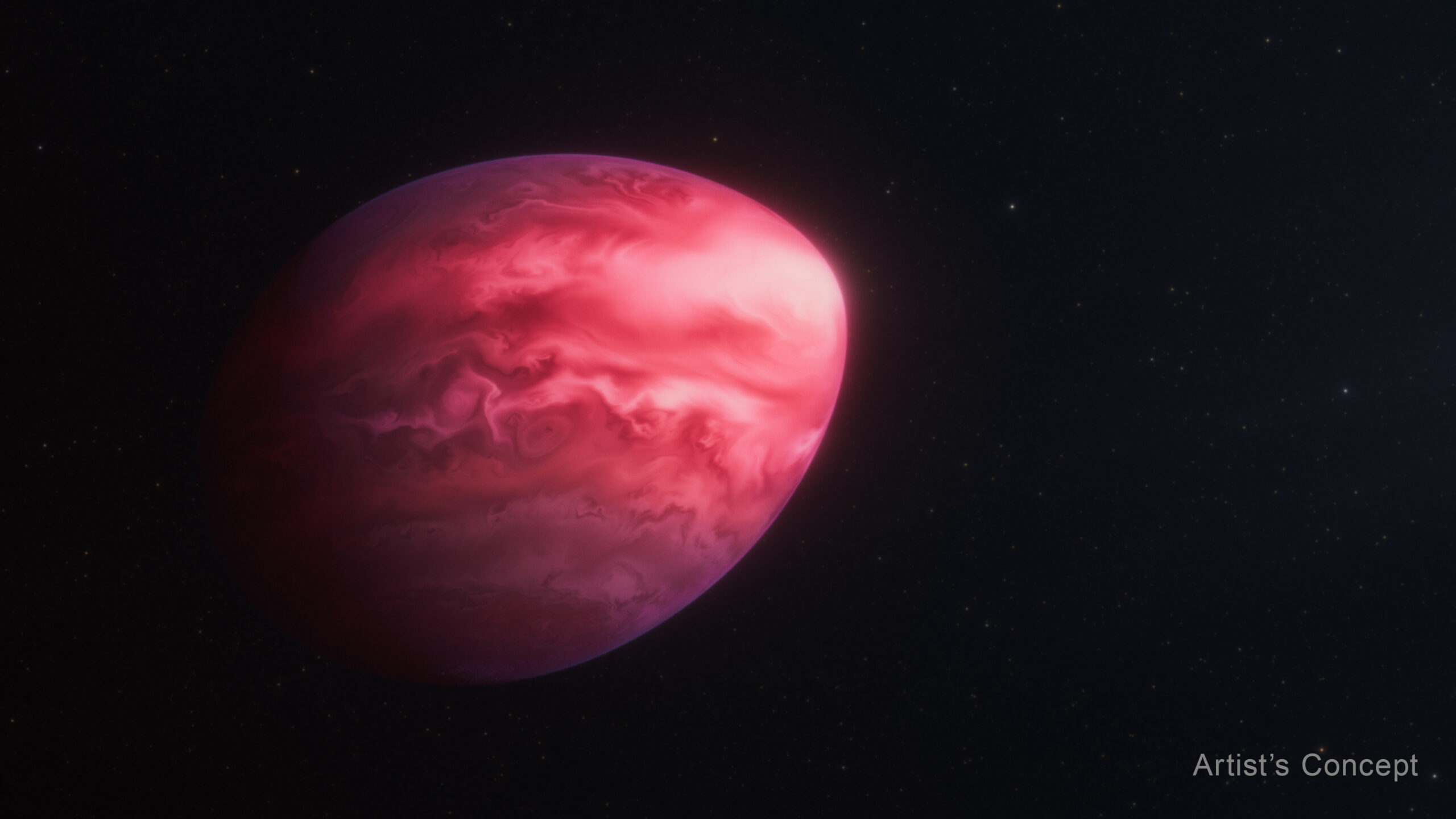

James Webb reveals lemon-shaped planet with carbon-rich atmosphere, soot clouds, and possible diamond formation.
The James Webb Space Telescope has revealed one of the strangest worlds ever observed by modern astronomy. The object is called PSR J2322−2650b, is approximately 750 light-years from Earth, and orbits something even more extreme than a common star: a pulsar, the ultra-dense core remnant of a star that exploded as a supernova.
But what really shocked scientists was not just the absurd environment of the system. James Webb detected an atmosphere with virtually no known equivalent, dominated by helium and molecular carbon, with soot clouds floating in the atmosphere and conditions that may allow diamond formation in the planet’s deep regions. NASA itself stated that the composition “defies explanation.”
Planet orbits an extremely compact dead star
The host of the planet is the pulsar PSR J2322−2650, an extremely compact neutron star that spins hundreds of times per second.
-
OnePlus N6 Smartphone to Launch in India with 8,000mAh Battery and 45W SuperVOOC Charging, Lasting Up to Three Days

-
Scientists Plan to Release Air Bubbles Underwater to Protect Antarctica’s “Doomsday Glacier” from Melting

-
Chinese R6000 Drone Combines Airplane and Helicopter Features, Carries Up to 12 People for Multiple Missions
-
In the World’s Most Densely Populated Desert, Families Dig Funnel-Shaped Underground Cisterns to Capture Rare Rainfall and Store Drinking Water for Up to Eight Months




According to system data, the pulsar completes approximately 300 rotations per second, emitting intense beams of radiation while the planet orbits incredibly close to it.


The distance between the planet and the pulsar is only about 1.6 million kilometers, less than 1% of the distance between Earth and the Sun. As a result, the planet completes an entire orbit in approximately 7.8 hours. This extreme environment creates violent gravitational forces on the planet.
Extreme gravity deformed the planet into a lemon shape
One of Webb’s most bizarre discoveries was the shape of the planet. The gravitational forces of the pulsar are so intense that the planet has been gravitationally stretched to acquire a shape similar to a lemon or an elongated rugby ball.
According to the models cited in astronomical analyses, the equatorial diameter of the planet may be approximately 38% larger than the polar diameter due to the extreme tidal effect caused by the pulsar.
Scientists claim that this is one of the most gravitationally deformed objects ever identified outside the Solar System.
Carbon-rich atmosphere challenges all known models
The most important aspect of the discovery lies in the planet’s atmosphere. Spectroscopic observations from the James Webb showed that the atmosphere of PSR J2322−2650b is dominated by:
- helium
- molecular carbon C₂
- tricarbon C₃
At the same time, researchers detected an extremely unusual absence of:
- oxygen
- nitrogen
- water
- methane
- carbon dioxide
According to the scientific article published in The Astrophysical Journal Letters, the carbon/oxygen and carbon/nitrogen ratios appear absurdly high, at levels practically never seen in planetary atmospheres. This has made the object a huge problem for traditional planetary formation models.
Soot clouds may transform into diamonds
Another impressive detail detected by Webb was the probable presence of carbon and soot clouds in the atmosphere.

According to NASA and researchers involved in the study, carbon particles may condense in the planet’s deep regions under extreme pressure, potentially forming diamonds.
The atmosphere seems to contain soot-like clouds suspended in a superheated environment of pure helium and carbon.
Scientists state that the planet has such a different atmospheric chemistry that there is practically no known equivalent among the exoplanets already studied.
Temperature may exceed 2,000 °C on the illuminated side
The planet is gravitationally locked to the pulsar, which means that one side remains constantly facing the neutron star.
According to estimates cited in astronomical analyses:
- the hotter side can exceed 2,040 °C
- the colder side still stays around 650 °C
Even the planet’s “cold side” is hot enough to melt many terrestrial metals. The intense heat helps explain why common compounds like water and methane have practically disappeared from the observed atmosphere.
Scientists still cannot explain how the planet formed
The biggest crisis for researchers might be the origin of the object itself. According to the scientists involved, practically no known model can simultaneously explain:
- the carbon-rich composition
- the absence of oxygen and nitrogen
- the extreme proximity to the pulsar
- the survival of the atmosphere
One hypothesis is that the planet is the eroded remnant of a star destroyed by the pulsar in a system called “black widow.” In this scenario, the pulsar would have consumed much of the companion star, leaving only an extremely modified core.

But even this explanation still does not completely solve the observed chemical problem.
James Webb managed to study the planet because it practically does not “see” the pulsar
Curiously, part of the success of the observation happened precisely because James Webb does not see the pulsar well.
The pulsar emits mainly very high-energy radiation, especially gamma rays, while Webb operates primarily in the infrared. This allowed the instruments to directly observe the planet’s thermal and chemical signature without much interference from the star.
The researchers stated that the system has become a unique laboratory for studying exotic atmospheres in extreme environments.
Discovery opens a new category of planetary atmospheres
The study authors state that PSR J2322−2650b may represent a new class of planetary atmospheres. According to the scientific article, the planet inaugurates:
- a new chemical regime
- a new atmospheric regime
- a new combination of extreme dynamics and carbon-rich composition
Additionally, the atmospheric winds seem to blow in the opposite direction to the planet’s rotation, something extremely unusual compared to traditional gas giants.
The lemon-shaped planet has become one of the greatest enigmas ever found by James Webb
PSR J2322−2650b gathers practically everything modern astronomy considers extreme:
- orbits a dead star
- has a gravitationally deformed shape
- rotates around the pulsar in less than 8 hours
- has a pure carbon-rich atmosphere
- can form diamonds
- challenges planetary formation models
And perhaps the most unsettling detail is precisely this: the more James Webb observes extreme alien worlds, the more Earth seems to be just one among countless bizarre possibilities that the Universe can produce.