






 Portuguese
  Spanish


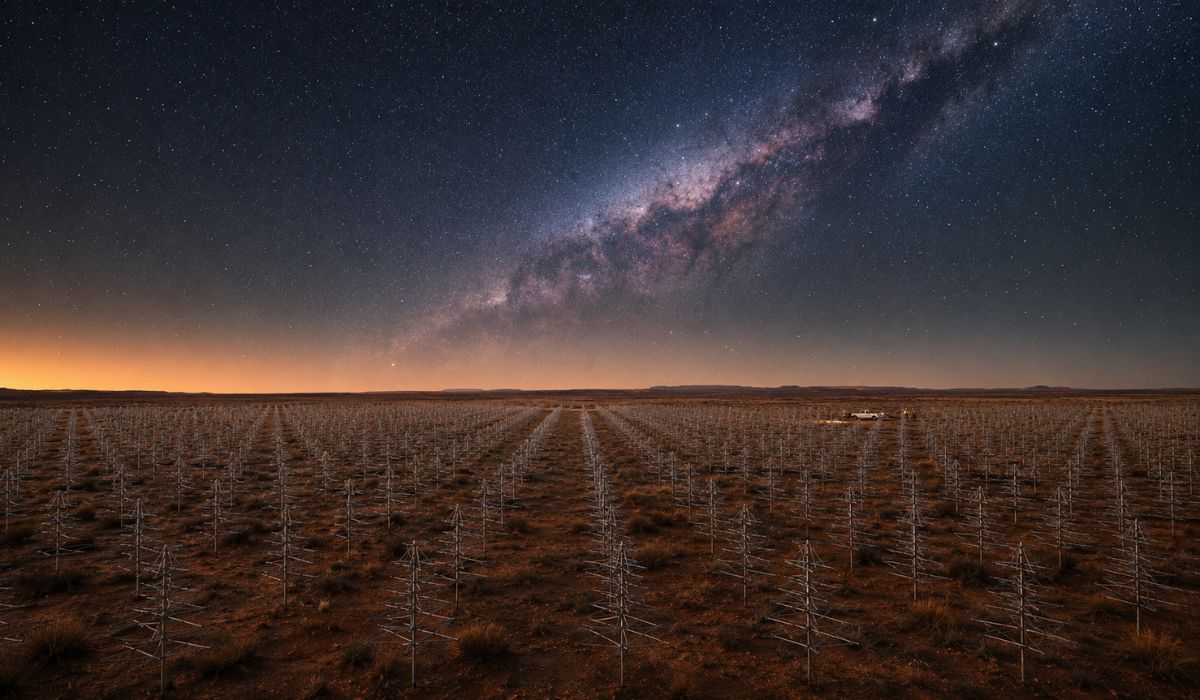

In the Australian desert, the SKA-Low reveals the scale of a scientific endeavor that combines thousands of antennas, radio astronomy, and data processing to capture ancient signals from the Universe in one of the quietest regions for radio.
In the remote interior of Western Australia, a radio telescope still under construction has already begun to show why it is considered one of the greatest bets in world astronomy.
With only 1,024 antennas installed and connected, less than 1% of the 131,072 planned in the complete project, the SKA-Low produced its first image of a region of the Universe and identified about 85 bright galaxies billions of light-years from Earth.
The image was released by the SKA Observatory on March 17, 2025 and remains relevant because it shows, on an initial scale, the operation of a technology that is expected to grow throughout the decade.
-
Man lives 105 days without a human heart after receiving a 650-gram titanium pump with a rotor that floats by magnetism, leaves the hospital in a world first, and gains time until receiving a transplant.

-
Stephen Hawking’s prediction from over 50 years ago is proven in a cosmic collision 1.3 billion light-years away, but the number recorded after the merger left scientists facing a historic confirmation.

-
Inhabited island eliminates all invasive ferrets after using 600 traps, thermal drones, 110 cameras, and a sniffer dog to prevent more than 250,000 seabirds from continuing to lose eggs, chicks, and adults.

-
The United Kingdom pumps more than one million tons of gravel removed from the sea onto a beach, doubling the width of the coastal strip and creating a barrier capable of reducing wave force, containing erosion, and helping to protect over 10,000 properties from flooding.



The record covers an area of approximately 25 square degrees in the sky, equivalent to about 100 full moons seen from Earth.
According to the SKAO, all the galaxies highlighted in this area host supermassive black holes.
The data that makes the case more curious lies in the comparison with the final project.
When the SKA-Low is complete, scientists estimate that the same region of the sky could reveal more than 600,000 galaxies in the same frame, using the full sensitivity of the radio telescope.
The structure is being built at Inyarrimanha Ilgari Bundara, the name of the CSIRO Murchison Radio-astronomy Observatory, on the traditional lands of the Wajarri Yamaji people.
The location is in an area of low radio interference, an essential condition for capturing weak signals that travel through space for billions of years before reaching Earth.
SKA-Low in the Australian Desert
The SKA-Low does not resemble the classic image of a telescope.
Instead of a large lens or a single dish pointed at the sky, it will be formed by thousands of metal antennas two meters high, shaped like small metal trees.
These antennas will be grouped into 512 stations, each with 256 units.
Some will be concentrated in the center of the observatory, while other stations will spread out in three spiral arms across the Australian desert, reaching a maximum distance of 74 kilometers between the furthest points.
In practice, the set functions as a single telescope.
Each antenna captures low-frequency radio waves coming from space.
Then, the signals are combined by processing systems to form images and data that astronomers can analyze.
This technique is called interferometry.
The concept may seem complex, but the logic is straightforward: instead of relying on a gigantic antenna, the observatory uses many separate and synchronized antennas to simulate the capacity of a much larger instrument.
Therefore, the expression “forest of antennas” helps visualize the scale of the project.
What is spread across the desert is not just a collection of metal pieces, but a network capable of transforming invisible signals into maps of the Universe.
First image with 1,024 antennas
The first image of SKA-Low was produced with data from the first four connected stations.
Together, they total 1,024 antennas and are spread over a distance of less than 6 kilometers, according to the SKAO.
In the image, the points may look like stars, but they are galaxies observed in radio light.
These objects are billions of light-years away and contain supermassive black holes at their centers.
The gas around these black holes heats up, moves at high speed, and emits energy, including in radio waves.
The SKA-Low can detect these waves after a long journey through space.
It is this type of signal that allows observing distant phenomena without relying solely on visible light.
At the center of the image released by the SKAO appears a galaxy known for expelling jets of matter visible in both optical and radio light.
This detail helps show why radio telescopes are used to study objects that emit energy in ways different from the common light captured by the eyes.
George Heald, lead commissioning scientist of SKA-Low, stated that the quality of the image was “even beyond what we expected” for such an early version of the telescope.
According to him, the bright galaxies observed are just “the tip of the iceberg.”
Galaxies billions of light-years away
The first result was obtained with less than 1% of the final instrument.
As new stations are connected, the sensitivity and resolution should increase, allowing the observation of weaker and more distant sources.
The SKAO reported that, in the complete stage, deep surveys of the same area of the sky could reveal up to 600,000 galaxies.
The difference between 85 initial objects and hundreds of thousands in the future helps to gauge the expected leap.
The construction has also progressed beyond the initial image.
According to the official SKAO tracking page, by the end of 2025 there were about 15,000 antennas assembled at the SKA-Low site, while the team completed the final phase of verification tests for the first four stations with 1,024 antennas in August 2025.
This point is important to not treat the image from March 2025 as if it were the final stage of the observatory.
It was a commissioning milestone, used to demonstrate that the first stations could work together as a system.
There are still years of assembly, connection, testing, and calibration ahead.
The construction of the SKA telescopes formally began after the SKAO council’s approval in July 2021, with groundbreaking ceremonies at the sites in Australia and South Africa in December 2022.
SKA-Low and SKA-Mid
The SKA Observatory is not composed solely of SKA-Low.
The project also includes SKA-Mid, under construction in the Karoo region of South Africa.
While SKA-Low captures lower frequencies, SKA-Mid will use parabolic antennas to observe mid-range frequencies.
Together, the two instruments will form one of the most complex radio astronomy systems ever planned.
The SKAO is an intergovernmental organization, headquartered in the United Kingdom, created to build and operate these telescopes on behalf of member countries and international partners.
In Australia, the project is developed in collaboration with CSIRO, the country’s national science agency.
CSIRO manages the Murchison observatory, assists in the construction of SKA-Low, and will be an operational partner of the telescope in Australian territory.
The choice of location also involves a territorial and cultural dimension.
The SKAO and CSIRO recognize the Wajarri Yamaji as the traditional owners and native title holders of the area where SKA-Low is being installed.
How radio waves show the Universe
The word “see,” in this case, does not mean seeing with visible light.
SKA-Low observes the sky through radio waves, a form of electromagnetic radiation that can also be emitted by stars, galaxies, cosmic gas, and regions near black holes.
These waves travel great distances and carry information about phenomena that may be hidden, faded in visible light, or located so far away that their signals reach Earth very weakly.
SKA-Low will operate between 50 and 350 megahertz, a range similar to frequencies used in FM radio and TV broadcasts.
The difference is that the telescope seeks natural signals coming from space, not emissions produced on Earth.
Therefore, the observatory needs a radio-quiet region.
Phones, transmitters, and electronic equipment can create interference capable of disrupting the capture of astronomical signals.
The isolation of the Murchison Radio-astronomy Observatory helps to reduce this problem.
The information captured by the antennas travels through fiber optic cables and passes through computing systems.
The expected volume of data is very high.
The Australian government states that the SKA could generate almost 1 terabyte of raw data per second, equivalent to downloading several ultra-high-definition movies every second.
Radio Astronomy and the First Signals of the Cosmos
The SKA-Low was designed to study some of the lesser-known phases of the Universe’s history.
The SKAO states that the telescope could investigate the first billion years after the Big Bang, a period when the first stars and galaxies began to form.
This stage of cosmic history is difficult to observe because the signals are very old, weak, and distant.
To capture them, scientists need sensitive instruments, a large collecting area, advanced processing, and locations with little interference.
Besides the first galaxies, the SKA is expected to aid research on black holes, cosmic magnetism, pulsars, galaxy evolution, dark matter, dark energy, and possible signals related to the formation of structures in the Universe.
Philip Diamond, director-general of the SKAO, stated that the first image represents a critical step for the observatory and the astronomical community.
According to him, the record demonstrates that the system works as a whole and that the images should improve as more stations and antennas come into operation.
Sarah Pearce, director of the SKA-Low telescope, attributed the result to the work of engineers, astronomers, and computer scientists from different countries.
She stated that reaching this point required decades of international collaboration.
Largest Low-Frequency Radio Telescope
The SKA-Low is being constructed in stages.
The model allows parts of the system to be installed, connected, tested, and used for scientific verification before full completion.
This gradual advancement reduces technical risks because problems can be identified while the observatory is still growing.
It also allows early data to be used to test algorithms, calibrate equipment, and train teams.
The scale of the project helps explain the caution.
There are 131,072 antennas planned in the complete version of the SKA-Low, distributed across 512 stations, in addition to power systems, fiber optics, data processing, control, roads, and support infrastructure.
SKAO itself states that its intention is to build the complete baseline design, but the implementation goes through delivery phases.
The strategy includes an initial array with 307 stations in Australia, before the eventual completion of the full design of 512 stations.
Even before being completed, SKA-Low already demonstrates a central idea of modern radio astronomy: observing the Universe does not only depend on building a larger instrument, but on connecting thousands of sensors, processing gigantic volumes of data, and transforming almost imperceptible signals into scientific information.
In the Australian desert, the first image made with 1,024 antennas is just an initial cut of a network that should grow to become one of the largest observation structures on the planet.


