






 Portuguese
  Spanish
  3 min of reading
  0 comments


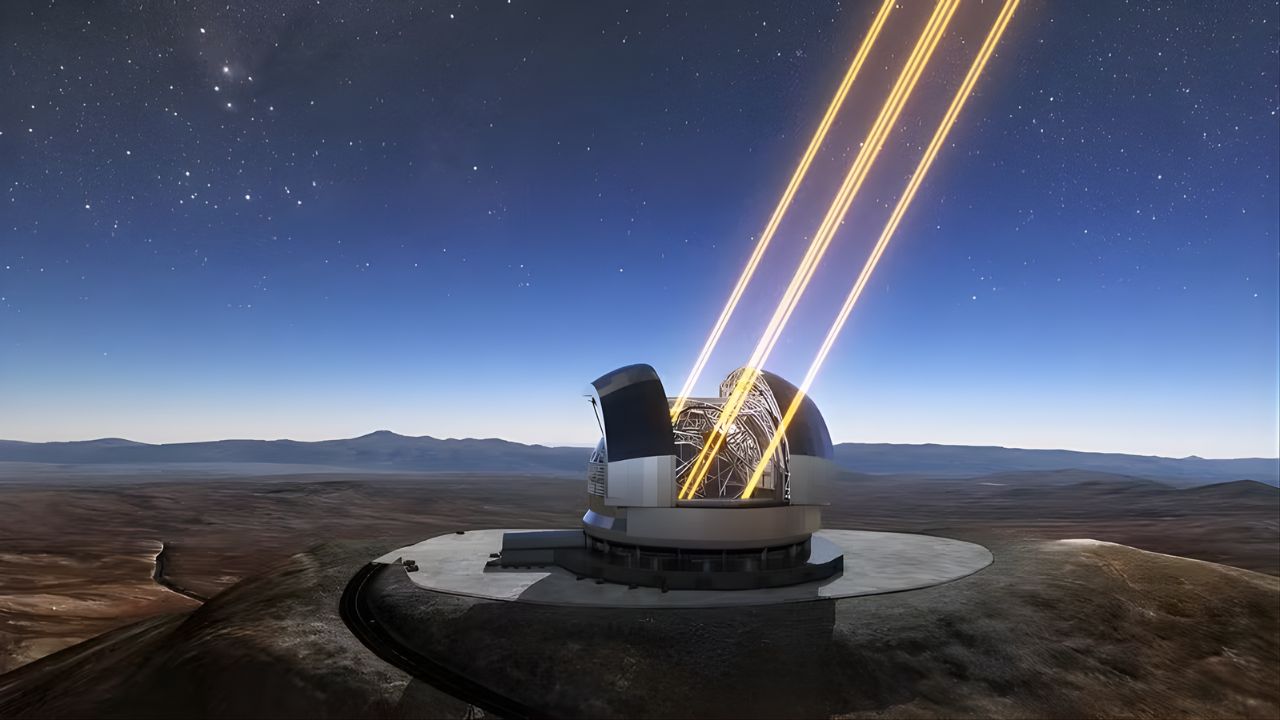
Brazil Contributes to the Development of MOSAIC, Instrument of the World’s Largest Telescope, Which Promises to Revolutionize Global Astronomy.
The Extremely Large Telescope (ELT), which will be the largest optical and infrared telescope on the planet, will have significant participation from Brazil in the development of one of its main instruments.
The country will be responsible for MOSAIC, a multi-object spectrograph that will allow the observation of hundreds of stars and galaxies simultaneously, opening new possibilities for the study of the universe.
The installation of the telescope is underway in the Atacama Desert, Chile, with operation expected by the end of the decade.
-
Goodbye traditional laundry: Roborock launches washer and dryer with super hydrolysis, microbubbles, 99.99% sterilization, low-temperature drying, automatic detergent, app control, and cycles to remove stains, odors, mites, and bacteria from clothes.

-
It is now possible to generate energy without batteries: new flexible material transforms body heat into electricity and paves the way for more efficient, autonomous, and comfortable wearable devices, with the potential to revolutionize personal electronics in the coming years.

-
Leaving the charger plugged in without a phone consumes energy or is it a myth? Experts call the phenomenon “phantom consumption” and warn that dozens of devices on standby can add up on the bill over the year.
-
It accompanies Earth, but it is not a moon: Chinese probe reaches Kamo’oalewa and begins an unprecedented mission to investigate where the strange asteroid came from, what its internal structure is like, and whether its origin is linked to an ancient collision that launched fragments of the lunar surface into space.


The Brazilian participation is coordinated by the Institute of Astronomy, Geophysics and Atmospheric Sciences (IAG/USP) and the National Astrophysics Laboratory (LNA/MCTI), with financial support from FAPESP.
The project also involves institutions from 13 countries in Europe, North America, and South America, making MOSAIC a global scientific effort.
MOSAIC: Brazilian Participation in the ELT Drives a New Era of Astronomical Discoveries
The MOSAIC will allow the study of multiple targets simultaneously, observing up to 140 objects at medium resolution and 80 at high resolution.
According to Beatriz Barbuy, a professor at IAG/USP, “it would be unfeasible to make individual observations when there are several targets in the same region of the sky.”
The instrument divides light into visible and infrared bands, helping to identify chemical elements, measure movements of stars and galaxies, and understand the formation of cosmic structures.
With this technology, researchers will be able to observe very distant and faint objects, overcoming the limitations of current telescopes and complementing discoveries made by the James Webb Telescope.
Brazil will be responsible for the Instrument Core System, the mechanical core of MOSAIC. It includes the structural platform, the rotator — which follows the Earth’s movement — and the support for optical units and fibers.
Everything needs to operate with extreme precision: “There can be no movement greater than 50 microns in a structure of about 25 tons,” explains Barbuy.
This cutting-edge engineering ensures that targets remain stable during long observations, essential for accurate and reliable measurements.

Scientific Impact and Future of the Telescope Project
The Extremely Large Telescope will have the largest mirror ever built for optical observation, allowing for unprecedented studies of the cosmos.
The MOSAIC is expected to start operating between 2032 and 2035, with completion projected for 2039.
Brazilian participation puts the country in the spotlight in the international scene of astronomical instrumentation.
“Brazil will have cutting-edge engineering and optics, ensuring active presence in the evolution of scientific instrumentation,” affirms Barbuy.
With the ELT and MOSAIC, Brazilian researchers will have access to unprecedented observations of distant galaxies, very faint stars, and regions of the universe never before studied.
The national contribution to the project reinforces Brazil’s prominence in global science and consolidates the country’s technological capacity for future astronomical challenges.
Source: Galileu Magazine






-

2 people reacted to this.