






 Portuguese
  Spanish


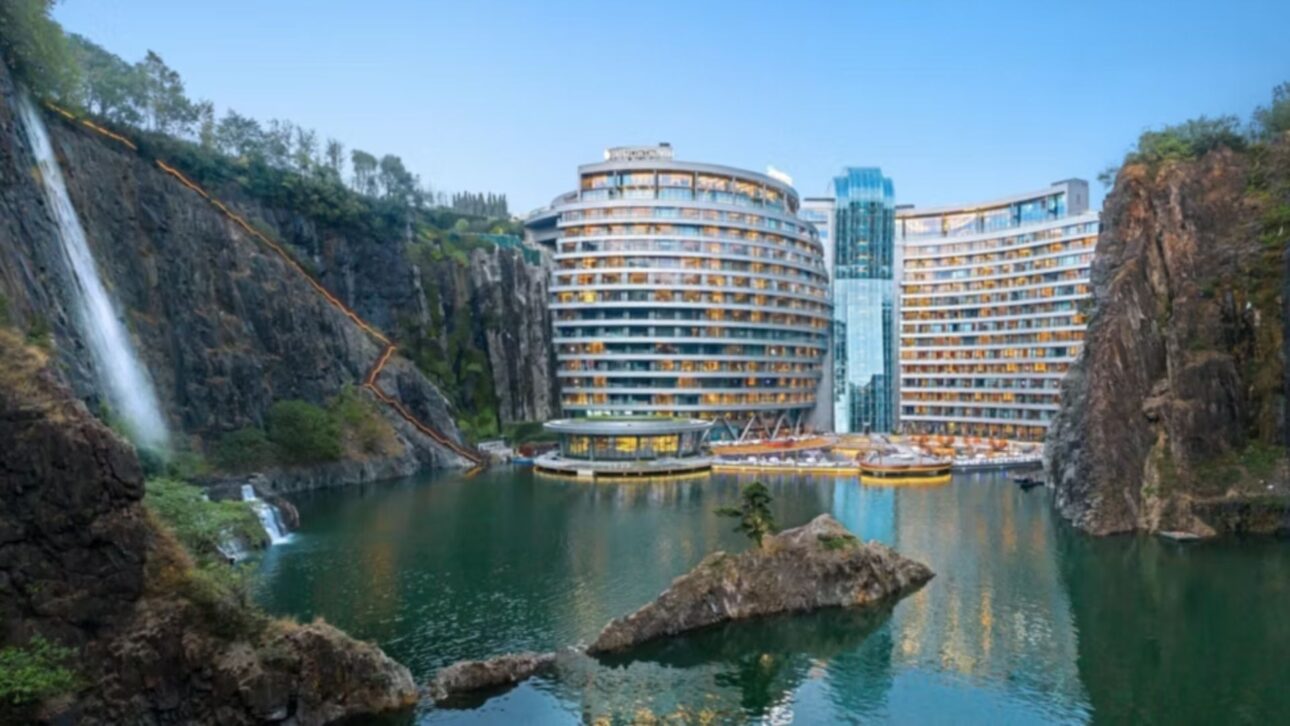
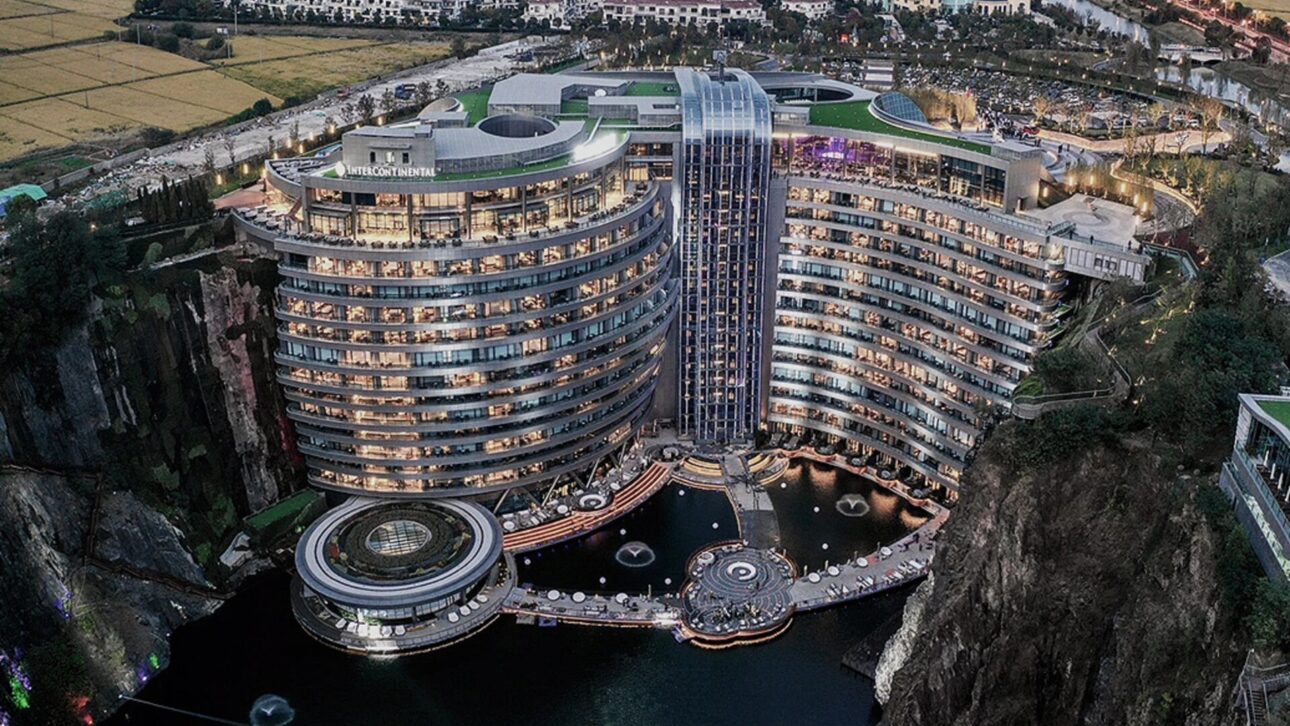
In the Songjiang district, 50 kilometers from downtown Shanghai, China built the InterContinental Shanghai Wonderland inside an abandoned quarry 88 meters deep. The hotel has 18 floors, 16 of which are below ground level, two of which are completely submerged. It opened in November 2018 after an investment of US$ 555 million.
When thinking of a five-star hotel, the usual image is of a glass and steel tower dominating the skyline. The InterContinental Shanghai Wonderland does the opposite. Opened on November 20, 2018, in the Songjiang district of Shanghai, China, the development was built inside a crater: an abandoned quarry 88 meters deep that the Shimao Property Group decided to transform into one of the country’s most unusual architectural projects. There are 18 floors in total, with 16 below the natural ground level.
The investment declared by the developer group was US$ 555 million, according to the InterContinental. Two of the underground floors are completely below the water surface that partially fills the old quarry, forming an artificial lake that surrounds the hotel’s structure. In these submerged floors, there are rooms with views of a five-meter-deep aquarium and a restaurant entirely surrounded by water. China did not build a skyscraper. It built the opposite: an earthscraper.
A forgotten quarry in the middle of Songjiang
The site has a history that predates the hotel by decades.
-
California Diverts 65% of Construction Waste from Landfills, Repurposing Millions of Tons into Road Base, New Asphalt, and Wood Chips

-
Japan Constructs World’s Deepest Sea Wall in the Pacific, Sinking Massive Concrete Structures for Three Decades

-
Pair Transforms Sunken Pontoon Bought for $4,000 on Facebook into 8,800-Pound Solar-Powered Tiny Home on Water
-
In Flood-Stricken South Sudan, Displaced Families Use Sand-Filled Plastic Bottles to Build Cooler, More Durable Homes


The Tianma quarry, in the Songjiang district, was mined for years for rock extraction and then simply abandoned, leaving a deep crater 88 meters in the middle of the landscape.
This type of geological void is a common problem in regions with a history of mining: it is expensive to recover, not suitable for conventional construction, and remains unused for an indefinite period.
China has numerous quarries in this situation scattered throughout the country’s interior.
What changed in Songjiang was the decision by the Shimao Property Group to see the depth as an asset, not as an obstacle.
Instead of filling the crater or surrounding it with fences, the group hired architectural firms to develop a project that would use the 88 meters of depth as a central element of the hotel experience.
The abandoned quarry became both the terrain and the landscape.
The exposed rock on the crater walls became part of the aesthetic of the development, not a problem to be hidden.
The project that took a long time to get off the ground
The journey of the InterContinental Shanghai Wonderland to opening was marked by prolonged delays.
The project was a finalist for an award at the World Architecture Festival back in 2009, almost a decade before opening its doors.
Between 2009 and 2013, the construction saw many starts and stops without significant progress. From 2013, the pace accelerated, and the finishing works were completed in 2017, with the inauguration taking place at the end of November 2018.
The concept and facade design were created by architect Martin Jochman, who began the work while at the Atkins office and, in 2013, founded his own studio, JADE+QA, continuing the project directly for the Shimao Property Group.
The technical development, construction documentation, structural design, and electrical, hydraulic, and mechanical systems were handled by ECADI, the East China Architectural Design & Research Institute.
The interior design was divided between the CCD and AB Concept offices, and the lighting was managed by the Illuminate Lighting Design consultancy.
How to build an upside-down hotel
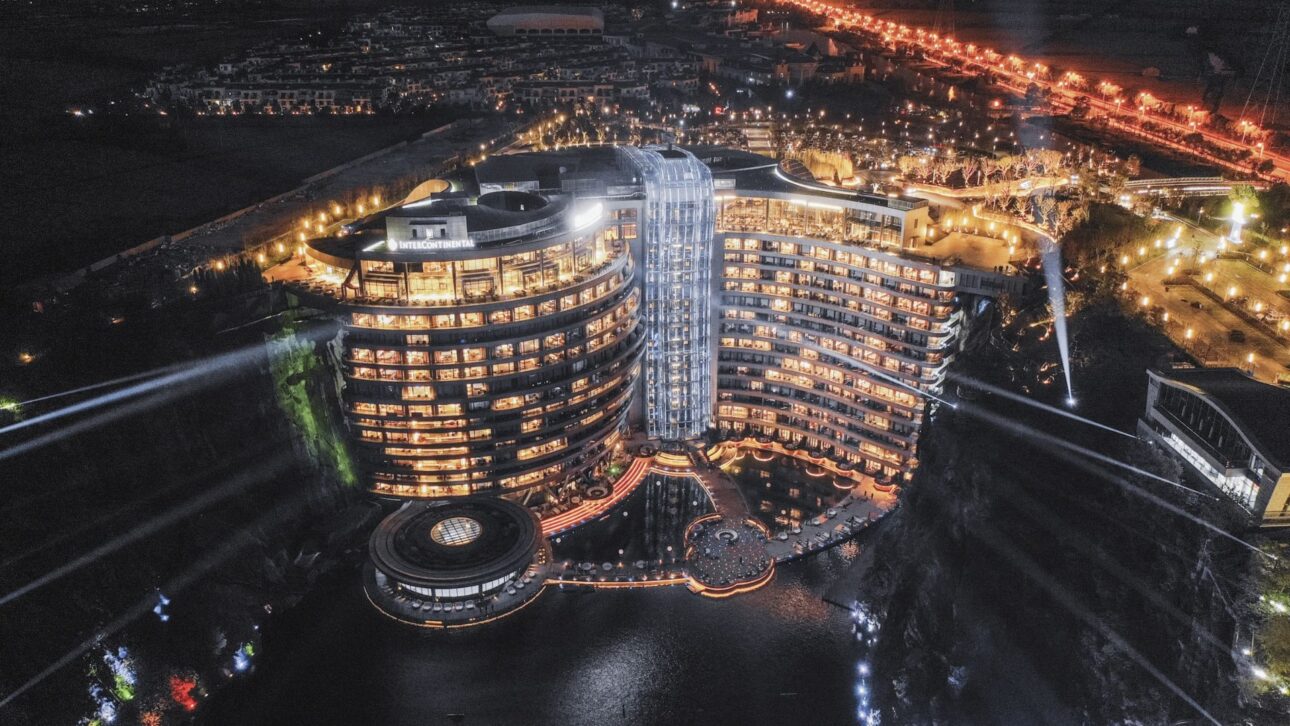
The “S” shape of the building was chosen to adapt the structure to the irregular contour of the quarry, alternating between a convex and a concave face along the main facade.
The architects’ vision included sequential hanging gardens designed to create the effect of a green slope descending down the crater wall.
Both the exposed rock of the quarry and the room blocks were planned to surround a central vertical atrium, glass-clad, visually mimicking an artificial waterfall.
This glass atrium was described by the specialized portal New Atlas as the pièce de résistance of the project, the visual element anchoring the experience of those walking through the hotel’s internal corridors.
At the top of the structure, still within the property, there is a glass walkway positioned 87 meters above the ground, projected out from the edge of the cliff.
Those who cross this walkway have only glass under their feet and, below, the entire quarry crater with the lake and the hotel floors visible down below.
The submerged floors: rooms and underwater restaurant
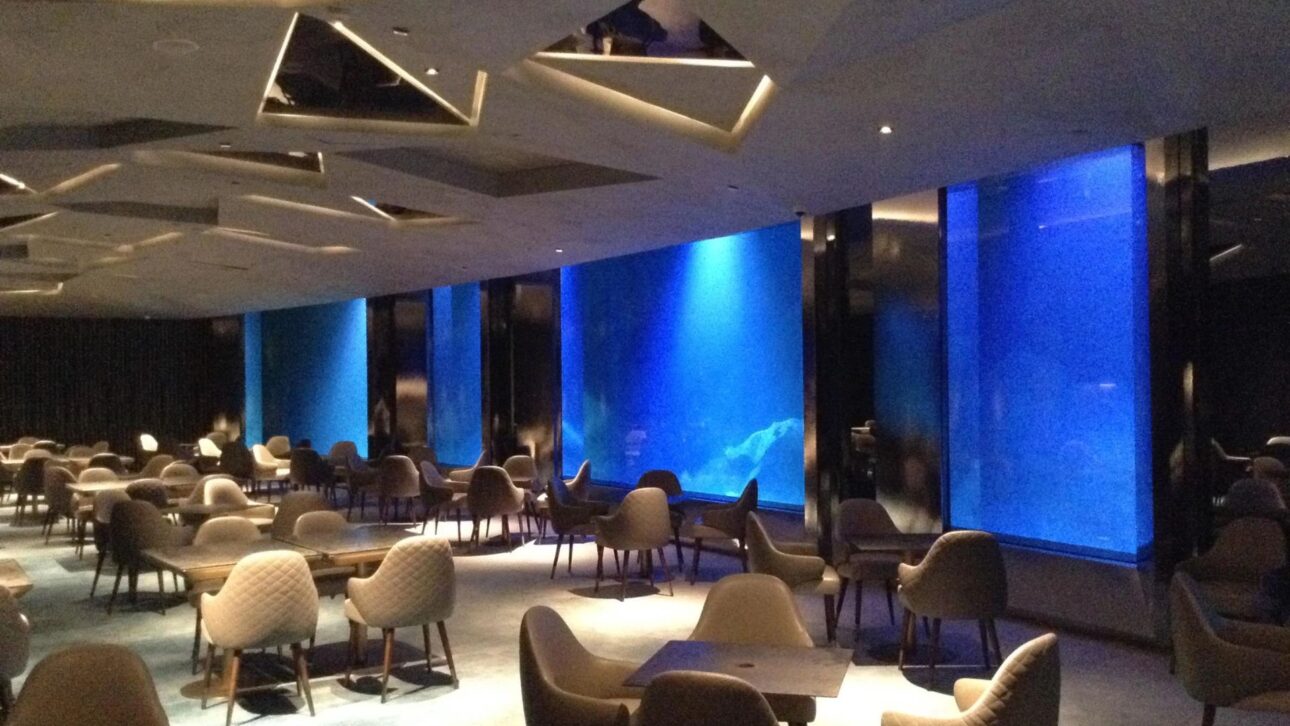
The two floors below the lake level are the most unique part of the project.
The lower floor houses the hotel’s technical and infrastructure facilities, the so-called MEP systems of mechanical, electrical, and plumbing.
The upper floor is where the submerged rooms and the restaurant with a view into the five-meter-deep aquarium are located. Guests in these rooms look out the window and see water, rocks, and fish, not the city.
The idea of hosting people below the water surface in a high-quality environment poses considerable engineering challenges: structural sealing against hydrostatic pressure, specific lighting systems for the depth, humidity, and temperature control in continuously damp conditions.
The project has not publicly detailed all the technical solutions adopted, but the hotel’s operation since November 2018 indicates that these issues have been resolved satisfactorily.
The price of the underwater rooms started at $500 per night at the opening, adjusted to about $360 in 2020, according to information available on the official InterContinental website.
337 rooms, a thousand people in conferences, and a glass waterfall
The InterContinental Shanghai Wonderland is not just an architectural curiosity.
It is a fully operational hotel, with 337 rooms, conference space with a capacity for up to a thousand people, a large ballroom, and restaurants and cafes at ground level above the crater.
The property management was entrusted to the InterContinental Hotels Group, one of the largest hospitality groups in the world, which used the project as one of its flagship ventures in China.
The combination of luxury hotel, underwater experience, and quarry setting is unusual enough that the project has generated international coverage since before it opened.
Visitors arriving at the site find a complex that includes, in addition to the hotel, the Chenshan Botanical Garden, the Tianmashan Country Club, and access to nearby mountains.
What was an abandoned crater has become a high-end tourism and hospitality hub less than an hour from downtown Shanghai.
What this project says about current Chinese engineering
The InterContinental Shanghai Wonderland represents a specific strand of architecture and civil engineering that China has been exploring with increasing frequency: transforming environmental liabilities into high-value economic assets.
Abandoned quarries, contaminated lands, and topographies considered unviable for conventional construction have become standout projects in different Chinese cities in recent years.
The model combines the need for land use with a desire for image innovation.
The scale of investment in Songjiang, $555 million according to New Atlas, shows that this type of bet has real financial backing in the Chinese real estate market.
The project took almost a decade from concept to inauguration, with delays reflecting the technical and bureaucratic complexity of an unprecedented construction.
But the physical result exists and works.
In a world where flat and easily accessible land is increasingly scarce and expensive, the idea of building downwards instead of upwards may seem eccentric today and become more common tomorrow.
Transforming an abandoned quarry 88 meters deep into a hotel with underwater rooms is an example of creative engineering that the world should replicate, or is it a showy project using expensive technology to solve a problem no one had? Would you sleep in a submerged room? Leave your opinion in the comments.







Trust China, they can create anything out of nothing/anything.
Incredible absolutely STUNNING accomplishment the placement the design the 💡innovative reuse of discarded industrial wasteland – my applause couldn’t be more thunderous C👏🏼👏🏼👏🏼👏🏼👏🏼👏🏼👏🏼👏🏼 Bravo!
I think this is brilliant! Such an incredibly innovative way of thinking, and a true showcase to the powers of what current technology and engineering can accomplish! I think most people in the West tend to either forget or ignore this aspect of China. They can be incredibly forward thinking, and their ability to create these massive projects is something remarkable.