






 Portuguese
  Spanish


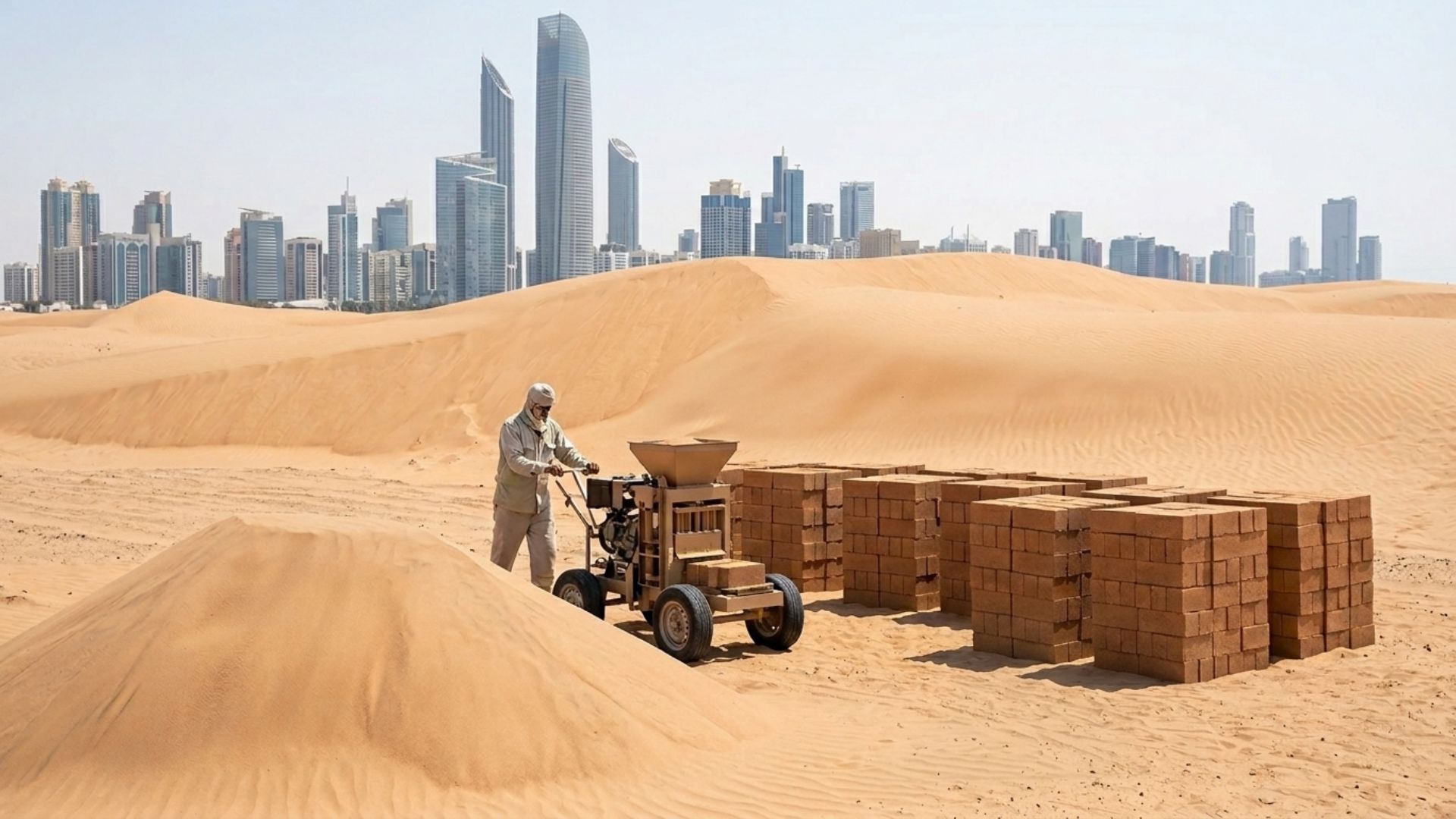


Researchers from the United Arab Emirates have transformed desert sand into eco-friendly bricks that harden without kilns and reduce dependence on Portland cement.
For decades, desert sand was considered a paradox in construction. Although it covers vast areas of countries like the United Arab Emirates, it has always been seen as unsuitable for conventional concrete and mortar because its grains are excessively smooth and rounded, making it difficult to achieve the necessary adhesion to form strong structures. This limitation forced many desert countries to import huge volumes of sand from other regions to supply the construction sector.
Now, researchers from the University of Sharjah in the United Arab Emirates claim to have found a solution to this historical problem. The team has developed bricks made from desert sand and alkali-activated binders, creating a material capable of hardening at room temperature and reducing dependence on Portland cement, one of the most environmentally impactful materials in modern construction.
Why desert sand has always been rejected by construction
Construction relies on mineral aggregates to produce concrete, mortar, and blocks. In general, the sand used comes from rivers, quarries, or specific deposits because it has more angular grains that fit better in the mix.
-
China’s Engineered Bamboo: The “Material of the Future” Stronger Than Steel and a Sustainable Wood Alternative

-
Egypt’s “New Nile”: 170 km Artificial River Aims to Turn Desert into Farmland, but Water Supply Concerns Loom
-
Unable to secure a mortgage as a self-employed single mother, she designed her own floating home from a 20-meter boat and now lives “off-grid” with her two children and solar panels on an English canal.
-
Man Transforms Rusty Shipping Container into Luxury Home with Insulated Walls, Large Windows, and Drywall Finish, Surprising Onlookers




According to the University of Sharjah, the sand found in deserts has been considered unsuitable for various structural applications for decades due to the shape of its grains. The constant action of the wind over thousands of years leaves the particles extremely rounded and smooth, reducing the adhesion between materials.
This scenario created a curious situation in several Gulf countries. Surrounded by some of the largest sand expanses on the planet, they often need to import suitable sand to meet the demand of the construction industry.
How scientists transformed dunes into eco-friendly bricks
To overcome this limitation, the researchers used sand collected in the Sharjah region and combined it with alkali-activated binders, known internationally as Alkali-Activated Binders (AABs).
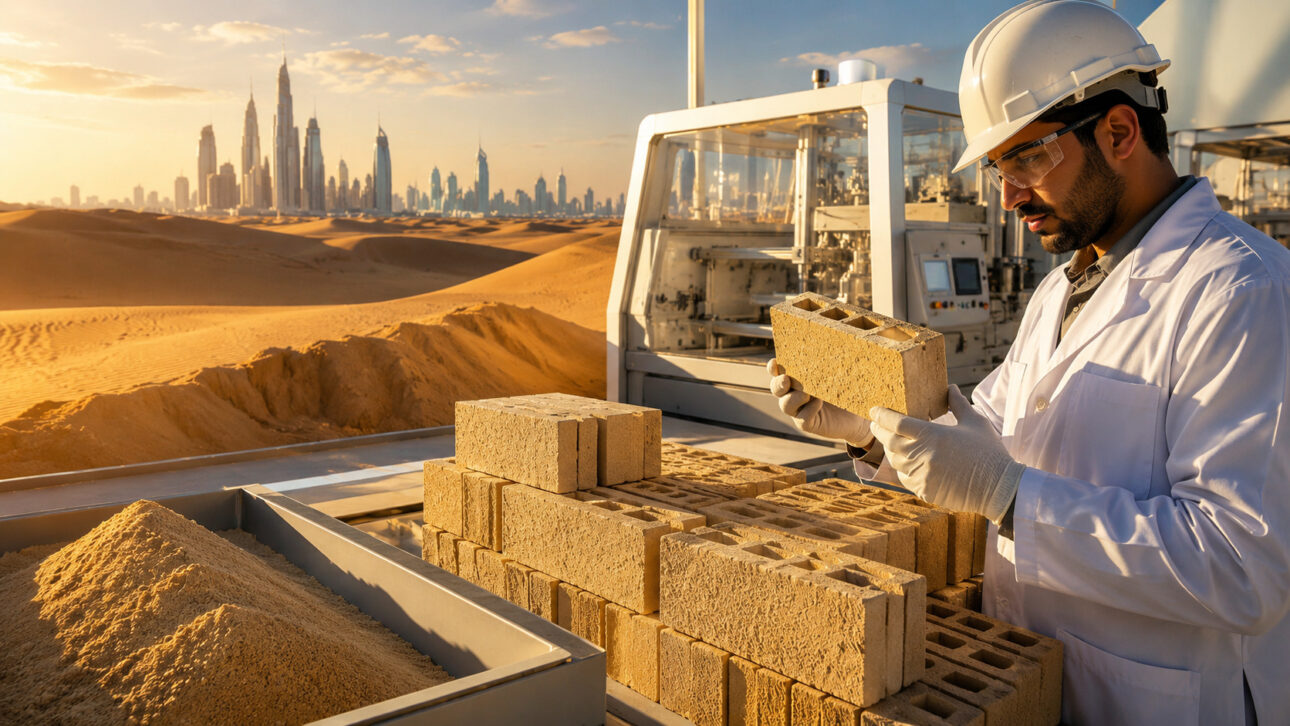
According to the study published in the Journal of Materials in Civil Engineering, these binders use alkaline solutions to trigger chemical reactions that form solid rock-like structures. Unlike traditional Portland cement, the system can also incorporate industrial by-products such as blast furnace slag and industrial ashes.
One of the most relevant aspects of the technology is that the bricks harden at room temperature, eliminating the need for thermal curing processes or kiln firing. According to the researchers, this significantly reduces energy consumption and potential manufacturing costs.
Bricks showed superior performance in durability tests
The results obtained by the team indicate that the blocks produced with desert sand not only serve as an environmental alternative. They also showed competitive mechanical performance compared to conventional materials.
According to the researchers from the University of Sharjah, the bricks demonstrated greater mechanical strength, lower water absorption, and better performance in durability tests when compared to blocks produced with conventional cement.
The tests also evaluated resistance to the so-called sulfate attack, one of the main problems faced by structures located in coastal regions or in soils rich in mineral salts. According to the results released by the university, the desert sand bricks maintained their structural integrity and, in some scenarios, outperformed traditional cementitious materials.
The goal is to reduce one of the largest sources of CO₂ in construction
The relevance of the research goes beyond the use of an abundant resource. Portland cement is among the most criticized industrial materials for its carbon footprint.
The University of Sharjah highlights that the production of Portland cement is associated with a significant portion of global carbon dioxide emissions. The researchers cite that this material accounts for up to 10% of global CO₂ emissions, making it one of the main targets of initiatives aimed at decarbonizing civil construction.
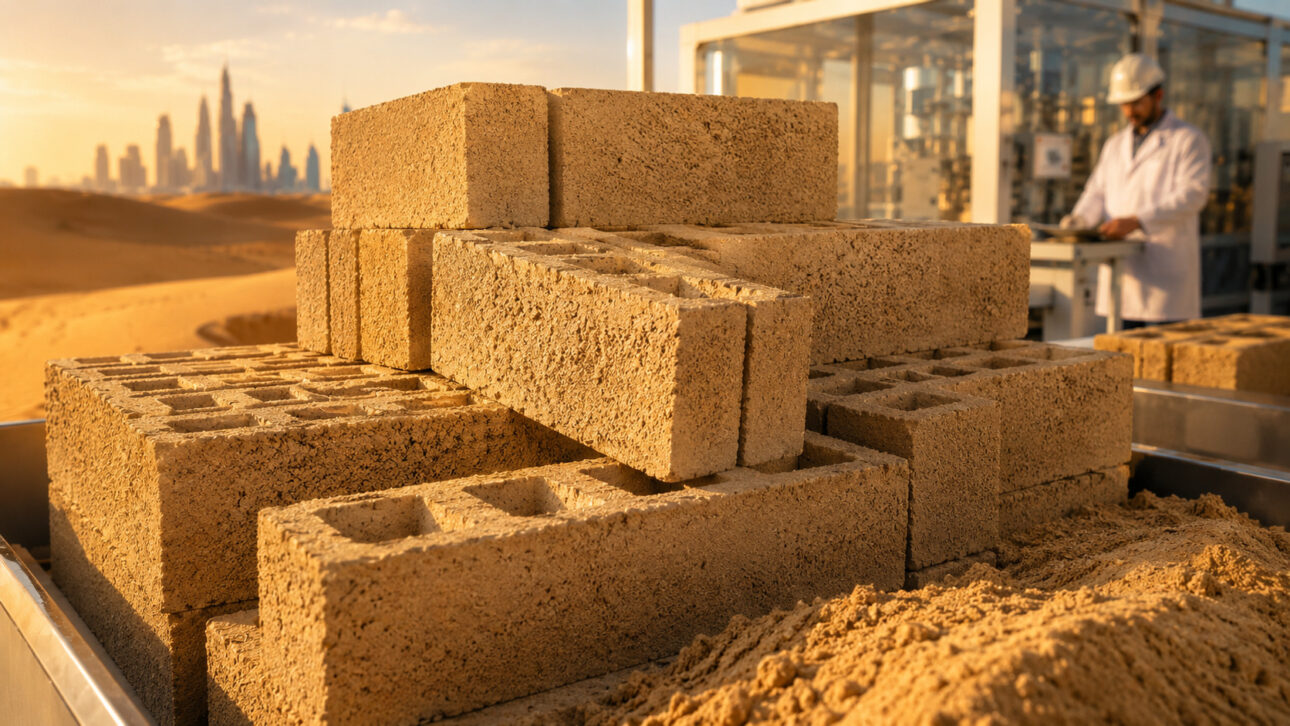
By using local sand and reducing dependence on conventional materials, the technology can decrease emissions related to both the manufacturing and transportation of inputs. Additionally, the use of industrial waste such as slag and ash creates a production chain more aligned with the principles of the circular economy.
The next step is to bring the technology to real construction projects
Despite promising results, the researchers emphasize that the project still needs to go through additional stages before reaching the large-scale market.
According to the University of Sharjah, the team is now working on pilot test programs and economic feasibility analyses to verify the consistency of production on an industrial scale. The goal is to assess costs, logistics, performance in real construction projects, and potential adoption by the construction industry.
If the results are confirmed outside the laboratories, one of the planet’s most abundant and historically underutilized raw materials could gain a new function.
The same sand that for decades was considered unsuitable for construction could help build cities in arid regions, reducing emissions, utilizing local resources, and creating a new category of sustainable materials for civil engineering.





Highly needed so I appreciate their research work and looking forward results of economic feasibility on an industrial scale.
Don’t forget that the Pyramids of Giza, Egypt and Sudan were build years ago with desert sand and they still stand up till as we speak!
They were not built with desert sand, they used stone mined from quarries.
Its been used in Saudi Arabia for a long time. Even the pyramids were built using the Sahara sand with special binders. It is quoted in the Noble Quran.
They were not built with desert sand, they used stone mined from quarries. The Quran also never mentioned the pyramids.