Portuguese
 Spanish


StoneX projects higher imports of anhydrous ethanol during the sugarcane off-season, driven by lower inventories, strong consumption and slower mill production. Imports could exceed the volume recorded in the first quarter of 2026.
Brazil is one of the world’s largest ethanol producers, but that does not mean enough fuel will be available throughout the year. As the sugarcane off-season begins, the country may need to import 562 million liters of anhydrous ethanol between January and March 2027, according to a forecast by consulting firm StoneX.
If the estimate holds, imports will be about 59% higher than the 353 million liters imported during the same period in 2026. The increase stands out because it comes as Brazil expands the use of biofuel in gasoline.
The forecast, released on November 18, assumes tighter inventories, higher consumption and slower production at mills in Brazil’s Center-South region. StoneX considers several possible scenarios, but sees 562 million liters as the most likely volume.
-
Cooperalfa invests R$230 million in a biodiesel plant in Chapecó to produce up to 414 million liters annually and create 110 jobs

-
Goiás to Establish R$140 Million Plant to Convert Industrial Waste into Biomethane, Fueling 100 Buses via 25-Kilometer Pipeline
-
Ethanol rises 2.41% at Brazilian gas stations to R$4.25 per liter as gasoline barely moves, leaving flex-fuel drivers to compare their own car’s fuel economy

-
Brazil logs R$27.5 billion across 24 corn ethanol plant listings in seven states, but 14 show no construction underway




Falling ethanol inventories raise concerns ahead of the off-season
The main reason imports may be needed is the amount of fuel held in storage by mills. On November 1, stocks of anhydrous ethanol in the Center-South totaled about 2.85 billion liters, based on data from Brazil’s Ministry of Agriculture and Livestock used by StoneX.
That was 20.7% below the level recorded on the same date in the previous crop year. It was also the lowest level for that point in the season since the 2021/22 crop year.
At first glance, the situation seems contradictory. Total ethanol production in the Center-South had reached 28.1 billion liters by early November, up 3% from the previous season.
But higher output over the course of the crop year does not guarantee sufficient inventories for the months ahead. Supply depends on the pace of mill operations, how much feedstock is allocated to each type of ethanol and how much the market consumes.
In recent weeks, rain disrupted sugarcane crushing and reduced production. At the same time, higher sugar prices on the international market encouraged mills to direct some of their feedstock toward sugar production.
With less sugarcane available for fuel production at the end of the crop year, the market enters the off-season with less room to meet demand.
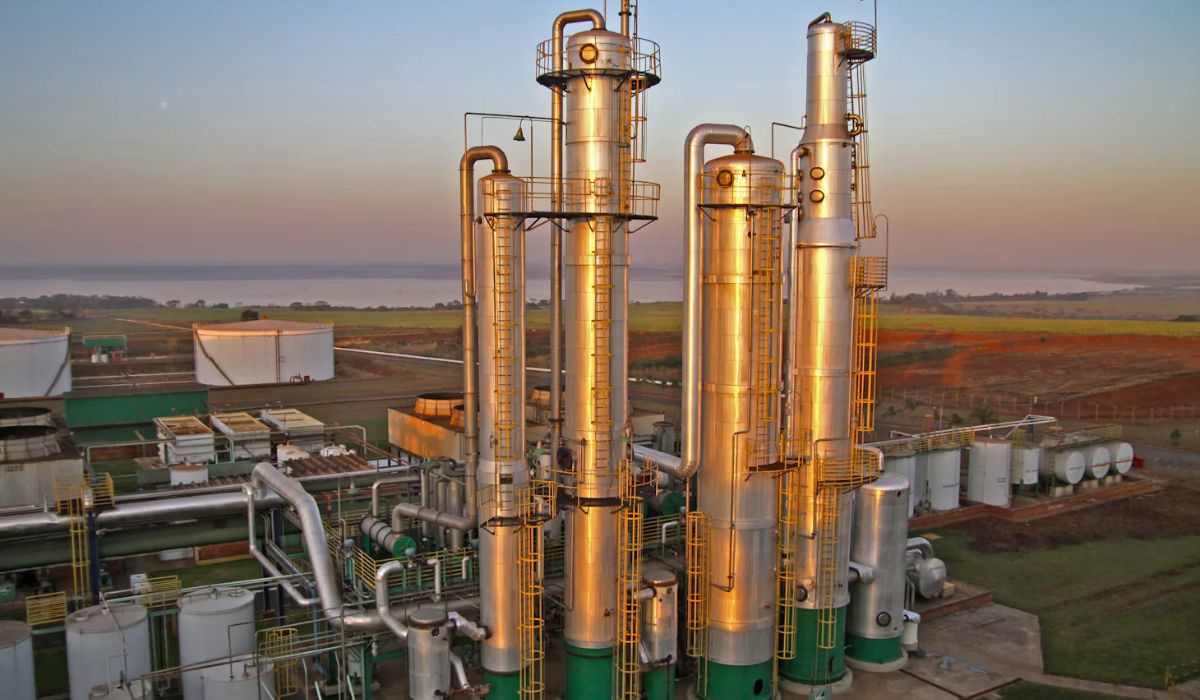
32% gasoline blend increased demand for anhydrous ethanol
Another factor helping explain the projection is the gasoline sold at filling stations in Brazil. Since August 1, 2026, regular gasoline has contained 32% anhydrous ethanol, replacing the previous 30% blend.
The change increased distributors’ supply requirements. StoneX’s calculations show that the two-percentage-point increase in the blend raised mandated biofuel consumption by 6.7%.
Domestic anhydrous ethanol shipments were already up 8% from the previous crop year.
It is important to note that anhydrous ethanol is not the same fuel sold separately at filling-station pumps. It contains less water and is blended with gasoline, while hydrous ethanol is sold directly for use in compatible vehicles.
For that reason, an increase in total ethanol production does not necessarily mean more anhydrous ethanol will be available. Mills also have to meet demand for hydrous ethanol, and production allocation can shift with prices and market conditions.
The E32 blend was authorized temporarily by Brazil’s National Energy Policy Council, initially for 180 days starting in August, with the possibility of an extension for an equal period.
That detail will matter for supply in 2027. Whether the 32% blend remains in place after the initial period will depend on applicable regulatory decisions, potentially changing the demand assumptions used in the projections.
StoneX models three import scenarios through March 2027
The estimate of 562 million liters is not based on an isolated forecast of purchases. The consultancy analyzed available ethanol supplies, expected production through March, and the consumption that will need to be met during the months when mills are less active.
The calculation starts with approximately 2.846 billion liters in storage on November 1. StoneX projects another 3.267 billion liters of production through March 2027, while shipments from mills are expected to reach 5.921 billion liters.
Without additional imports, that balance would leave just 192 million liters in inventory at the end of March, an amount considered insufficient to maintain the supply security envisioned in the consultancy’s scenarios.
Based on these figures, three import scenarios were calculated, depending on the level of reserves the market aims to maintain.
In the lowest-need scenario, which assumes the regulatory minimum inventory, imports would total 339 million liters. To maintain a reserve equivalent to 30 days of projected shipments, the volume would reach 1.032 billion liters.
Between these two possibilities is the forecast of 562 million liters, based on a year-end inventory similar to the level recorded in March 2026.
For Letícia Corrêa, StoneX’s market intelligence analyst, this is the most likely scenario. The projection points to purchases concentrated between January and March, when imports could become more economically competitive.
The increase would also be significant compared with recent history. In the first quarter of 2024, Brazil imported just over 6 million liters of anhydrous ethanol. The volume rose to 65 million liters in 2025 and reached 353 million in early 2026.
Ethanol prices and the dollar exchange rate could determine import volumes
Although the need to replenish inventories is growing, importing ethanol is not necessarily the cheapest option for distributors.
StoneX says domestic anhydrous ethanol prices have risen 24% since the beginning of September, reaching R$3.46 per liter in the week ended November 11.
Over the same period, hydrous ethanol became 22% more expensive, reaching R$2.93 per liter. The sharper rise in anhydrous ethanol prices reflects pressure from stronger demand on supply that has begun to weaken.
The consulting firm is closely tracking import conditions at the ports of Santos, in São Paulo state, and Suape, in Pernambuco state.
In its survey, domestically produced anhydrous ethanol cost R$3,650 per cubic meter in Suape, while imported product would cost R$4,192. In Santos, the respective prices were R$3,865 and R$4,294.
At the conditions observed, that price gap still made overseas purchases less attractive. However, lower international prices, particularly in the United States, could make imports more appealing in the coming months.
The exchange rate will also weigh on that decision. A stronger dollar makes foreign fuel more expensive, while ocean freight and insurance costs could erode the advantage offered by international prices.
StoneX considers it possible that the import window will begin to open in December 2026, with more favorable conditions in January 2027.
The 562 million liters, therefore, represent an estimated need to preserve inventories, not a volume of purchases already contracted. The outcome will depend on Brazilian production in the coming months, gasoline consumption, decisions on the E32 blend, and the competitiveness of imported ethanol.