






 Portuguese
  Spanish


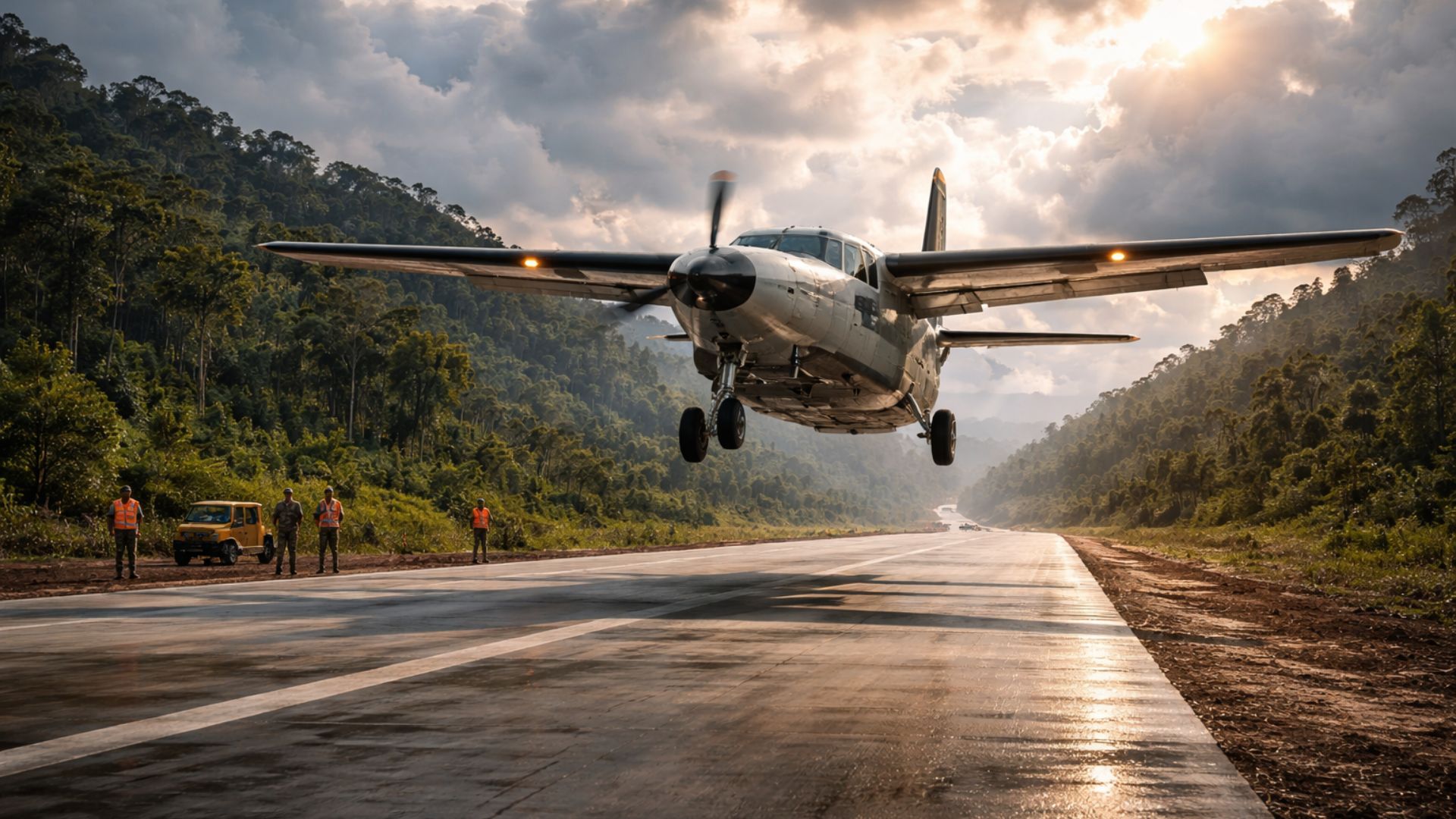

Unprecedented operation validates concrete runway in the Amazon and reinforces logistics strategy in isolated region, with direct impact on operational capacity, durability of infrastructure, and air integration in Coari, Amazonas.
On March 26, the Brazilian Air Force executed the first technical landing on the new section of the runway at the Coari Aerodrome in Amazonas, validating in real conditions the newly implemented rigid pavement and advancing the modernization of the local airport infrastructure.
Conducted by a C-98 Caravan aircraft from the Seventh Air Transport Squadron, the Cobra Squadron, the operation took place under the coordination of the Amazon Region Airports Commission, COMARA, responsible for works and logistical support in hard-to-reach areas.
Considered a technical milestone in the project schedule, the procedure allowed for the assessment of the performance of the new segment of the runway and verification of its compliance with safety and efficiency requirements, according to the operational planning established for the aerodrome.
-
Workers renovating a playground in northern England uncover 176 World War II bombs buried underground; training artifacts still contained explosives.

-
Brazilian Architect Transforms Waste into Sustainable Homes with Solar Power and Rainwater Systems for 40 Years

-
Security Guard Becomes Doctor at Louisiana Hospital Where He Once Worked, Studied Chemistry Between Shifts

-
Woman Rescued from Luxury Complex in Brazil Worked Without Pay for 55 Years, May Be Entitled to Over $300,000




Participating in the agenda were the commander of the First Air Command, Major Brigadier José Virgílio Guedes de Avellar, and the vice president of COMARA, Colonel Aviator Antônio Carlos Neves Trigueiro, overseeing the field validation.
Concrete runway increases resistance and operational capacity

Designed to increase the durability of the runway and elevate its load-bearing capacity, the concrete section responds to the severe climatic conditions of the region, where heavy rains and environmental variations directly affect maintenance conservation and logistics.
In this scenario, the adoption of rigid pavement meets a recurring operational need in the Amazon, where the transport of supplies, movement of teams, and execution of services depend on more complex logistical chains than in areas connected by road networks.
Construction in Coari advances with a focus on infrastructure and operation
Part of a broader set of initiatives, the intervention in Coari integrates actions of the FAB with the National Civil Aviation Secretariat and the Ministry of Ports and Airports, structured by administrative instruments aimed at airport requalification in the region.
Among these instruments, the Decentralized Execution Term No. 937690/2022 stands out, formalized on December 27, 2022, which provides for the construction of the new passenger terminal at Coari Airport as part of the ongoing modernization.
Although the technical landing symbolizes a visible advance, the project involves multiple fronts of engineering, oversight, and logistical support, maintained by the Aeronautics to ensure the continuity of the works and the integration of local airport structures.
With a transfer of R$ 12,206,458.21 for the construction of the new passenger terminal, the TED demonstrates that modernization is not limited to the runway, also encompassing essential facilities for the operation and expansion of the airport’s operational capacity.
Airport infrastructure is strategic in the Amazon
In Amazonian municipalities with restricted access, improvements of this magnitude play a decisive role, as airport infrastructure enables the movement of teams, institutional support, and the circulation of supplies in regions with limited logistical alternatives.
At the same time, more resilient runways and adequate facilities help reduce operational vulnerabilities, as well as increase the predictability of air missions, especially during periods of heavy rain or accelerated surface wear.
COMARA inspection toured bases and detachments in the Amazon

Integrating the Monthly Inspection Visit of COMARA, held from March 23 to 27, the stop in Coari was part of an itinerary that included various points in the Amazon with high logistical complexity.
During the trip, the delegation led by the commander of I COMAR and the vice president of the commission visited support and engineering detachments, supervising activities, monitoring the execution of services, and assessing operational conditions in the field.
On the itinerary, the COMARA Support Detachment in Manaus was visited, as well as the structures located in São Gabriel da Cachoeira and Tabatinga, enhancing the monitoring of the operational fronts maintained by the Aeronautics in the region.
Inspections also took place at the Engineering Detachments in Iauaretê and Coari, where the commission monitors the progress of the municipal airport’s paving, a stage considered strategic for consolidating local infrastructure.
Technical inspections ensure military engineering standards
Throughout the inspections, technical assessments, analysis of operational conditions, and logistical checks were carried out, procedures aimed at aligning guidelines with local teams and ensuring compliance with military engineering parameters.
This continuous monitoring becomes especially relevant in Amazonian projects, where factors such as climate, distance, and supply directly influence the pace of construction and the efficient use of available resources.
Also on the agenda, the delegation conducted a technical visit to the Estirão do Equador Airport, on the border with Peru, considered essential for supporting the 4th Special Border Platoon of the Brazilian Army.
Completed by COMARA through a Decentralized Execution Term signed with the National Civil Aviation Secretariat, the infrastructure follows the same model adopted in other strategic interventions in Western Amazonia.
In 2021, the Air Force itself had already highlighted the inauguration of the local runway with 1,500 meters of concrete pavement, emphasizing the relevance of this type of solution for remote locations in the border area.
In the case of Coari, the first landing on the modernized stretch indicates reduction of infrastructure vulnerability, greater operational robustness, and increased response capacity, reinforcing the role of aviation as an essential link for integration in isolated areas of the Amazon.


