Portuguese
  Spanish


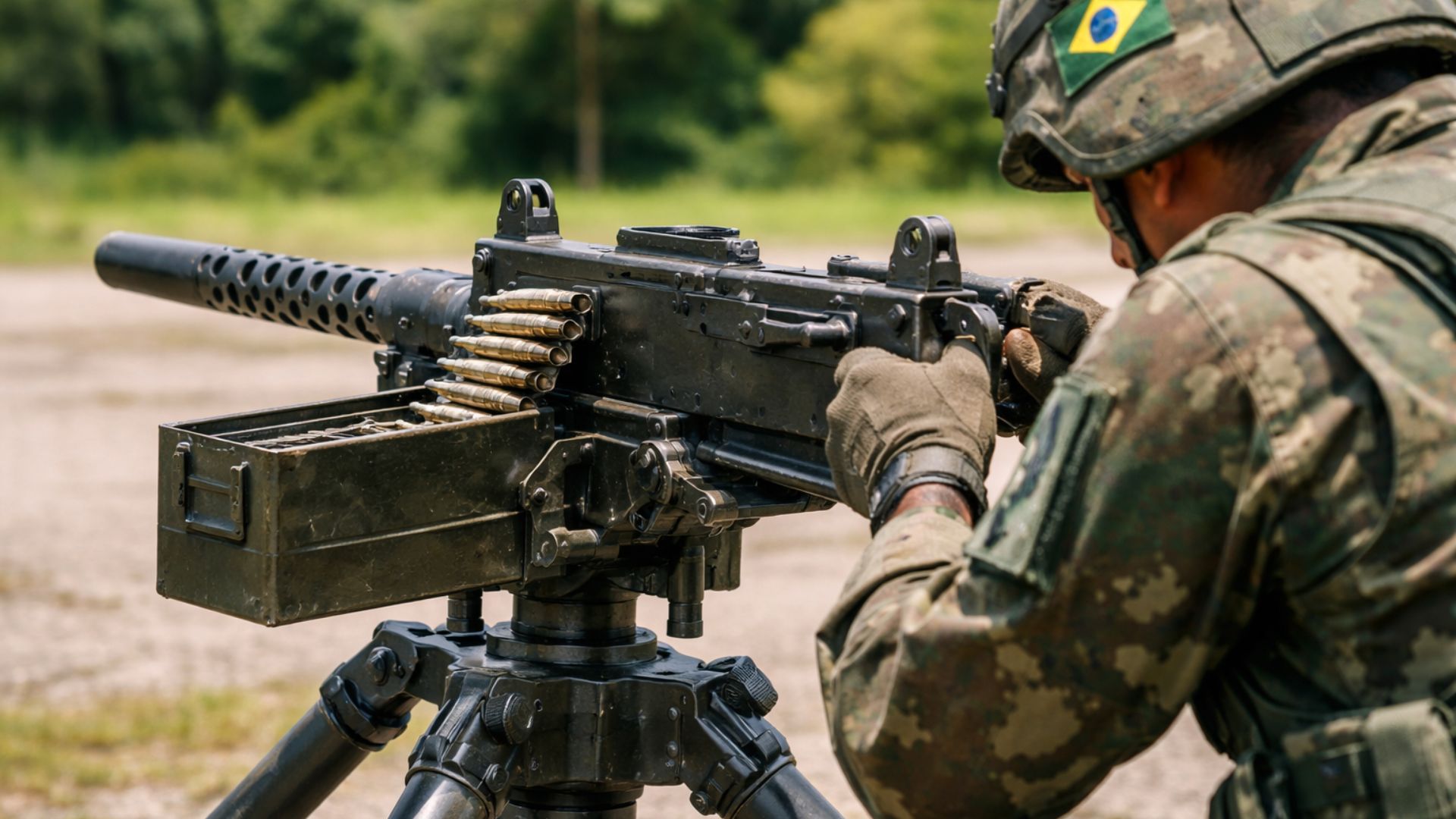

Standardization of .50 machine guns redefines the logistical base of the Army with international high-performance models, operational compatibility, and a focus on maintenance, training, and tactical employment on different platforms, consolidating heavy armament widely used in military forces around the world.
The Brazilian Army has defined three models of .50 caliber machine guns for use in the Ground Force, in a move that consolidates the standardization of this heavy armament within the institution’s logistical support structure.
The measure encompasses the versions M2HB QCB from FN Herstal, M2A1 QCB from US Ordnance, and M2 QCB from Canik, all in 12.7 x 99 mm NATO caliber, according to an act from the Army Command linked to the records 64535.031899/2025-13.
In practice, the decision does not announce immediate purchases or detailed doctrinal changes regarding the use of the armament.
-
Seen from space, an astronaut captures in Canada a geometric carpet of crops drawn over the backdrop of a ghost lake that disappeared 12,000 years ago, was once larger than all the Great Lakes combined, and left a scar of fertile mud that still sustains agriculture.

-
Billionaire says the most valuable skill will help overcome job elimination caused by AI, following Bill Gates’ fears

-
A Dutchman created a ‘box’ that makes trees grow in the desert almost without water and without irrigation: the invention has already brought seedlings to dozens of countries and achieves up to 90% survival where common planting did not exceed 10%.

-
Abandoned warehouse hid a giant collection of rare computers, with over 2,000 artifacts from the 1930s to the 1980s.




What the official text establishes is the standardization of the models for use in the Brazilian Army and the maintenance of this condition as long as the materials remain integrated into the logistical support chain of the force.
This point is central because standardization, in military and administrative vocabulary, is linked to the compatibility of maintenance, supply, training, and replacement.
Logistical standardization and operational impact
The document published by the Army General Secretariat on October 2, 2025, uses the expression “authorizes the standardization” and lists the three armaments by name.
The wording reproduced in subsequent publications maintains the same essential content: the incorporation, for the purposes of use in the Brazilian Army, of the models from the Belgian manufacturer FN Herstal, the American US Ordnance, and the Turkish Canik.
In all cases, the permanence of the standardization depends on the continuity of these weapons in the logistical structure of the force.
Technical characteristics of .50 machine guns
The decision brings the Army closer to a common base of heavy machine guns from the Browning M2 family, a system widely disseminated in NATO environments and in armed forces of various countries.
Although produced by different companies, the three versions share the same caliber, the same general operating architecture through short recoil of the barrel, and the QCB configuration, an acronym used to indicate quick barrel change.
This feature reduces intervention time in the field and facilitates heat control during continued use.
Additionally, standardization around technically similar models tends to simplify the routine of instruction and support.
FN Herstal emphasizes that its version maintains the QCB configuration with a quick, easy, and safe barrel change procedure, while Canik states its capability for operation in single and automatic fire.
In the case of US Ordnance, the technical sheet also indicates firing mode in single or automatic, a relevant point for fire control and tactical use on different platforms.
Range and rate of fire of heavy machine guns
The available technical data confirm that the standardized models operate with performance compatible with the category of .50 caliber heavy machine guns.
The US Ordnance sheet indicates a maximum effective range of approximately 1,829 meters and a cyclic rate of 450 to 635 rounds per minute.
Canik reports a maximum effective range of 1,830 meters and a rate of 450 to 650 rounds per minute.
FN Herstal, on the other hand, records a cyclic rate between 485 and 635 rounds per minute, without indicating, in this specific sheet, the numerical effective range of the model.
These numbers help explain why the 12.7 mm caliber remains relevant in heavy support roles, suppression, and engagement of light material targets.
This is weaponry employed on tripods, vehicles, vessels, and other mounts, with versatility for different scenarios.
FN Herstal itself states that its M2HB-QCB can be installed on vehicles, boats, and ships, in addition to M3 tripods for precise long-range fire.
Canik, in turn, describes the M2 QCB as suitable for use in armored and light vehicles, naval mounts, and infantry tripods.
Logistical structure and military standardization
Although the presence of manufacturers from three different countries draws attention, the official text does not associate the measure with technology transfer, acquisition contract, or exclusive supplier choice.
The axis of the decision lies in the logistical support structure, a term used in Article 2 of the ordinance.
In other words, the formal focus is to ensure that these models can be supported by the supply and maintenance machinery of the Army while they are part of its inventory or standardized material base.
This administrative aspect is often decisive in ground forces that operate weapons with high maintenance demands.
When the command standardizes models, it opens up space to streamline inspection processes, component acquisition, training of shooters and weapon mechanics, as well as predictability in the replacement of barrels, parts, and accessories.
Still, the consulted documentation does not detail quantities, incorporation schedule, recipient units, or contracts possibly associated with each manufacturer.
What the Army ordinance says
The act of the Army Command lists, directly, three versions of the .50 caliber machine gun: the M2HB QCB, from FN Herstal, the M2A1 QCB, from US Ordnance, and the M2 QCB, from Canik.
It also determines that the standardization will remain valid as long as these materials are part of the logistical support structure of the Brazilian Army.
There is no expanded operational justification in the text located on the official SGEx portal, detailing troop distribution or additional explanation regarding employment priority.
Thus, the measure should be read less as an announcement of an isolated novelty and more as an administrative formalization of a set of heavy weapons compatible with the logistical framework of the Ground Force.
The core of the decision lies in the organization of support and the predictability of employment, based on models that operate in the same caliber and exhibit similar technical performance in range and rate of fire.
This is the objective data confirmed by official sources and by the manufacturers’ sheets consulted.