






 Portuguese
  Spanish


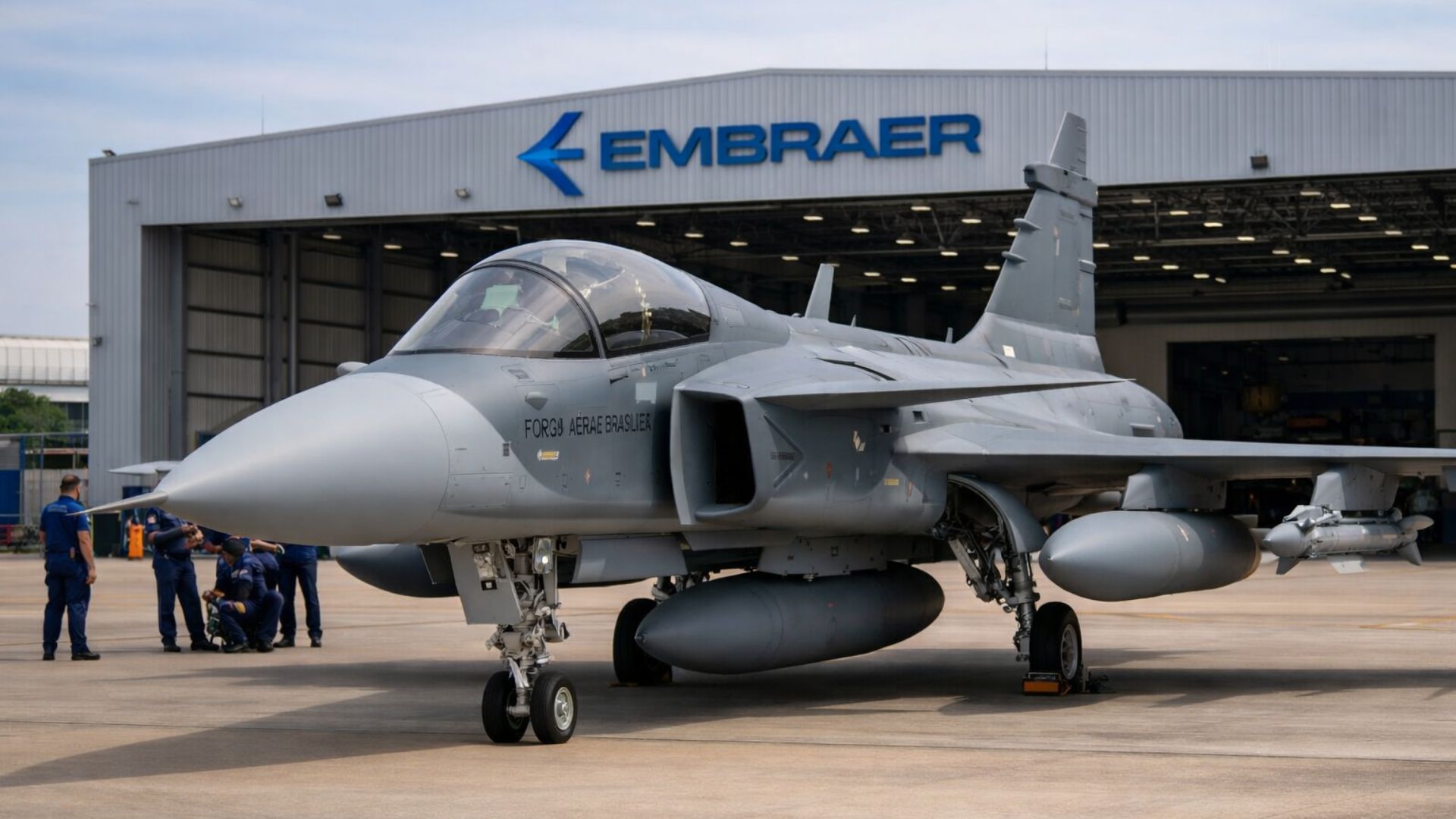


Modernization of air defense advances with national production, technology transfer, and generation of strategic jobs in the Brazilian aerospace industry, consolidating operational capacity and technological autonomy in one of the most relevant military programs in the country in recent decades.
Brazil has advanced in renewing its fighter aviation with the incorporation of 36 F-39 Gripen aircraft, of which 15 will have final assembly in national territory, in Gavião Peixoto, in the interior of São Paulo.
The most recent milestone occurred on March 25, 2026, when the first unit produced in the country was presented, at a ceremony attended by President Luiz Inácio Lula da Silva.
Program F-X2 and modernization of the Brazilian Air Force
The initiative is part of the F-X2 program, aimed at re-equipping and modernizing the Brazilian Air Force’s fleet of supersonic fighters.
-
Bruno Guimarães, 28, Misses Crucial Penalty Against Norway in World Cup After Replacing Vinicius Jr.

-
Inspired by a school lesson on Africa’s water crisis, a young boy raised money through chores to fund a well that transformed a Ugandan community.

-
Brazilian Construction Worker Moves to France, Earns Up to €2,500 Monthly with Home Renovations, Gains Social Media Attention

-
US Navy Sinks USS Oriskany with 230 kg of C-4, Creating World’s Largest Artificial Reef in 37 Minutes





In addition to the delivery of aircraft, the project combines technology transfer, training of technical personnel, and expansion of the defense industrial base, in an arrangement involving the FAB, Embraer, Saab, and federal government agencies.
Although international news has turned attention to military escalation in different regions of the world, the Brazilian program did not arise as a reaction to recent crises.
The procurement of the Gripen stems from a process that began more than a decade ago, with the choice announced in December 2013, a commercial contract signed in 2014, and financing formalized on August 26, 2015, with the Swedish Export Credit Corporation, AB SEK.
Capabilities of the F-39 Gripen and embedded technology
The F-39 Gripen is classified by the FAB as a next-generation multirole fighter, prepared for air defense, alert, attack, and reconnaissance missions.
In practice, this means a platform capable of operating in both air superiority actions and operations against ground and maritime targets, with integration between sensors, armaments, and electronic systems.
Among the onboard resources, the model features an electronic warfare system and the AESA Raven ES-05 radar, cited as one of the central elements of the aircraft’s situational awareness enhancement.
This set allows tracking targets in different directions and frequencies, while also enhancing reaction capacity in complex scenarios.
The advancement was not limited to technical specifications.
Since February 2026, the Gripen has been employed for the first time in Air Defense Alert missions from the Anápolis Air Base in Goiás.
Production in Brazil and technology transfer
The presentation of the first fighter jet produced in Brazil consolidated a phase that had been prepared since the installation of the Gripen E production line at Embraer’s facility in Gavião Peixoto, inaugurated in 2023.
With this move, the country joined a select group of nations capable of participating in the manufacturing of advanced combat aircraft.
In the official speech released by the federal government, Brazil was described as the first country in Latin America to master the process of producing supersonic fighters.
The industrial axis of the project also includes structured knowledge transfer.
According to the Ministry of Defense and the PGFN, the program took about 350 Brazilians to Sweden for advanced training.
The training of these professionals feeds the Gripen development center established in Brazil and reinforces the retention of specialized labor in areas considered strategic.
Jobs, industry, and economic impact of the Gripen
The numbers released by the government indicate that the program has already driven the creation of more than 12,000 jobs, with about 2,000 direct and 10,000 indirect.
The estimate is presented as part of the cascading effect generated by production, technological development, and the supplier network associated with the Gripen.
In the contractual plan, the financing for the acquisition was agreed upon in December 2014 and formalized in August 2015 between the Federative Republic of Brazil and AB SEK.
According to prosecutor Suely Dib, who participated in the negotiation, the instrument was amended in 2018 and again in 2025.
She stated that the process occurred “always represented by the PGFN.”
The original contract with the Brazilian government provides for 28 Gripen E aircraft and 8 Gripen F.
Deliveries began in 2020 and, by the time of the presentation of the first fighter jet produced in Brazil, 11 aircraft had already been delivered.
Operational progress and upcoming milestones of the program
Before the presentation of the unit assembled in the country, Brazil had already received serial aircraft produced abroad.
The current phase marks the transition from operational reception to production with a more robust local industrial participation.
The continuation of the schedule foresees ongoing deliveries and deepening technological training.
For the FAB, the Gripen was designed to meet Brazil’s operational needs within the National Defense Strategy.
At the same time, the program acts as a lever for the aerospace industry established in the country, combining military power, technical training, and industrial policy.





