Portuguese
  Spanish


Tired of seeing the rain flood the street in Miami, Luca Durham, a 6th-grade student, created a porous concrete that absorbs rainwater instead of pushing it away. He used discarded materials like oyster shells and charcoal and won a Lemelson Young Inventor Award.
A problem he saw from his home window turned into an award-winning science project. In Miami, USA, 6th-grade student Luca Durham created a concrete that “drinks” rainwater instead of letting it flood the streets. The story was shared by the Society for Science, an organization that hosts major science fairs.
The young inventor’s insight was to look at waste. To make the concrete porous and capable of absorbing water, he relied on materials people usually throw away, like oyster shells and charcoal, turning waste into a solution. The idea earned him a Lemelson Award for a budding inventor.
The starting point was a common scene in Miami. Seeing water run off a garage and flood the street during a storm, Luca wanted to understand why regular concrete pushes rain away instead of absorbing it. Next, see how the boy turned this question into an invention.
-
Brazilian Researchers Develop Portable, Painless, Radiation-Free Breast Cancer Tracker Using Microwaves, Costing Around $200 and Potentially Replacing $240,000 Mammograms

-
Beer as a Vaccine? Scientist Develops Experimental Method with Live Yeasts, Tests Own Brew, and Publishes Results on Zenodo

-
Brazilian Researchers Develop ‘Rapha’ Device Using Natural Latex and LED Light to Heal Diabetic Foot Ulcers and Prevent 50,000 Annual Amputations
-
Brazilian Startup Offers Free Home Cleaning in Exchange for Data to Train AI-Powered Domestic Robots


Who is Luca Durham, the boy who created the concrete
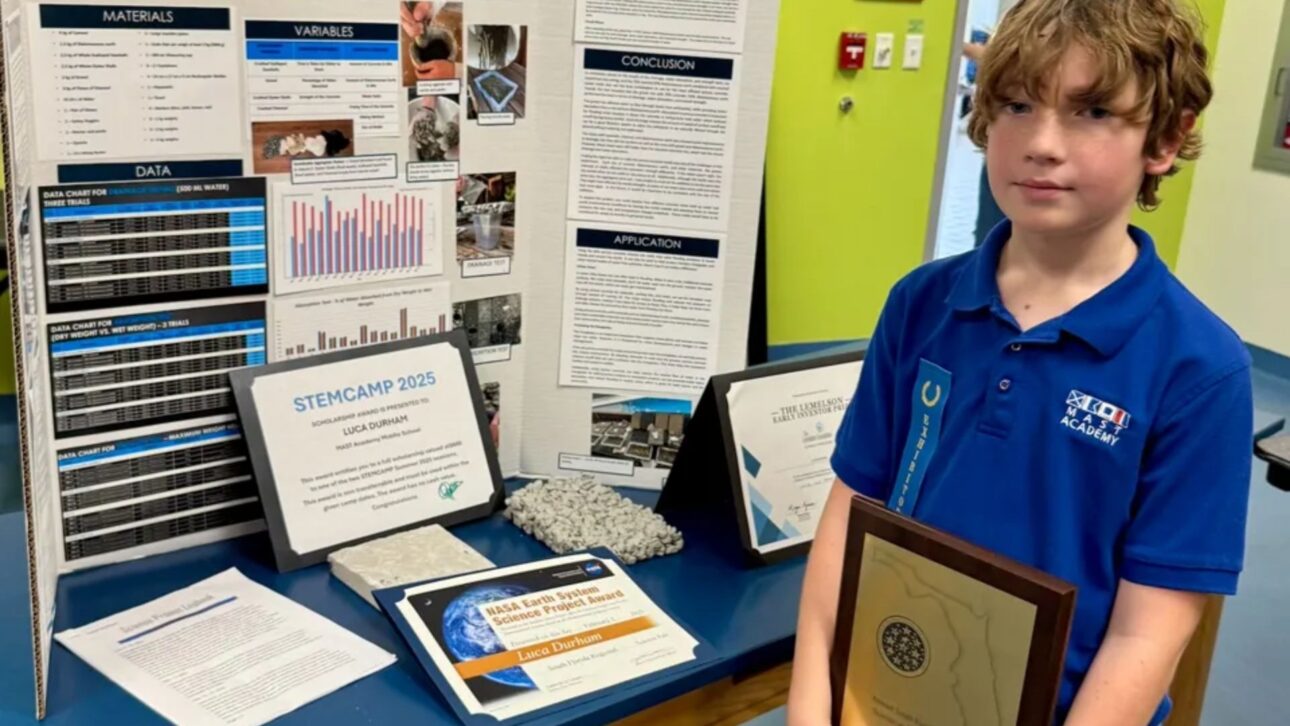
The inventor is an elementary school student. Luca Durham is in the 6th grade and lives in Miami, a city known for flooding whenever it rains heavily. It was precisely this experience with water invading the streets that sparked his desire to find a solution.
The trigger was an ordinary storm. During a rain, Luca observed the rainwater overflow from a neighbor’s garage and spread across the street, forming a miniature flood. Instead of just complaining, the boy wondered if it was possible to make the concrete work in favor of, rather than against, drainage.
From this question, he became a little researcher. Luca began to study why regular concrete is impermeable and to test ways to make it porous, capable of letting water pass through. The goal was clear and practical: to create a material that would absorb rain and help prevent flooding.
His motivation is evident in his own words. “I wanted to find additives that would help the concrete drain water, but still be strong,” explained the young inventor, according to reports. The sentence summarizes the challenge: to combine absorption and strength in a single material.
Cases like his show the value of turning annoyance into a question. Instead of accepting the flooded street as something normal, Luca treated the flood as a problem to be studied. It is this attitude of a little scientist, more than any magical talent, that is behind the invention of the porous concrete.
The concrete that “drinks” rainwater
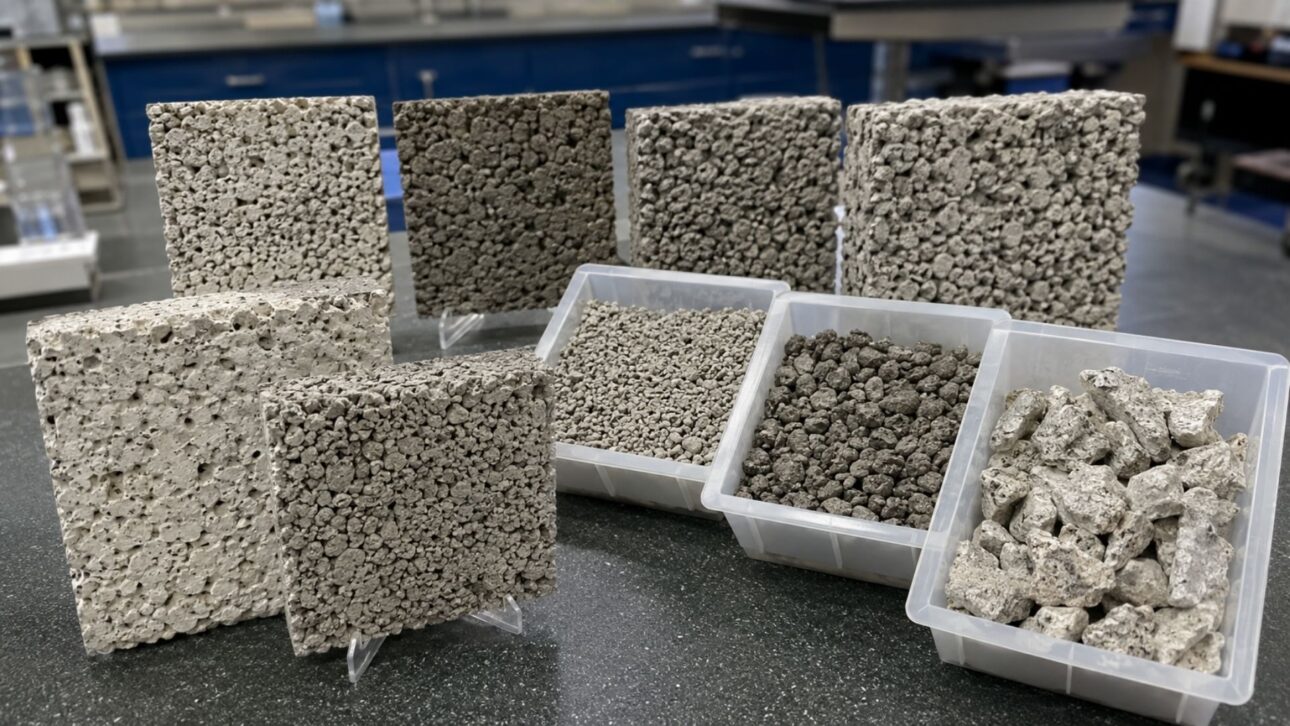
The central idea of the project is to reverse the logic of the pavement. Traditional concrete is made to be impermeable, so the rainwater flows over it and accumulates, turning into a flood. Luca’s proposal was to create a porous concrete, full of small channels through which water can pass and infiltrate the soil.
This type of material works like a rigid sponge. Instead of blocking the rain, it absorbs it and channels it downward, reducing puddles and the volume of water running through the streets. It’s the difference between a pavement that “repels” and one that “drinks” the rainwater, as the report itself describes.
The technical challenge is to balance two opposing qualities. The more porous the concrete, the more it drains, but it also tends to become more fragile. Therefore, Luca’s work was to find additives that would open paths for the water without compromising the strength of the piece, a problem that challenges even engineers.
His answer came from unexpected materials. To create the pores and still filter the water, the young inventor turned to leftovers and discards, giving a noble function to what normally becomes trash. That’s where the oyster shells and charcoal came in, key components of the invention.
Oyster shells and charcoal: discarded materials
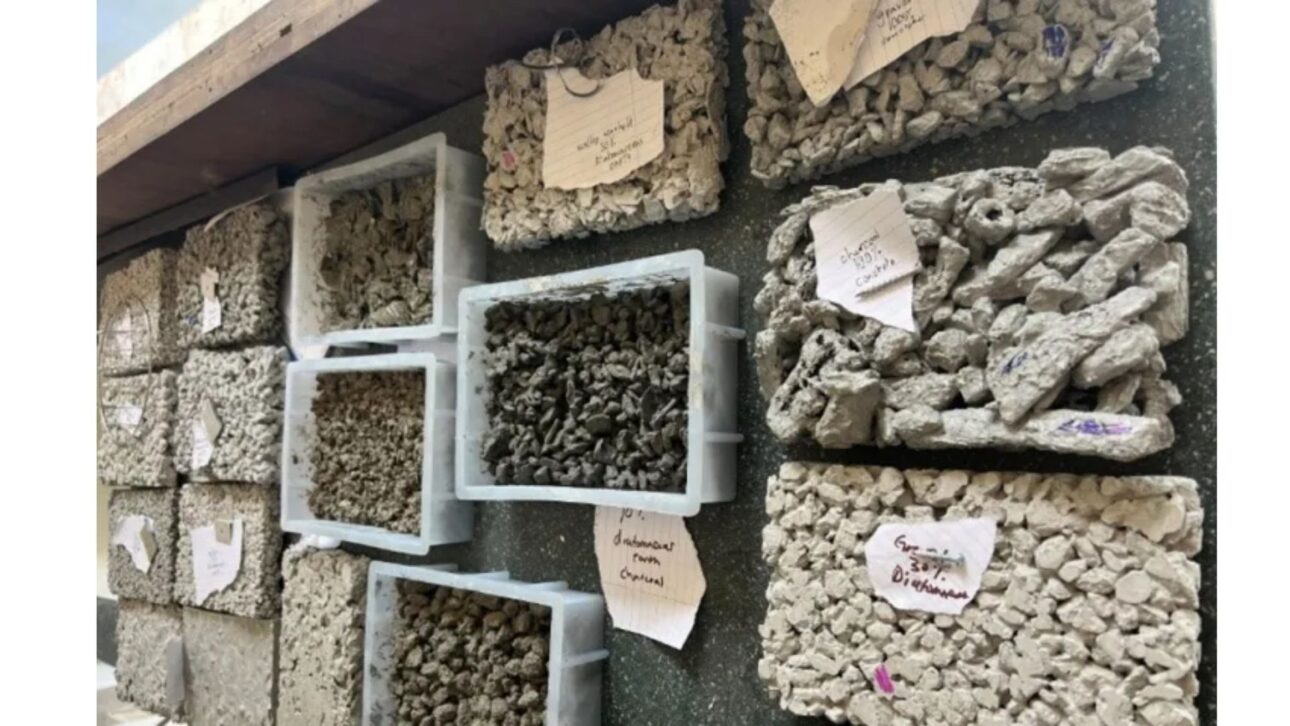
The choice of oyster shells has an ingenious logic. When crushed and mixed with concrete, they create small internal openings, thanks to their irregular shape, through which water can move more easily. Thus, a seafood waste becomes a natural pore creator.
Charcoal was added for another function. Luca explained that the material is porous and helps filter the water that passes through the concrete, contributing to making it cleaner. Besides paving the way for the liquid, charcoal acts as a kind of built-in filter in the structure itself.
Gravel completed the recipe for a practical reason. As it is already used in porous concretes to improve durability and drainage, it helped to give firmness to the material. The combination sought the balance between allowing water to pass and keeping the piece resistant.
The guiding thread of everything is reuse. “Materials that people usually throw away” was the definition used by the young inventor himself for the heart of the project. Transforming discarded oyster shells and charcoal into a concrete that combats floods is both an environmental and economic idea.
What the tests revealed
Like any good science project, the work went through experiments. Luca prepared and compared different concrete mixtures, measuring which absorbed rainwater better without losing strength. It was a process of trial and error, with several recipes tested until reaching the best combinations.
Curiously, the winning material was neither the oyster nor the charcoal. According to reports, the best-performing mixture combined about 30% diatomaceous earth, a natural powder made from fossilized algae and very absorbent, with 70% cement and gravel. In other words, the research revealed a result that the inventor himself did not expect.
The unexpected result is, in fact, part of science. Testing a hypothesis and discovering that another option works better is exactly what is expected from a good experiment. Instead of forcing the answer he wanted, Luca followed the data, a stance that impresses even more coming from such a young inventor.
This does not diminish the value of oyster shells and charcoal. They remain examples of how waste can become useful additives and are part of the set of materials that Luca investigated. The strength of the project lies precisely in testing various cheap and sustainable options for the same problem.
The young inventor is already thinking about the next steps. To make the porous concrete even stronger and capable of bearing weight, he plans to add carbon fiber strips to the mix. The idea is to finally solve the old dilemma of this type of material: draining well without cracking or falling apart.
The Lemelson Award for Young Inventor
The project did not go unnoticed by the evaluators. Luca Durham won the Lemelson Award for Emerging Inventor, a distinction aimed at young inventors who stand out at science fairs affiliated with the Society for Science. The recognition values promising ideas for real-world problems.
The Society for Science, which endorses the award, is one of the most traditional institutions in supporting young scientists. It is behind some of the largest student fairs in the world, from which future leading researchers have emerged. Getting on this radar so early often opens doors for a young inventor.
The award ceremony took place at a large regional fair. Luca’s concrete was a highlight at the South Florida Science and Engineering Fair, one of the largest student scientific exhibitions in South Florida. Competing and winning there, still in the 6th grade, is a remarkable achievement for someone so young.
This type of award usually has an effect that goes beyond the trophy. By recognizing a young inventor, the award gives visibility to the project, encourages the student to continue, and shows other children that it is also possible to create. Many scientists started exactly like this, at school fairs.
For Luca, the victory is a push and a starting point. Instead of ending the work, the recognition serves as motivation to improve the concrete and carry the idea forward. The journey of the young inventor, after all, is just beginning.
Why Miami Needs Water-Absorbing Concrete
The invention makes even more sense because of where it was born. Miami is one of the U.S. cities most threatened by water, with frequent flooding linked to heavy rains, high tides, and rising sea levels. Streets underwater have become a common sight there.
The problem has several combined causes. The low soil, intense urbanization, and the excess of impermeable surfaces, like asphalt and regular concrete, mean that rainwater has nowhere to go. Without absorption, it quickly accumulates and causes floods even during short storms.
The situation tends to worsen over time. In Miami, episodes of “sunny day flooding,” when seawater invades the streets even without rain, are already frequent, and rainwater exacerbates the situation. Solutions that help drain and absorb the excess become more urgent each year in the city.
In this scenario, a concrete that “drinks” water gains importance. Sidewalks, parking lots, and streets made with porous material could absorb part of the rain and alleviate flooding, returning water to the soil. For a city like Miami, this would be a huge gain.
Therefore, Luca’s idea addresses a real and urgent problem. Even as a school project, it points to a solution that large cities are already seeking: pavements that help control water instead of worsening floods. The young inventor has hit a sensitive point.
Permeable concrete: an idea that already exists and is gaining strength
It is worth mentioning that porous concrete is not a completely new invention. Known as permeable or draining concrete, this type of material is already used worldwide on sidewalks, parking lots, and low-traffic roads, precisely to allow rainwater to pass through the surface and reduce flooding.
In practice, this concrete already appears in sponge city projects, a concept that seeks to return water to its natural path to the soil. The idea is for the city to absorb rainwater in parks, gardens, and porous pavements, instead of dumping everything into rivers and sewers all at once.
The difference lies in the details and materials. Traditional draining concrete is often criticized for clogging over time and being less resistant than regular concrete, two problems that limit its use. It was precisely against these weaknesses that Luca’s project aimed to advance.
The young inventor’s contribution lies in the search for cheap and sustainable additives. By testing waste materials like oyster shells and charcoal, he explores a path to make permeable concrete more accessible and eco-friendly. Even without reinventing the wheel, the work points to possible improvements.
There is also an environmental gain behind it all. Cement production accounts for a large share of the planet’s carbon emissions, so using waste and reducing new material helps the environment. A concrete that combats floods and also reuses waste offers two advantages at once.
What this has to do with Brazil
Brazil suffers greatly from urban floods, which makes the idea very relevant here. Cities like São Paulo and Rio de Janeiro experience flooding every rainy season, and tragedies like the floods in Rio Grande do Sul have shown the magnitude of the problem. Excess of impermeable concrete and asphalt is part of the cause.
The Brazilian problem has a technical name: soil impermeabilization. When streets, sidewalks, and roofs cover the ground, rainwater does not infiltrate and rushes all at once to the sewers, which overflow. Pavements that absorb part of this water help relieve the pressure on city drainage systems.
Luca’s solution interacts with technologies already arriving in the country. The permeable concrete has been tested on sidewalks, squares, and parking lots in Brazil as an alternative to allow rainwater to infiltrate the soil. The logic is the same as the young inventor’s project: pavements that absorb instead of flood.
There is also a link with Brazil’s vocation for reusing materials. In a country that generates a lot of waste, the idea of using discards like oyster shells and charcoal to make concrete aligns with local research on sustainable construction. Transforming waste into building material is a promising path.
Finally, it serves as inspiration for young scientists here. Brazil has fairs like Febrace and Mostratec, which reveal children and teenagers full of ideas for real problems. The story of the inventor from Miami shows that, with curiosity and method, a student of 11 or 12 years old can create something that interests the whole world.
And you, would you live in a city with sidewalks that drink the rain?
The story of Luca Durham proves that great ideas can be born from a simple look out the window. At 11 or 12 years old, in the 6th grade, he created a concrete that absorbs rainwater, using discarded oyster shells and charcoal, and won a Lemelson prize for young inventor in Miami. All from the discomfort of seeing the street flooded.
And you, would you like to live in a city where sidewalks and streets “drink” the rain instead of flooding? Share your thoughts in the comments about the boy’s invention and if you believe materials like this can help reduce flooding in Brazilian cities.