






 Portuguese
  Spanish
  6 min of reading
  0 comments


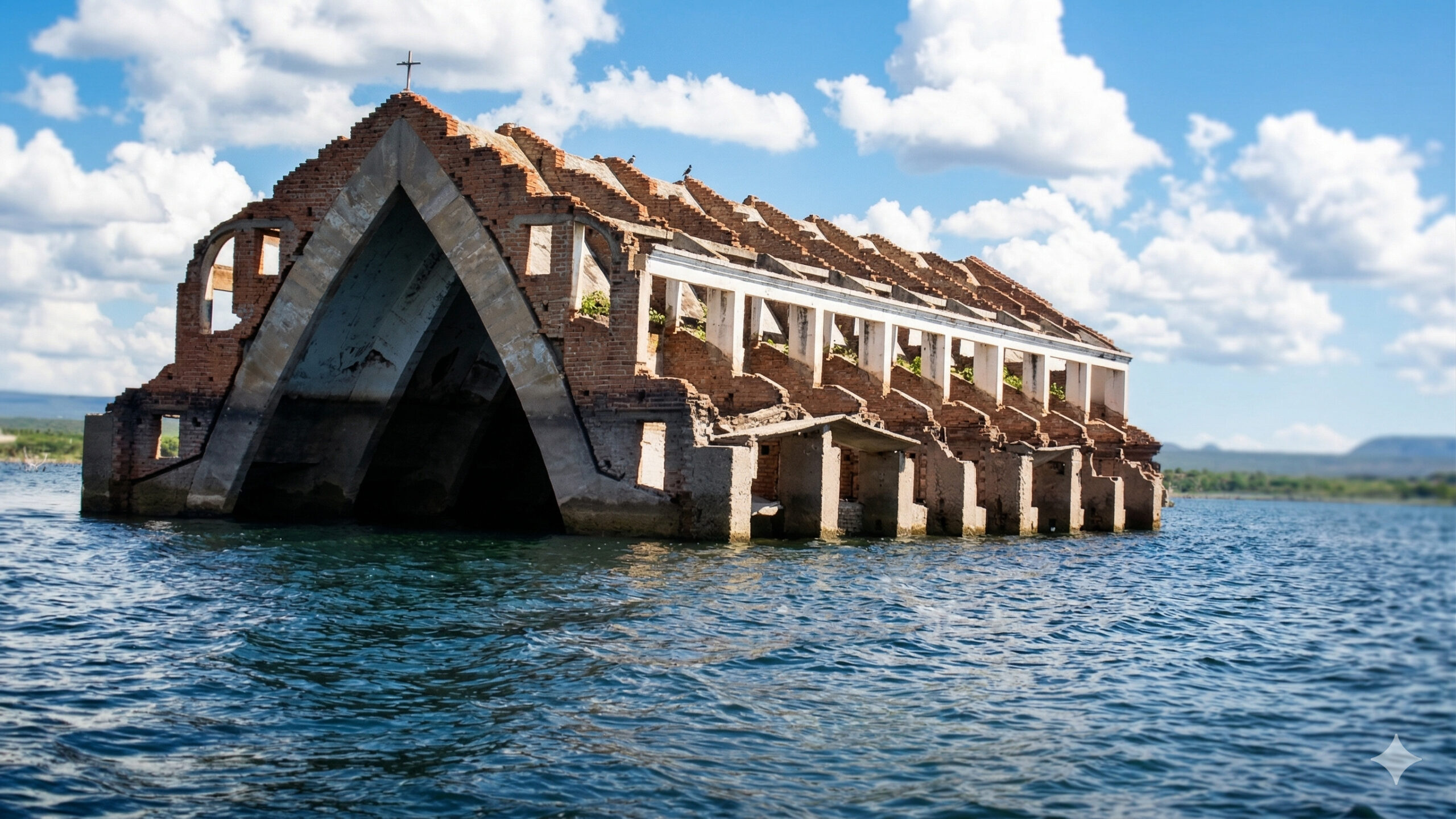
Discover Petrolândia, the “Brazilian Atlantis” submerged since 1988, where a church resists beneath the waters and reappears in dry periods.
Itaparica, the former city of Petrolândia, in the interior of Pernambuco, was flooded by the formation of the reservoir on the São Francisco River. The project, led by CHESF, aimed to increase energy generation in the Northeast and gave rise to the Itaparica Lake, which, according to the Chamber of Deputies, flooded 83.4 thousand hectares and extends for about 150 kilometers between two states.
The construction of the reservoir required the removal of the population from the old headquarters and the creation of a new Petrolândia in another part of the territory. The old urban nucleus, with streets, houses, public buildings, and churches, was progressively swallowed by the waters, leaving as the most visible remnant the Church of the Sacred Heart of Jesus, now treated by Fundarpe as a historical and symbolic landmark of the submerged city. Decades later, this scenario would help popularize the region in the tourist imagination as the so-called “Brazilian Atlantis.”
The case also frequently appears in research on population resettlement, forced displacement, and social impacts of large dams in Brazil. In a study deposited in the UFPE repository, the filling of the Itaparica lake is associated with a process that affected more than 40 thousand people; academic works from Univasf highlight that the territorial reorganization involved not only New Petrolândia, but a broad network of urban and rural resettlements in Pernambuco and Bahia.
-
Goodbye, clothesline: new option for drying clothes utilizes walls, doors, and even room height with multiple drying levels, retractable model, and compact structure that promises to transform small laundries in 2026.

-
A discarded microwave may contain 22-carat gold in internal components; study recovered a 450 mg nugget from electronic boards.
-
Beach in the Northeast reaches a new level with a resort worth R$ 745 million, villas up to R$ 8.3 million, a complex of 2,347 hectares, and 6.5 km of beachfront in a destination still far from the hustle and bustle of Pipa.
-
Man buys abandoned luxury Mitsubishi for R$ 2,000 and performs an impossible transformation after finding the engine without oil, the car covered in mud, and even slugs; the project consumed R$ 17,000 and the final result impresses.


Church of the Sacred Heart of Jesus became the most striking symbol of the submerged city
Among all the structures that disappeared under the artificial lake, one of them remained as a visual and historical reference: the Church of the Sacred Heart of Jesus. Built during the original period of the city, the church was not demolished before the filling of the reservoir, unlike other buildings.
As a result, the structure became partially submerged, with its façade, staircase, and part of the tower remaining intact over the years. In certain periods, when the level of the São Francisco River drops, parts of the church emerge again, creating one of the most emblematic images of the northeastern interior.
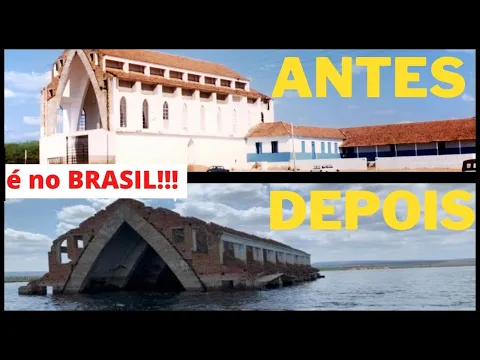

This phenomenon does not occur constantly, as it directly depends on the hydrological regime of the river, which varies according to rainfall, flows, and the operation of the plant.
Water level variation turns the church into an attraction that appears and disappears
The dynamics of the Luiz Gonzaga Plant reservoir cause the water level to fluctuate throughout the year. In periods of severe drought, such as those recorded between 2013 and 2015, the volume of the lake dropped significantly, exposing parts of the old Petrolândia.

In these moments, the Church of the Sacred Heart of Jesus reappeared more completely, allowing visitors to walk around the structure and observe details that are normally submerged.
In flood phases, on the other hand, the church is almost completely covered by water, being visible only partially or accessible only by diving. This alternation between visibility and submersion has contributed to solidifying the location as a continuous point of interest.
Historical tourism and diving transformed ruins into a destination visited by all of Brazil
Over the years, the old Petrolândia ceased to be just a submerged memory and became part of the tourist circuit of the Pernambuco hinterland. The church and other flooded structures began to attract visitors interested in experiences that mix history, landscape, and natural phenomena.
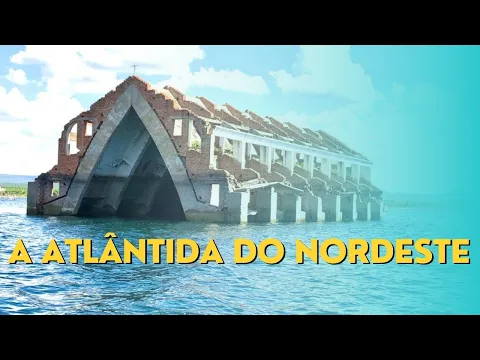
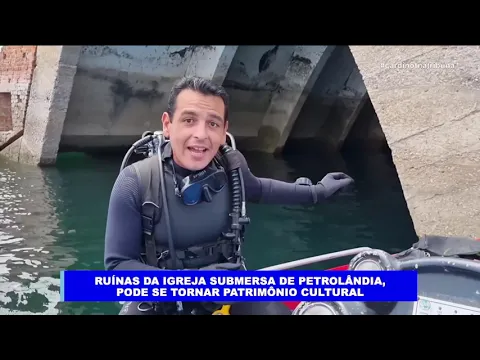
Catamaran tours take tourists to the area where the city was submerged, allowing them to observe the church from different angles. In parallel, divers explore parts of the structure that remain below the surface, including the nave, columns, and internal elements.
This type of tourism gained strength especially after the extensive dissemination of images of the church partially emerging, which circulated in media outlets and social networks.
Listing process recognizes historical value of the submerged structure
In 2021, the government of Pernambuco, through Fundarpe (Foundation of Historical and Artistic Heritage of Pernambuco), initiated the listing process for the Church of the Sacred Heart of Jesus.
The aim of the measure was to officially recognize the historical and symbolic value of the structure, ensuring institutional protection and preservation over time. The initiative also reinforces the importance of the location as cultural heritage, not only for the region but for Brazil’s recent history.
The church has come to be treated as a landmark of collective memory, representing both the past of the original city and the impact of large infrastructure works on entire communities.
Hydroelectric project completely transformed the local geography
The formation of the Itaparica lake permanently altered the landscape of the region. The reservoir occupies an extensive area along the São Francisco River, modifying ecosystems, navigation routes, and economic activities.
In addition to the urban impact, the flooding also affected agricultural areas and production zones, requiring adaptation from the displaced communities. The new scenario brought opportunities, such as tourism and fishing, but also challenges related to economic reorganization.
The old Petrolândia remains at the bottom of the reservoir as a physical record of this transformation, preserved involuntarily by the waters.
Submerged structures create one of the most unusual scenarios in the interior of Brazil
The combination of an abandoned city, a partially visible church, and water level variation results in a rare scenario in the country. Unlike traditional ruins, which remain static, Petrolândia presents a dynamic landscape that changes according to the behavior of the river.
This aspect reinforces the unique character of the location, where urban elements coexist with an aquatic environment, creating a kind of submerged historical archive.
The image of the church surrounded by water, with the rest of the city invisible beneath the surface, has become one of the most striking representations of this type of territorial transformation in Brazil.
Brazilian Atlantis became one of the strongest symbols of the impact of large works
The story of Petrolândia is often associated with the debate about the effects of large infrastructure projects. The construction of the plant ensured an increase in energy generation but also resulted in the physical disappearance of an entire city.
This contrast between development and social impact is one of the central points of the case, which continues to be studied by researchers and remembered by the local population.
The expression “Brazilian Atlantis” synthesizes this duality, while reinforcing the impressive visual aspect of the submerged structures.
What do you think of the city that disappeared beneath the waters and can still be visited
The old Petrolândia remains a concrete example of how human interventions can completely redefine a territory. Decades after its submersion, the city is still present, although invisible most of the time.
The church that resists beneath the water serves as a link between past and present, revealing fragments of a history that has not completely disappeared.
Now I want to know your opinion: would you visit the “Brazilian Atlantis” to see up close a submerged city that still holds intact structures after more than three decades?


Be the first to react!