Portuguese
  Spanish


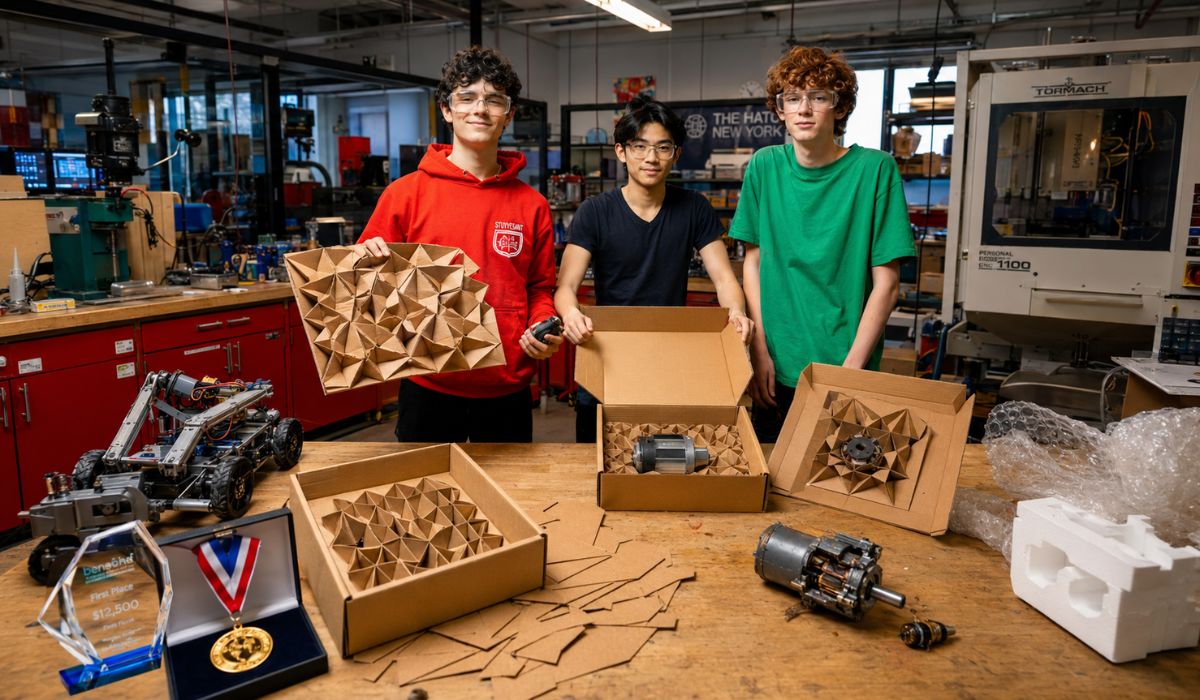

Three students from New York created the Kiriboard, a cardboard packaging inspired by kirigami, to test an alternative to styrofoam and bubble wrap in delivery boxes, with support from an international award.
Three students from New York created a cardboard packaging inspired by kirigami, a Japanese technique of cutting and folding paper, to try to replace materials like styrofoam and bubble wrap in delivery boxes.
The invention, called Kiriboard, won the North American stage of the Earth Prize in April 2025 and received US$ 12,500 to advance in new tests.
The project was developed by Zhi Han Anthony Yao, Flint Mueller, and James Clare, students from Stuyvesant High School in New York.
-
The large jar blender has a rival: Oster Ultra Power bets on 1,000 W, six stainless steel blades, and two portable cups with leak-proof lids.

-
Tesla injected an additional $250 million into the German factory, doubled the battery cell target, and opened its own production line for startups.

-
No more TV stuck on the wall: Samsung The Freestyle+, the new projector with over 400 lumens projects on walls, floors, and ceilings, bringing cinema to any corner of the house.
-
A Japanese governor single-handedly stalled the construction of the world’s fastest train for nine years, and only now has he agreed to allow a tunnel excavated at a depth of 1,400 meters.


According to Business Insider, the three intended to seek a patent, purchase a CNC milling machine to cut prototypes more precisely, and present the solution to companies like Amazon, Home Depot, FedEx, and the United States Postal Service.
In 2024, Amazon announced that it had replaced 95% of plastic cushions used in deliveries in North America with paper filler and was working to completely remove this type of material by the end of that year.
During the same period, Home Depot reported having eliminated expanded polystyrene foam and PVC film in new packaging of own-brand products sold in the United States, Canada, and online.
What stands out about the Kiriboard is the use of a common material in a different format.
Instead of using air trapped in plastic or molded styrofoam pieces, the students cut cardboard into geometric patterns to make the structure fold, form volumes, and absorb impacts inside the box.
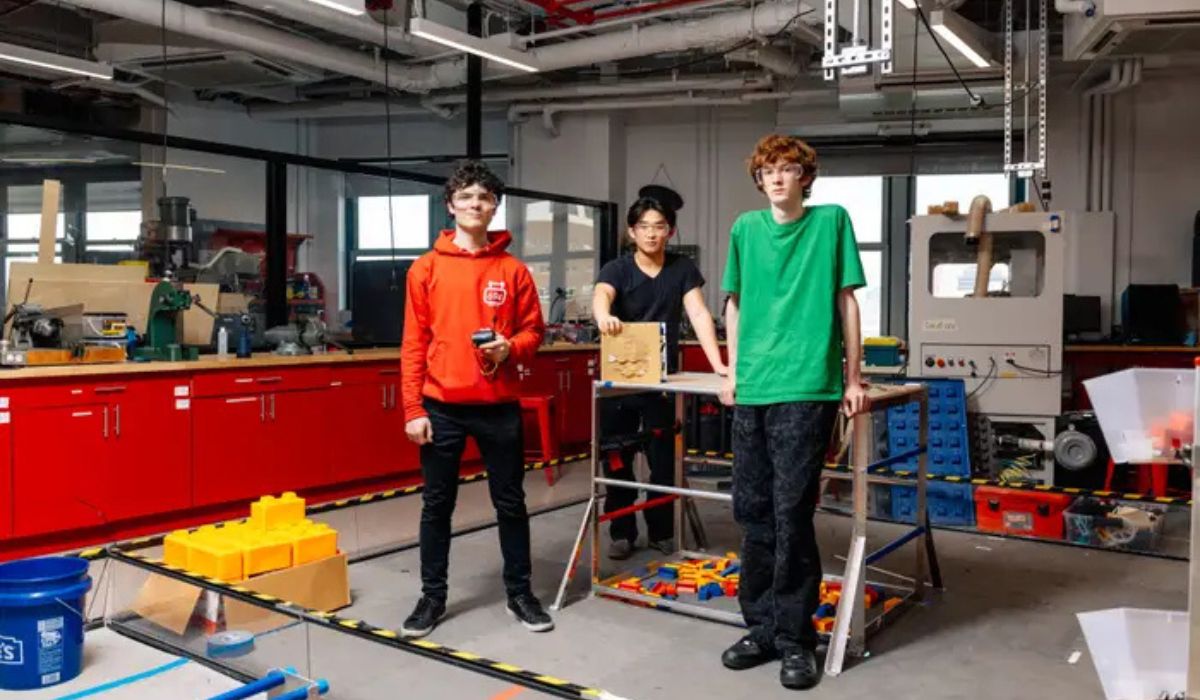
Kiriboard was born from a broken delivery
The origin of the project did not come from a traditional class on packaging, but from a problem faced by the students’ robotics team.
According to Business Insider, the three opened a shipment with Kraken X60 motors, used in robots and valued at about US$ 200 each, and noticed that the brass pins had arrived damaged.
From the delivery, the students assessed that the packaging might not have adequately protected the parts during transport.
With this, they began to think of a way to create deformation points in the material, so that the box would absorb part of the impact energy before the damage reached the product.
James Clare compared the logic to crumple zones used in cars, designed to absorb impacts and protect passengers.
According to him, it would be possible to create strategic weak points in the packaging so that it would deform in a controlled manner and preserve the transported item.
“You can create strategic weak points in your packaging so that it bends and deforms,” Clare told Business Insider, explaining the logic used in the prototype.
This situation turned a damaged delivery into a starting point for a school experiment.
With support from environmental science teacher Jerry Citron and the Earth Prize program, the students began to design, cut, and test versions of the Kiriboard.
How the cardboard packaging works
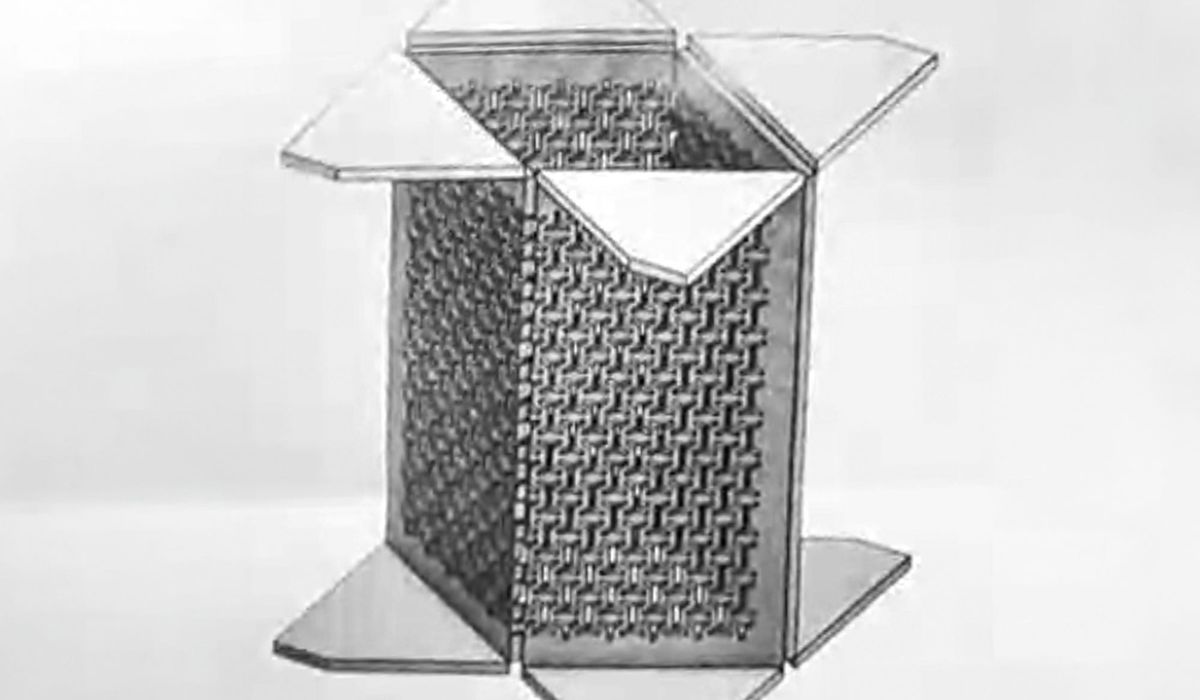
The Kiriboard looks like a cut-out sheet of cardboard, but gains volume when folded and placed inside the box.
The cuts form a three-dimensional structure, capable of occupying the space between the product and the packaging walls.
The function is similar to that of bubble wrap, styrofoam, or plastic cushions used in deliveries.
The difference lies in the material: the system is made of recycled cardboard and was designed by the students to reduce the use of plastic protective packaging.
According to the Earth Prize Foundation, the Kiriboard transforms a flat sheet of recycled cardboard into an impact absorption structure.
In one of the versions described by the entity, the design forms a diamond-shaped column with flaps that help provide resistance against pressures coming from different directions.
Yao explained to Business Insider that the central part of the structure is called the matrix by the group.
“This middle section, we call it the matrix. It should be flexible,” he stated. According to him, when placing an item inside the box, this area should mold to the product.
The students’ intention is for different designs to be used according to the type of delivery.
A heavy item, a sensitive electronic part, or a small object may require different protection formats inside the box.
Prototypes Tested with Impact
The first prototypes were made with cardboard reused from the school itself.
After researching patterns and consulting teachers, the students designed eight or nine models and chose four to build and test.
The next phase involved impact tests with everyday objects.
They dropped a roll of tape, stapler, soda can, and metal water bottle onto the prototypes, varying heights to observe the cardboard’s resistance.
“Basically, we want to see what is the greatest amount of force it can withstand before breaking,” Yao told Business Insider.
According to the students, the initial results were evaluated by them as positive.
The observation was made through dents and damage to the cardboard after impacts, but these tests were still school prototypes and do not equate to industrial performance certification.
The purchase of a CNC milling machine was planned to improve this stage.
With a more precise cutting machine, the group intended to automate the cutting of cardboard and test prototypes in real shipments, inside boxes actually transported.
Earth Prize Award of US$ 12.5 thousand
The Kiriboard won on April 8, 2025, the North America stage of the Earth Prize Award, an environmental competition aimed at young people.
The team StuyBigCompGroup, formed by the three students, was one of the seven regional winners that year.
The award came with US$ 12.5 thousand.
According to the Earth Prize Foundation, the resources would be used to scale the idea, create connections with companies, reuse materials from recycling centers, and present prototypes to large delivery operators.
“We are absolutely thrilled to have won the Earth Prize 2025 for North America,” Yao said in a statement released by the organization. He said the funding would help the group take the Kiriboard to a new stage.


Jerry Citron, environmental science professor for students, told Business Insider that such a solution could represent a trend for the future.
The statement was made in the context of alternatives to plastic packaging, an area where e-commerce and retail companies are already seeking changes.
Yao also told Business Insider that he did not realize the magnitude of the plastic packaging problem before researching the topic.
“I hadn’t realized it was such a big problem,” he stated. According to him, companies have created more sustainable initiatives, but have not yet fully replaced plastic packaging.
Plastic Packaging and Microplastics
Materials like styrofoam, bubble wrap, and plastic cushions are used because they are lightweight, cheap, and help protect products during transport.
The problem, according to environmental studies on plastic waste, is that some of these materials can fragment into smaller particles and remain in the environment for long periods.
Microplastics have already been detected in oceans, soils, water, animals, and human tissues in different scientific studies.
Studies also investigate possible health impacts, although the relationship between exposure, dose, and long-term effects is still a topic of scientific debate.
In the delivery sector, the challenge is to balance protection and waste reduction.
A weak package can lead to more broken products, returns, and disposal, while excess plastic increases waste volume and can hinder recycling in many municipal systems.
The Kiriboard proposal attempts to operate in this intermediate space.
The declared goal by the students is to maintain mechanical protection inside the box, but using cut and folded cardboard instead of cushioning plastic materials.